

Across IT services companies and enterprise transformation programs, on-time delivery is often celebrated as the ultimate measure of project success. Delivery teams work relentlessly to ensure milestones are achieved, schedules are maintained and dashboards remain green. Yet many organizations still find themselves facing an uncomfortable reality: projects that are delivered on time often fail to deliver meaningful business impact.
Executives begin asking difficult questions months after the project closes. Revenue projections tied to the initiative fail to materialize. Operational efficiency improvements remain marginal. Customer experience metrics show little change. Despite flawless delivery metrics, the expected business transformation never truly happens.
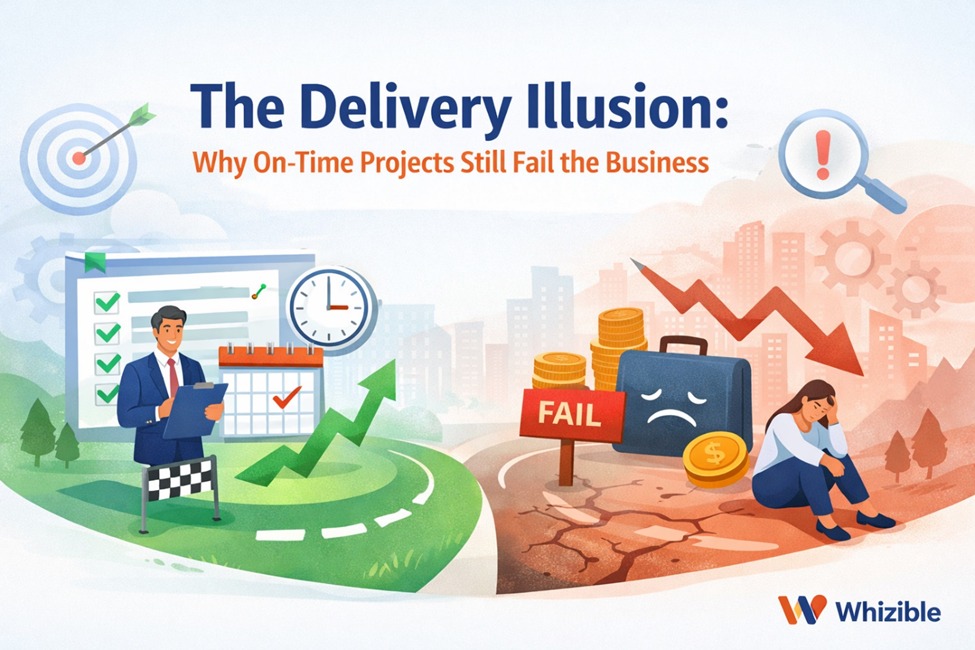
This phenomenon creates what can be called the delivery illusion a situation where projects appear successful from a delivery perspective but fail from a strategic or business perspective.
The delivery illusion occurs because traditional project management frameworks measure execution efficiency rather than business value. Timelines, milestones and task completion rates are tracked meticulously but the deeper connection between project activities and business outcomes often remains invisible.
Organizations today operate in far more complex environments than traditional project management methodologies were designed for. Digital transformation programs span multiple systems, vendors, and departments. Resource capacity fluctuates constantly. Financial impact evolves as projects progress. In such an environment, measuring success purely through timelines is not only insufficient, it can be misleading.
Understanding why the delivery illusion occurs requires examining several structural gaps that exist in modern project delivery environments.
When Delivery Metrics Measure Activity Instead of Value
The Problem: Success Defined by Schedule Instead of Outcomes
Many organizations still rely heavily on schedule adherence as the primary indicator of project success. Project dashboards emphasize milestone completion, timeline adherence and workload progress. While these metrics are important for operational tracking, they rarely answer the most critical question executives care about: Is the project creating measurable business value?
A transformation initiative might be delivered exactly according to plan yet fail to generate the expected revenue growth. A technology implementation might meet every deadline while still failing to improve operational efficiency. Teams celebrate delivery success while leadership quietly questions whether the effort actually moved the business forward.
This disconnect happens because project execution is often disconnected from strategic objectives during day-to-day operations. Teams focus on completing tasks, closing deliverables, and meeting deadlines, while the larger strategic context gradually fades into the background.
The Solution: Linking Execution Metrics to Business Outcomes
To eliminate the delivery illusion, organizations must connect delivery metrics with outcome metrics. Instead of evaluating success purely through timeline adherence, organizations must integrate execution visibility with financial impact, strategic objectives, and operational performance indicators.
Platforms designed for execution intelligence make this possible by combining project data, resource allocation patterns, and financial insights into a unified operational framework. Leaders can see not only whether projects are progressing on schedule but also whether they are delivering the outcomes that justified the investment.
Organizations that adopt this approach move beyond traditional project tracking and begin evaluating delivery through questions such as:
- Is the initiative improving profit margins?
- Are delivery efforts aligned with strategic priorities?
- Is resource capacity being deployed toward the most valuable initiatives?
👉 Learn how modern delivery organizations build execution visibility in this detailed article:
https://www.whizible.com/why-pmos-struggle-with-visibility-in-hybrid-delivery-models-and-how-to-fix-it/
For deeper insights on building execution-driven organizations, explore the leadership perspective shared by
https://www.linkedin.com/in/vishmahajan/
The Visibility Gap: When Leadership Sees Reports Instead of Reality
The Problem: Status Updates Without Operational Insight
Most leadership teams rely on weekly or monthly reports to understand project health. These reports summarize delivery status, highlight risks and present milestone progress. However, they rarely capture the real operational dynamics unfolding within delivery teams.
Execution challenges rarely emerge suddenly. They build gradually through subtle signals such as overallocated resources, delayed dependencies, inefficient task distribution and financial overruns. By the time these issues appear in a formal status report, the project may already be drifting off course.
The problem is not the absence of reporting, it is the lack of real-time execution visibility.
When leadership depends solely on retrospective reports, decision-making becomes reactive rather than proactive.
The Solution: Real-Time Execution Intelligence
Modern delivery organizations require continuous operational visibility rather than periodic reporting. Real-time execution intelligence allows leaders to observe delivery patterns as they evolve instead of discovering problems after they escalate.
By integrating project management, resource allocation, and financial tracking into a single operational platform, organizations gain early visibility into delivery risks. Leaders can identify bottlenecks before they derail timelines and address inefficiencies before they impact outcomes.
Execution intelligence platforms such as Whizible provide this capability by connecting multiple operational signals into a unified delivery dashboard.
👉 Discover how real-time delivery intelligence transforms project oversight:
https://www.whizible.com/real-time-delivery-intelligence-missing-layer-psa/
Strategic leadership insights on execution visibility can also be explored here:
https://www.linkedin.com/in/vishmahajan/
The Resource Utilization Myth
The Problem: Busy Teams That Deliver Limited Value
Resource utilization is often treated as a key performance indicator within project organizations. High utilization rates are interpreted as a sign of operational efficiency, and managers work hard to keep teams fully occupied.
However, high utilization does not necessarily mean high strategic impact.
Teams may spend months working on initiatives that contribute marginal value to the organization while high-priority initiatives struggle to secure the necessary talent. In such situations, organizations appear highly productive yet fail to achieve meaningful progress toward strategic goals.
This creates a paradox where teams are busy, dashboards look healthy and projects are completed on time but business transformation remains slow.
The Solution: Strategic Resource Intelligence
To address this challenge, organizations must shift from simple resource utilization tracking to strategic resource intelligence. This means aligning resource capacity with strategic priorities rather than merely filling available time with project work.
Strategic resource management integrates skills visibility, capacity planning, project prioritization and demand forecasting. When these dimensions are connected, organizations can ensure that their most valuable talent is deployed toward initiatives that generate the greatest business impact.
Platforms like Whizible enable organizations to connect resource management with delivery outcomes, ensuring that capacity planning supports strategic execution.
👉 Learn how modern IT services firms turn resource capacity into competitive advantage:
https://www.whizible.com/mastering-resource-management-project-success/
Leadership perspectives on resource strategy can also be explored here:
https://www.linkedin.com/in/vishmahajan/
The Financial Blind Spot in Project Delivery
The Problem: Projects Delivered Without Financial Accountability
One of the most common reasons projects fail to deliver business value is the absence of continuous financial governance. Budgets are often established during project planning, but financial performance is rarely monitored closely during execution.
This creates situations where projects meet delivery deadlines while quietly eroding profitability through scope creep, inefficient resource utilization or underestimated costs.
By the time financial issues become visible, the project may already be complete.
The Solution: Integrated Project Financial Governance
Modern delivery platforms integrate financial intelligence directly into project execution systems. This allows organizations to track profitability, monitor budget performance and analyze revenue realization while projects are still in progress.
Financial visibility transforms delivery management by allowing leaders to identify margin risks early and adjust execution strategies accordingly.
👉 Explore how integrated financial governance improves delivery profitability:
https://www.whizible.com/project-financial-governance-profit-control/
You can also explore leadership insights on financial visibility in delivery organizations here:
https://www.linkedin.com/in/vishmahajan/
The Strategic Drift Problem
The Problem: Projects Gradually Losing Strategic Alignment
Strategic initiatives often begin with clear business objectives but as execution progresses, operational pressures gradually take priority. Teams focus on resolving immediate delivery challenges rather than maintaining alignment with long-term goals.
Over time, projects drift away from their original purpose. Deliverables are completed, timelines are met but the strategic impact diminishes.
This phenomenon known as strategic drift is one of the most subtle yet damaging causes of the delivery illusion.
The Solution: Continuous Strategy-Execution Alignment
Preventing strategic drift requires maintaining continuous alignment between delivery execution and strategic objectives. Organizations must ensure that every project, workstream and resource allocation contributes directly to measurable business goals.
Execution platforms such as Whizible enable organizations to connect strategic initiatives with operational delivery data, ensuring that projects remain aligned with broader business outcomes.
👉 Discover how organizations maintain real-time strategy alignment:
https://www.whizible.com/strategic-drift-real-time-alignment/
More leadership insights on aligning strategy and execution can be explored here:
https://www.linkedin.com/in/vishmahajan/
Moving Beyond the Delivery Illusion
The delivery illusion persists because many organizations still evaluate project success through outdated operational metrics. Timelines and milestones remain important but they are only one dimension of delivery performance.
True project success lies in the intersection of execution efficiency, strategic alignment, resource intelligence and financial performance.
Organizations that move beyond the delivery illusion begin measuring delivery through a much broader lens. They connect project execution with business outcomes, integrate financial governance into delivery systems, and deploy resources strategically rather than operationally.
Platforms like Whizible enable this transformation by providing a unified execution intelligence layer that connects project management, resource planning and financial oversight into a single operational framework.
When organizations adopt this approach, project success stops being defined by green dashboards and starts being measured by real business impact.
👉 Explore how Whizible helps organizations build execution-driven delivery environments:
https://www.whizible.com/
For ongoing insights on execution intelligence, delivery governance, and strategy alignment, follow:
https://www.linkedin.com/in/vishmahajan/
👉 Book a Demo | 🌐 Visit Initiatives.app
📥 Learn more about features, benefits, and use cases at:
👉 www.initiatives.app
Contact Us : info@whizible.com | +91 855-498-3315
Address : Mrugank, Level 3, Kothrud, Pune, Maharashtra, 411038