
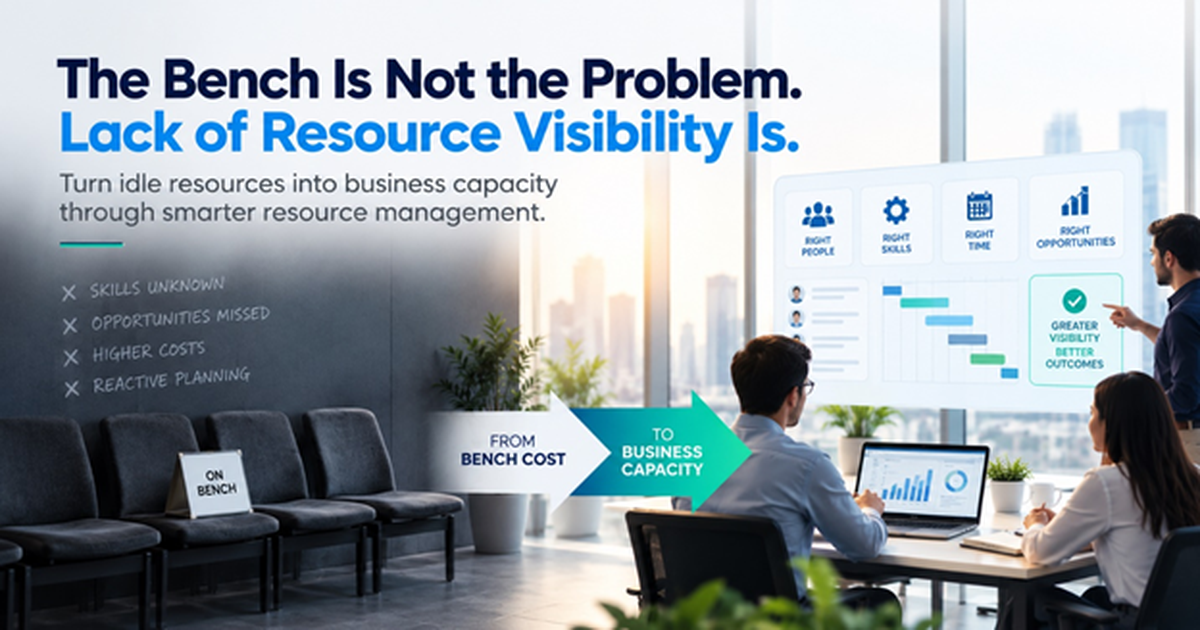
For many IT services and project-driven organizations, the word “bench” immediately translates into cost. A skilled employee without a billable assignment continues to add to payroll while generating no direct project revenue.
That makes reducing bench size an obvious objective.
But focusing only on the number of people on the bench can hide the real problem.
A resource may be technically “available” but have the wrong skills for upcoming demand. Another employee may become available next week but remain invisible to a resource manager working from an outdated spreadsheet. A third may have exactly the capability required for a new opportunity but sit in another business unit where nobody thinks to look.
The problem, therefore, is not always excess capacity.
It is often invisible capacity.
Whizible’s own discussion of modern bench management highlights the importance of understanding future roll-offs, skills and availability rather than treating bench purely as idle headcount.
The Problem: Bench Management Starts Too Late
Traditional bench management is largely reactive.
A project finishes. Resources roll off. Their names are added to a bench report. Resource managers then begin searching for another assignment.
By this stage, valuable time has already been lost.
Meanwhile, sales may be pursuing opportunities that require those skills, another delivery team may be planning external hiring for a similar role, and employees approaching release from other projects may not yet appear in the available-resource list.
This creates a fragmented cycle:
Project completion → Bench → Search for demand → Redeployment
The better model begins before the resource reaches the bench:
Future demand → Capacity visibility → Skill matching → Planned transition
The Solution: Create a Live View of Resource Capacity
The first step toward capacity intelligence is establishing a reliable view of your workforce.
Organizations need to know not only who is available today, but also who is allocated, partially available, overloaded, approaching project release, or likely to become available in the coming weeks.
Skills, roles, experience, location, project history and availability should exist in the same decision-making context.
This is where an integrated resource-management approach becomes valuable. Whizible describes resource management as covering resource estimation, planning, scheduling and monitoring connecting availability with actual project requirements.
Explore: Whizible’s Bench Management 2.0 article
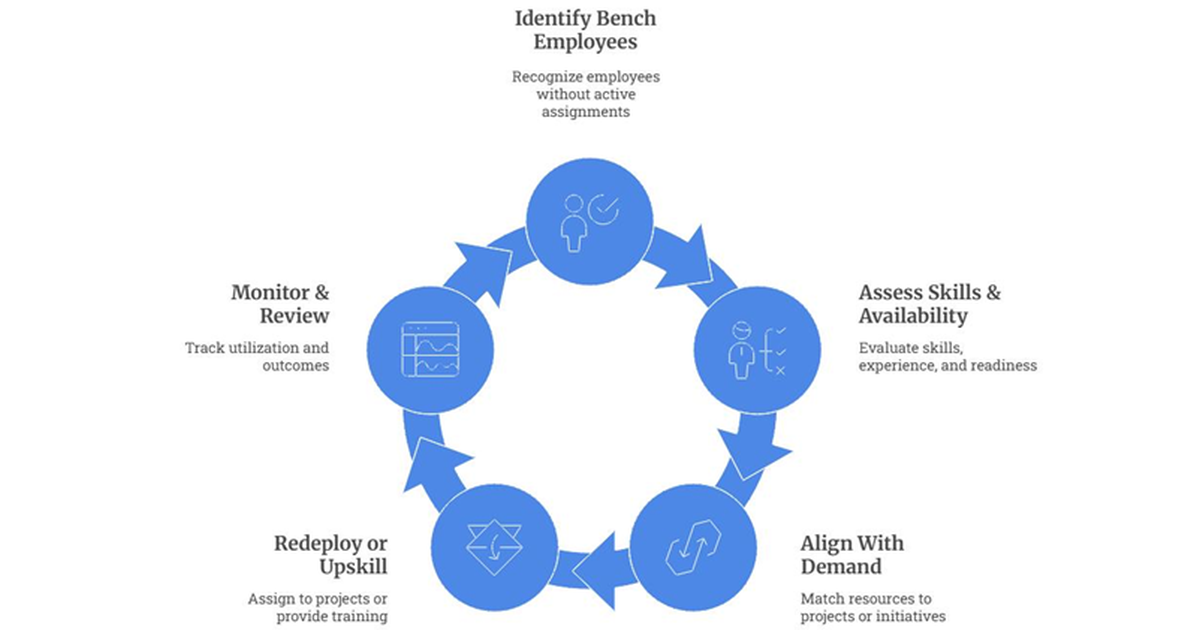
Stop Asking “Who Is on the Bench?”
A more useful management question is:
“What capacity will become available, with which skills, and where can we deploy it next?”
That small shift changes the conversation.
Bench becomes one component of a larger capacity picture. Upcoming project releases become supply forecasts. Sales opportunities become potential demand. Skills become planning variables. Upskilling can be connected to expected requirements instead of being treated as a generic learning exercise.
Most importantly, management gets time to act.
Instead of discovering idle capacity after it appears, organizations can anticipate it.
From Cost Control to Capacity Readiness
The objective should not be to eliminate every hour of unallocated capacity. Some capacity provides flexibility for new projects, urgent client requirements, knowledge transfer and changing demand.
The objective is to understand why capacity exists, how long it may remain available, and what should happen next.
That is the foundation of capacity intelligence.
For more perspectives on project execution, resource management and operational governance, follow Vishwas Mahajan on LinkedIn.
FAQs
What is bench management?
Bench management is the process of identifying, monitoring and redeploying employees who are temporarily not assigned to billable or productive project work.
Is zero bench a good resource-management target?
Not necessarily. Some available capacity can provide flexibility. The bigger concern is unmanaged or prolonged idle capacity without visibility into future deployment.
How can organizations reduce bench cost?
Earlier visibility into project roll-offs, centralized skills information, demand forecasting and proactive resource matching can help shorten unnecessary idle periods.
What comes after bench visibility?
The next step is understanding utilization in context not simply asking whether people are busy.
Next in the series: Blog 2 – Why Utilization Percentage Alone Cannot Tell You Whether Capacity Is Healthy.