
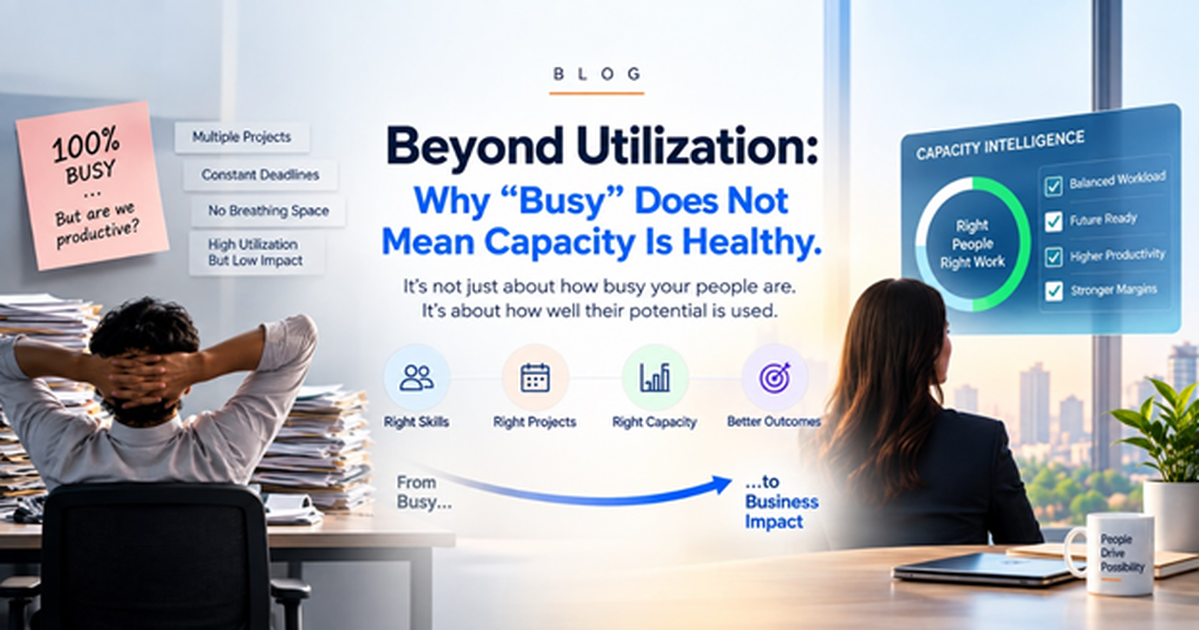
Once organizations gain visibility into their bench, the next instinct is often to focus heavily on utilization percentage.
“How utilized are our people?”
It sounds like the right question. But by itself, utilization can be misleading.
A team can report high utilization while critical projects remain understaffed. A highly skilled resource may spend most of the week on lower-value activities. Another employee may be booked across several projects but lack enough focused capacity to deliver effectively.
In other words:
Utilization measures how much capacity is being consumed. It does not automatically tell you whether that capacity is being used well.
Whizible’s resource-allocation guidance similarly distinguishes maximum utilization from effective utilization and emphasizes skills, availability and workload balance.
The Problem: Managing Resources Through One Percentage
When utilization becomes the dominant KPI, organizations may unintentionally optimize for activity rather than value.
Managers try to fill every available hour. Employees become fragmented across projects. Resource buffers disappear. Teams appear fully occupied, yet delivery managers continue asking for additional people.
At the same time, underutilization can be misunderstood.
A consultant at 60% utilization may look inefficient on a dashboard. But if that person is deliberately being kept available for a high-probability engagement beginning shortly, the same 40% capacity represents strategic readiness.
Without context, both situations look different from what they really are.
The Solution: Add Context to Utilization
Capacity intelligence connects utilization with the factors surrounding it.
Instead of viewing utilization as an isolated percentage, management should understand billable versus non-billable work, project demand, future allocation, skills, role requirements, availability and workload.
This changes resource conversations substantially.
A resource manager can identify people who appear utilized but are underused from a skill perspective. Delivery leaders can see where future capacity shortages may emerge. HR can understand which capabilities need development. Finance can distinguish productive capacity from capacity that merely looks occupied.
The goal becomes effective deployment, not simply maximum occupancy.
Explore: Whizible’s guide to smarter resource allocation
Connect Present Utilization With Future Demand
Most utilization reports answer a backward-looking question:
“How busy were we?”
Capacity management needs to answer a forward-looking question:
“Will we have the right capacity for what is coming?”
That requires connecting confirmed projects with tentative demand, pipeline opportunities and expected project roll-offs.
Consider a team that is 90% utilized today. If several projects finish next month and the sales pipeline does not require the same capabilities, future underutilization is already forming.
Conversely, a team operating comfortably today may face a severe capacity shortage if multiple opportunities requiring the same specialist skill convert simultaneously.
Historical utilization alone cannot reveal either situation.
Capacity Is a Business Signal
Once organizations begin viewing utilization in context, resource data becomes useful beyond the resource-management team.
Sales can evaluate whether delivery capacity exists before aggressive commitments are made. HR can align hiring and upskilling with actual demand. Delivery can plan staffing earlier. Finance can understand how resource decisions may affect project economics.
That is when utilization evolves from a reporting metric into a management signal.
For ongoing perspectives on execution and project-driven business management, follow Vishwas Mahajan on LinkedIn.
FAQs
What is resource utilization?
Resource utilization measures how much of an employee’s available capacity is being used during a defined period.
Is higher utilization always better?
No. Very high utilization can coexist with skill mismatches, workload fragmentation, burnout or insufficient capacity for upcoming work.
What should organizations measure alongside utilization?
Availability, billability, skills, future allocation, demand, workload, project role and cost provide important context.
How does capacity intelligence differ from utilization reporting?
Utilization reports capacity consumption. Capacity intelligence combines supply, demand, skills and future availability to support decisions.
Next in the series: Blog 3 – From Resource Planning to Capacity Intelligence: Connecting Supply With Future Demand.