
Real-time visibility solves an important problem: it tells leaders what is happening now.
But modern delivery organizations need to answer a harder question:
What is likely to happen next?
A resource dashboard may show today’s allocations perfectly. Yet if it cannot connect upcoming projects, planned roll-offs, future demand and skill availability, leaders are still forced to react.
The Problem: Demand and Capacity Operate on Different Timelines.
Resource demand rarely appears overnight.
Signals often exist much earlier.
Sales has opportunities moving through the pipeline. Existing projects have scheduled completion dates. Employees have planned leave. Contracts are approaching renewal. New projects have expected start dates.
But when those signals aren’t connected, staffing decisions happen too late.
The consequences are familiar: last-minute hiring, expensive subcontracting, delayed project starts, overloaded specialists and avoidable bench.
The Solution: Build a Forward-Looking Capacity Model.
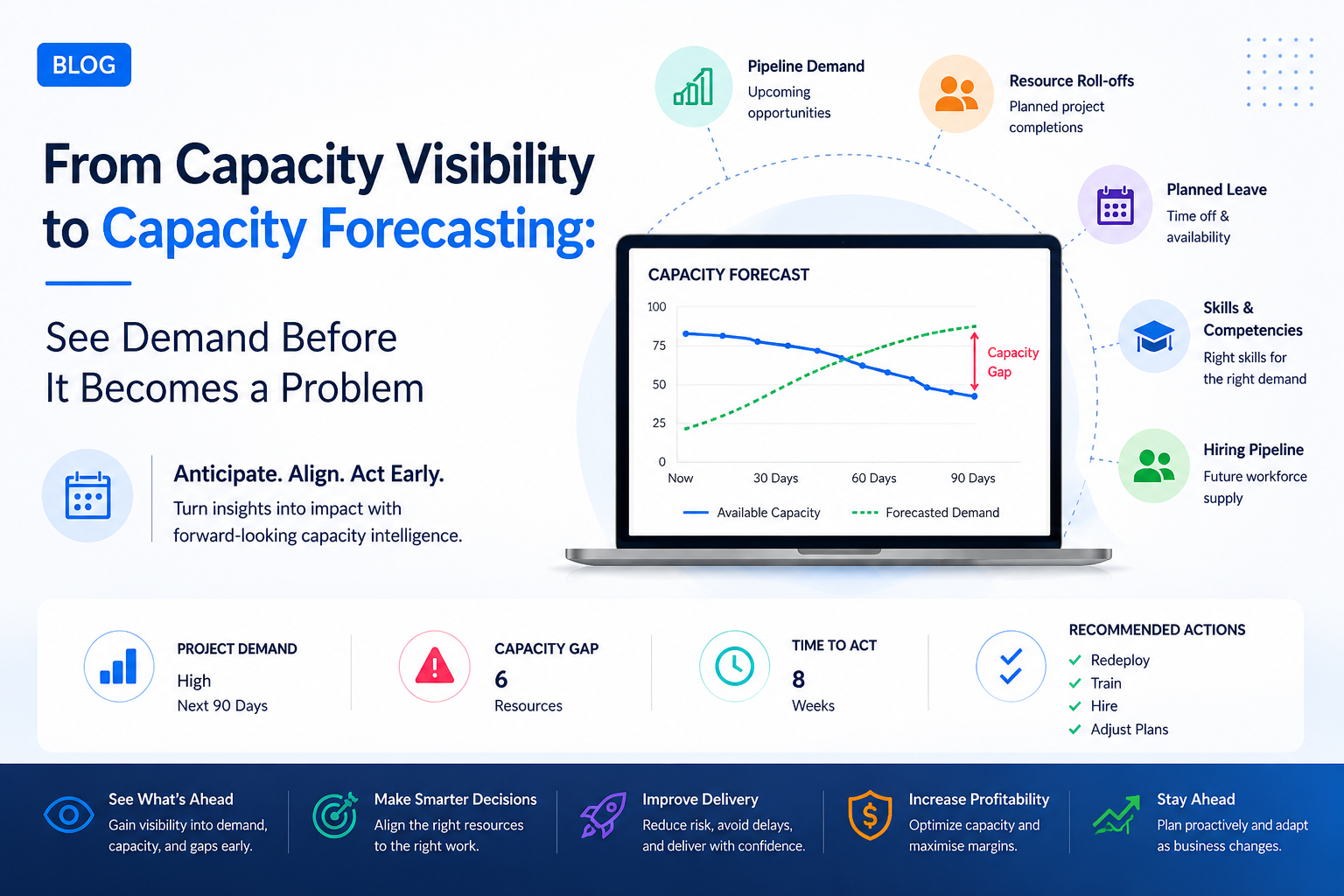
Capacity forecasting connects future project demand with expected workforce supply.
Rather than asking only:
“Who is available?”
leaders begin asking:
“What will our capacity look like 30, 60 or 90 days from now?”
Suggested visual
A useful forecasting model should connect several signals:
- Confirmed project requirements
- Tentative pipeline demand
- Resource roll-offs
- Skills and competencies
- Planned leave and availability
- Existing allocation
- Hiring pipeline
- Bench capacity
This allows delivery teams to identify gaps before they become escalations.
Forecasting Changes the Decision Window
Suppose future demand indicates that 15 Java engineers will be needed eight weeks from now, while current allocation data predicts only nine appropriately skilled resources will become available.
Without forecasting, that six-person gap may become visible shortly before delivery begins.
With capacity intelligence, leaders have eight weeks to respond.
They could redeploy resources, initiate training, accelerate hiring, adjust schedules or discuss alternatives with the business.
That additional decision window is where much of the value lies.
Whizible’s resource-management content highlights the role of forecasting and dynamic allocation in aligning future project needs with resource availability.
Explore related perspectives in the Whizible resource and project management insights.
For broader leadership perspectives, follow Dr. Vishwas Mahajan on LinkedIn.
Forecast Earlier. Decide Earlier.
The goal of forecasting isn’t to predict every project perfectly.
It’s to expose likely capacity gaps early enough to give leadership choices.
When leaders can see demand developing before it reaches delivery, resource management moves from firefighting toward proactive planning.
FAQs
-
What is capacity forecasting?
Capacity forecasting estimates future resource availability and compares it with anticipated project or business demand.
-
How far ahead should organizations forecast?
The appropriate horizon depends on project and hiring cycles, but organizations commonly benefit from short-, medium- and longer-term capacity views.
-
Can pipeline opportunities be included?
Yes. Probability-weighted or scenario-based pipeline demand can help organizations prepare without treating every opportunity as confirmed work.
-
How does forecasting reduce bench?
It gives managers earlier visibility into upcoming demand and project roll-offs, creating more time to redeploy available employees.