
Resource Management and Profitability
Resource management is often treated as an operational function.
Finance looks at margins. Delivery looks at project execution. HR looks at people. Resource managers look at allocation.
But in project-driven businesses, these areas are deeply connected.
Every resource decision has an economic consequence.
An employee remaining unallocated longer than necessary creates cost. An expensive specialist assigned where a different skill level would suffice can affect project economics. An overloaded team may create quality issues and rework. Hiring externally while suitable internal capacity exists increases cost. Delayed staffing can postpone project starts and revenue realization.
This means resource management is not simply about who works where.
It is ultimately about how workforce capacity converts into business value.
The Problem: Resource and Financial Decisions Are Disconnected
A resource manager may successfully fill every project request and still produce an inefficient outcome.
Why?
Because successful allocation does not automatically mean profitable allocation.
If resource decisions are made without visibility into project economics, organizations may optimize one metric while weakening another.
For example, increasing utilization can look positive while project margins decline because the resource mix is too expensive. Reducing bench aggressively can improve short-term numbers but leave no capacity for upcoming opportunities.
The challenge is balancing multiple outcomes simultaneously.
The Solution: Connect Capacity With Project Economics
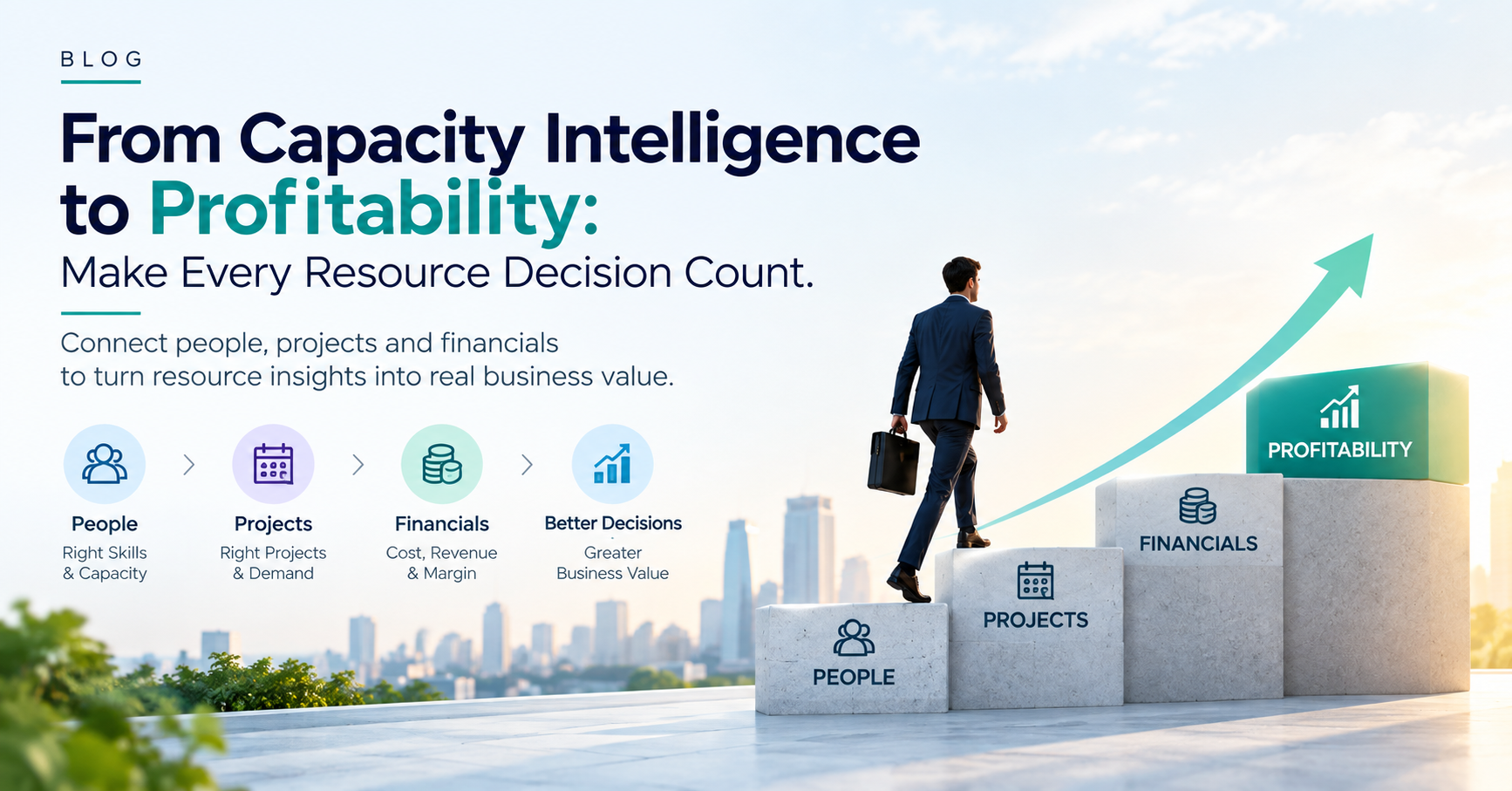
Capacity intelligence becomes significantly more valuable when combined with financial and project information.
Instead of viewing bench, utilization, allocation and project profitability separately, leadership gets a connected picture of how workforce decisions affect commercial outcomes.
Whizible’s integrated PSA approach connects project management, resource optimization, cost tracking, financial controls and profitability analysis, allowing operational information to contribute to broader business decisions.
Explore: Whizible’s integrated PSA capabilities
Resource Management Becomes a Profitability Lever
When capacity and financial information are connected, management can ask more meaningful questions.
Instead of simply asking whether utilization increased, leaders can evaluate whether billable utilization and project margins improved together.
Instead of asking how many people are on the bench, they can identify the cost of prolonged idle capacity and the opportunities available for redeployment.
Instead of automatically approving external hiring, they can determine whether upcoming internal capacity can satisfy demand.
Instead of staffing projects purely according to availability, they can evaluate the right mix of capability, experience and cost.
This is the final evolution from resource administration to capacity intelligence.
One Connected View for Leadership
The strongest resource-management model connects three dimensions:
Supply: What people, skills and capacity do we have?
Demand: What projects and opportunities will require that capacity?
Economics: What happens to revenue, cost and margin when we make a particular resource decision?
When these questions are answered together, resource planning becomes much more than scheduling.
It becomes part of business strategy.
Whizible’s financial-metrics material also identifies bench and utilization among operational measures relevant to identifying profit leakage in services businesses.
The Journey From Bench Cost to Capacity Intelligence
The evolution can be summarized simply:
Bench Cost → Resource Visibility → Utilization Context → Demand Forecasting → Capacity Intelligence → Profitability
The first question is operational:
“Who is sitting on the bench?”
The mature question is strategic:
“Do we have the right capacity, with the right skills, at the right cost, for the demand ahead?”
Organizations capable of answering that question are no longer merely managing resources.
They are managing their ability to deliver and grow profitably.
Explore Whizible to learn how integrated project, resource and financial management can provide greater visibility across project-driven operations.
For more leadership perspectives on project execution, capacity and governance, follow Vishwas Mahajan on LinkedIn.
FAQs
How does resource management affect project profitability?
Resource cost, billability, skill fit, availability and allocation directly influence the cost of delivering project work and therefore can affect margins.
What is the relationship between bench and profitability?
Prolonged unproductive bench periods increase workforce cost without corresponding project revenue. Proactive redeployment can help reduce unnecessary idle periods.
Why should finance care about capacity planning?
Capacity decisions influence hiring cost, billability, project staffing cost, revenue readiness and margins, making resource information relevant to financial planning.
Can a PSA platform connect resource and financial information?
An integrated PSA platform can connect project planning, resource allocation, time tracking and financial information to provide a more complete view of project operations.
What is the ultimate goal of capacity intelligence?
The goal is not maximum utilization. It is having the right capability available at the right time and cost to meet demand while supporting sustainable delivery and profitability.