
Most organizations have plenty of data. The problem is that the data often lives in different places.
Project managers know delivery progress. Resource managers understand allocation. Employees record effort. Finance tracks revenue and invoices.
But the CFO needs these perspectives together to answer one question:
What is the financial health of this project right now?
The Problem: Financial Truth Is Fragmented.
Consider a single billable hour.
A resource performs the work, records the time, a manager approves it, finance verifies billing eligibility and eventually an invoice is generated.
When each step happens through separate systems or spreadsheets, visibility between work performed and revenue realized becomes difficult.
Late timesheets can delay billing. Resource changes can increase costs. Milestone delays can affect revenue. Yet finance may see these impacts only after reconciliation.
This creates a dangerous gap between project reality and financial reality.
The Solution: Connect the Project-to-Cash Lifecycle.
CFOs need visibility across:
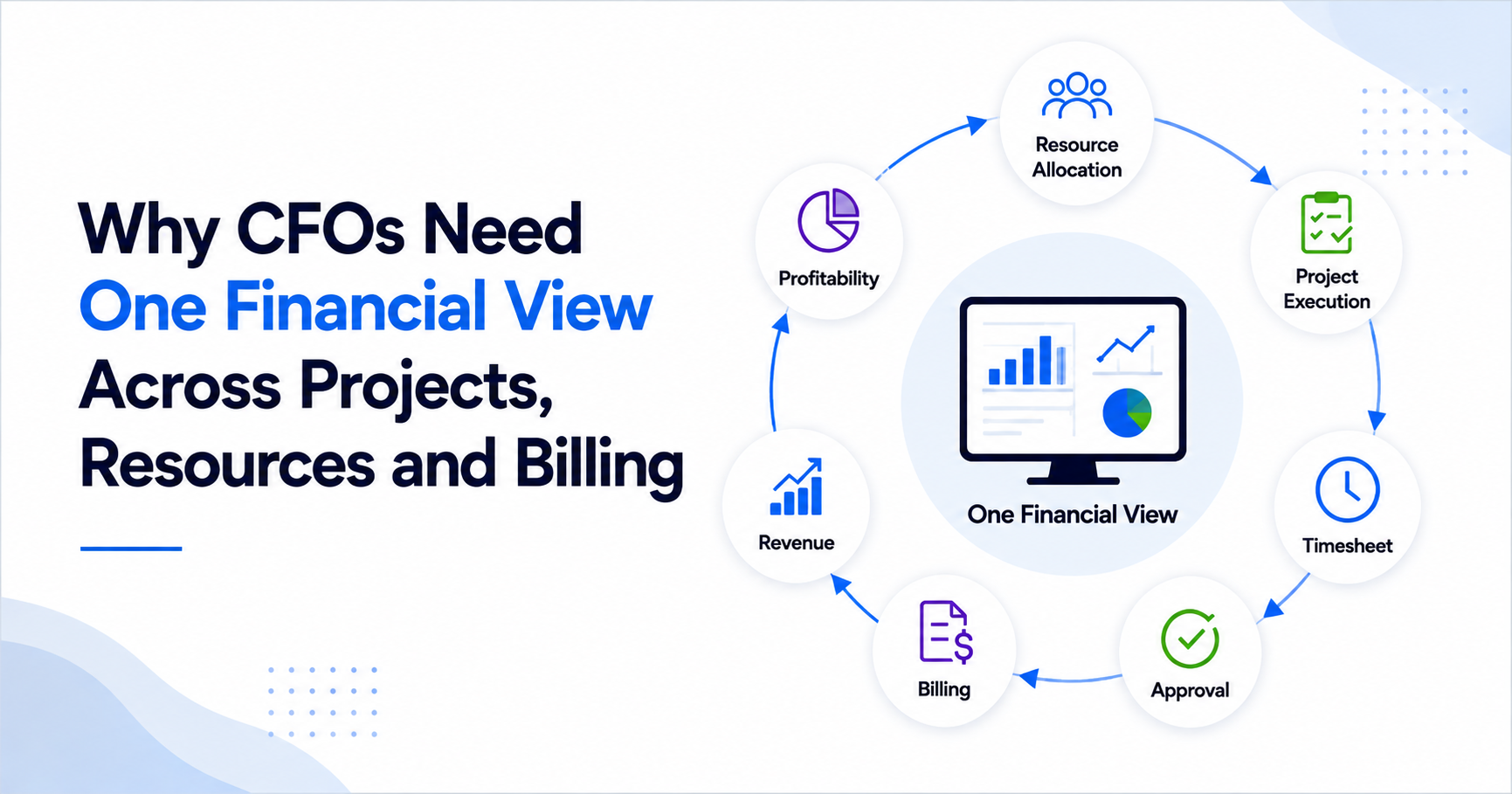
Resource → Project → Timesheet → Approval → Billing → Revenue → Profitability
When this information is connected, operational changes can immediately be viewed through a financial lens.
If effort increases, finance can assess margin impact. If approved work remains unbilled, the gap becomes visible. If resource costs change, profitability forecasts can be reviewed earlier.
Whizible brings project, resource, time and financial processes into a connected PSA environment, helping leadership create greater visibility across the project lifecycle.
Internal Reading: Are Your Projects Agile, But Your Billing Isn’t?
The goal is not necessarily to replace ERP, CRM or HR systems. It is to create a connected operational layer where the CFO does not need to manually reconstruct the financial story of every project.
FAQs
Why is disconnected project data a CFO concern?
Because project activity ultimately affects costs, revenue, billing, cash flow and profitability.
Does PSA replace ERP?
Not necessarily. PSA can complement ERP by managing the operational and financial lifecycle of project-based work.
Why are timesheets important for financial visibility?
Accurate effort data supports project costing, billing, forecasting and profitability analysis.
Coming Next
Connecting the data solves the visibility problem. The next step is turning that visibility into continuous financial control.
Part 4 explores how CFOs can build a real-time project financial control model.
Explore: Whizible
Leadership Perspective: Dr. Vishwas Mahajan