


Project margins rarely collapse overnight. In most organizations, margin erosion is gradual, invisible and dangerously normalized. Leadership notices the impact only when profitability reviews start showing uncomfortable trends shrinking realized rates, unplanned write-offs, delayed billing or projects that look “busy” but somehow underperform financially.
What often goes unquestioned is why this happens even when teams are competent, demand is strong and delivery frameworks are in place.
The answer, more often than not, lies in fragmented tools and delivery silos.
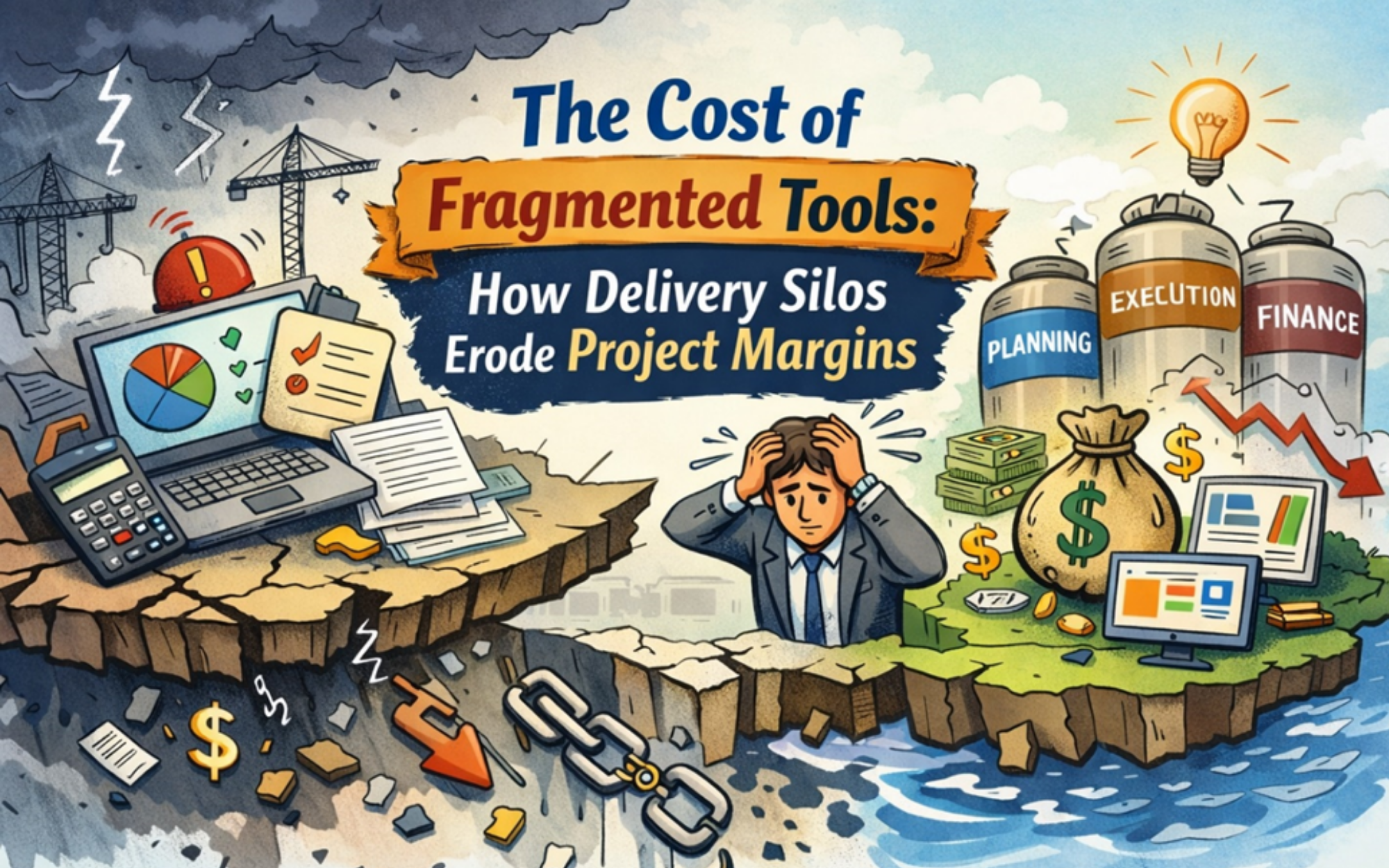
When project planning lives in one system, execution tracking in another, financials in spreadsheets and decision-making happens in meetings or emails, organizations unknowingly create friction across the entire delivery lifecycle. Each tool may work well in isolation but together they fracture visibility, slow response times and distort accountability directly impacting project margins.
This blog explores the real cost of fragmented tools, how delivery silos form and why unified execution platforms like Whizible are becoming essential for margin protection at scale.
Understanding Delivery Silos in Modern Project Environments
Delivery silos are rarely intentional. They emerge naturally as organizations grow, diversify clients, adopt new tools, and respond to short-term operational needs. A PMO introduces a project management tool. Finance adopts a billing or accounting system. HR manages resource data elsewhere. Delivery managers rely on spreadsheets to bridge gaps.
Over time, this patchwork becomes the operating reality.
The problem is not that teams use different tools. The problem is that these tools do not talk to each other in real time, forcing humans to manually reconcile information across systems. This creates a version-control nightmare where every stakeholder operates with partial, delayed or outdated data.
When delivery teams lack a single source of truth, decisions are made on assumptions rather than facts. Margins don’t just suffer they quietly leak.
How Fragmented Tools Directly Impact Project Margins
-
Margin Blindness Begins with Disconnected Planning and Execution
Most projects start with well-defined budgets, resource plans, and timelines. These plans usually live in a project management or proposal system. But once execution begins, reality diverges quickly.
Actual effort tracking often happens elsewhere timesheets, task trackers or ad-hoc reporting tools. Financials are reviewed periodically, not continuously. By the time leadership reviews margin performance, the opportunity to course-correct has already passed.
Without real-time linkage between planned and actual data, margin variance is detected too late. This delay alone can turn a profitable project into a marginal one.
👉 This is where unified delivery intelligence becomes critical. Platforms like Whizible connect planning, execution, and financial performance in one flow, allowing teams to see margin risks as they emerge not after the damage is done.
Explore how Whizible brings real-time visibility across delivery: https://www.whizible.com/
-
Resource Utilization Looks Healthy Until You See the Cost Impact
Fragmented systems often show utilization in isolation. A resource may appear 85% utilized on paper, but that number rarely tells the full story.
Without linking utilization to:
- Billable vs non-billable effort
- Skill relevance
- Project profitability
- Opportunity cost of misallocation
organizations make flawed staffing decisions.
High utilization on low-margin or mispriced work erodes margins faster than underutilization. Fragmented tools mask this reality because utilization dashboards are rarely connected to revenue realization or margin outcomes.
Unified platforms surface the economic impact of resource decisions, not just activity levels.
-
Change Requests Become Margin Killers in Silos
Change requests are inevitable in modern delivery environments. What destroys margins is not change itself but poor change governance.
In fragmented environments:
- CRs are discussed over email
- Approvals are informal or delayed
- Effort impact is estimated manually
- Financial implications are reviewed after delivery
This leads to scope creep being absorbed silently by delivery teams. The work gets done, but the margin never recovers.
When CRs are not systematically linked to effort, timelines, and billing, they become one of the biggest sources of hidden margin erosion.
A unified execution platform ensures that every change is evaluated for delivery and financial impact before work begins, preserving margin discipline.
The Hidden Operational Costs of Fragmentation
Decision Latency: The Silent Margin Drain
Fragmented tools slow decision-making. Leaders spend time reconciling reports instead of acting on insights. By the time data is consolidated, the situation has already changed.
This latency creates:
- Delayed corrective actions
- Missed billing opportunities
- Prolonged unprofitable execution
Margins suffer not because leaders don’t care but because they see the problem too late.
Manual Reconciliation Increases Error and Overhead
Every handoff between tools requires manual effort exports, imports, validations and reconciliations. These activities do not add value to the customer, yet they consume time and increase error rates.
Errors in effort tracking, billing data or cost allocation directly distort margin calculations. Worse, teams lose confidence in the numbers, leading to gut-driven decisions instead of data-driven ones.
Accountability Diffuses Across Systems
When information is fragmented, ownership becomes unclear. Delivery teams blame finance. Finance blames inaccurate timesheets. PMOs blame poor estimates.
No one owns margin outcomes end-to-end.
Unified platforms create shared accountability, where delivery, finance, and leadership operate on the same data and own the same outcomes.
Why Traditional Tool Stacks Fail at Scale
Many organizations attempt to “integrate” fragmented tools through APIs, custom reports, or BI layers. While this may improve reporting, it rarely fixes the core problem.
Data integration does not equal operational integration.
When teams still work in separate systems, insights remain retrospective. What organizations need is execution-native intelligence, where decisions, actions and outcomes occur within the same ecosystem.
This shift is less about technology and more about operating philosophy.
As industry leaders increasingly highlight, sustainable delivery performance requires systems that connect strategy, execution, and outcomes.
For a leadership perspective on execution discipline and value realization, follow insights from Vishwas Mahajan: https://www.linkedin.com/in/vishmahajan/
How Unified Delivery Platforms Protect Project Margins
Single Source of Truth for Delivery and Financials
A unified platform eliminates conflicting data sets. When project plans, actuals, financials, risks and changes live together, margin visibility becomes continuous not episodic.
Teams no longer debate numbers. They act on them.
Early Warning Systems Instead of Post-Mortems
Unified platforms surface margin risks early through:
- Cost variance trends
- Effort overruns
- Resource misalignment
- Scope change impact
This enables proactive intervention rebalancing teams, renegotiating scope or revisiting pricing before profitability collapses.
Execution Governance Without Micromanagement
One of the biggest fears leaders have is that better visibility leads to micromanagement. In reality, fragmented tools force micromanagement because leaders lack trust in data.
Unified platforms enable governance by exception, where leaders focus only on deviations that matter.
This balance protects margins while preserving team autonomy.
Why Whizible Is Built for Margin-Centric Delivery
Whizible was designed around a simple but powerful principle: delivery decisions must be financially intelligent by default.
Instead of treating projects, resources, time, and financials as separate modules, Whizible connects them into a unified execution fabric. This ensures that every delivery decision carries clear cost and margin context.
From real-time project profitability tracking to integrated resource intelligence and change governance, Whizible helps organizations shift from reactive margin analysis to proactive margin protection.
👉 See how Whizible helps organizations eliminate delivery silos and protect margins:
https://www.whizible.com/
The Leadership Imperative: Moving Beyond Tool Sprawl
Fragmented tools are often justified as “best of breed” choices. But best of breed does not mean best for margins.
As organizations scale, leaders must ask harder questions:
- Do our tools help us see margin risks early?
- Can we link execution decisions to financial outcomes instantly?
- Are we governing delivery or just reporting on it?
The cost of not asking these questions is silent but severe.
Conclusion: Margins Don’t Fail Systems Do
Project margins rarely fail because teams lack effort or intent. They fail because systems prevent organizations from seeing the truth early enough to act.
Fragmented tools create delivery silos. Delivery silos delay insight. Delayed insight erodes margins.
The solution is not more reports or more meetings but a unified execution platform that connects planning, delivery, and financial intelligence in real time.
Organizations that recognize this shift early don’t just protect margins they build a durable competitive advantage in an increasingly complex delivery landscape.
👉 If margin protection, delivery visibility, and execution governance matter to your organization, it’s time to rethink fragmented tools.
Start here: https://www.whizible.com/
👉 Book a Demo | 🌐 Visit Initiatives.app
📥 Learn more about features, benefits, and use cases at:
👉 www.initiatives.app
Contact Us : info@whizible.com | +91 855-498-3315
Address : Mrugank, Level 3, Kothrud, Pune, Maharashtra, 411038