
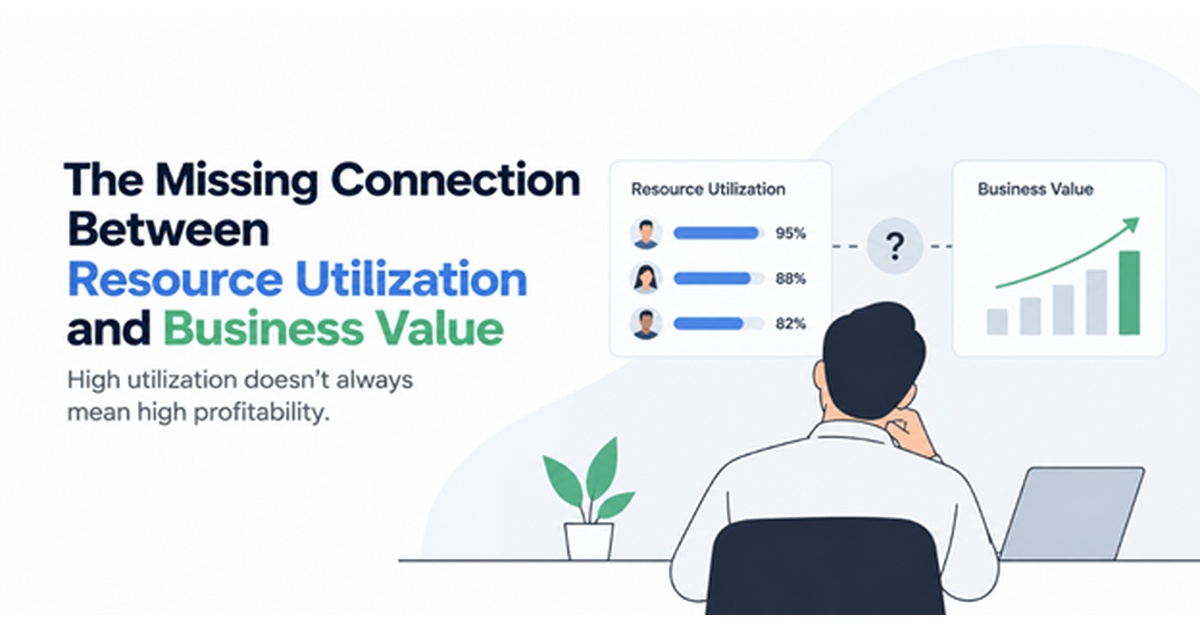
For IT services, engineering organizations, and Global Capability Centers, resource utilization is among the most closely monitored performance indicators.
Higher utilization is frequently associated with stronger productivity, better operational efficiency, and improved financial performance.
However, utilization alone cannot determine whether an organization is creating business value.
A team can be fully occupied and still contribute less value than a team operating at lower utilization.
The difference lies in understanding how resource effort connects with cost, revenue, project priorities, and customer outcomes.
The Problem Busy Resources Do Not Always Mean Profitable Projects.
Consider two consulting teams.
Team A operates at 95% utilization, primarily supporting low-margin engagements that require expensive specialist resources.
Team B operates at 80% utilization but works on strategically important, higher-margin customer projects.
If leadership evaluates performance exclusively through utilization percentages, Team A may appear more successful.
However, Team B could be generating greater contribution margins while retaining capacity for emerging business opportunities.
This is where utilization-focused management becomes misleading.
When resource planning operates independently of project financials and commercial priorities, organizations may unknowingly assign high-cost talent to low-value work, delay more profitable opportunities, or increase employee burnout.
The problem becomes particularly serious when staffing decisions are made through spreadsheets that do not reflect changing project demand or resource availability.
The Solution Connect Capacity, Skills, and Financial Outcomes.
Effective resource management should answer a more meaningful question:
Are we deploying the right capabilities to the right opportunities at the right cost?
Achieving this requires organizations to evaluate resource utilization alongside billing rates, resource costs, project profitability, skills, and future demand.
For instance, assigning a senior consultant to a routine activity may improve utilization but reduce the project’s contribution margin. Reallocating that consultant to a complex, higher-value engagement may produce a better business outcome.
Whizible’s resource management capabilities help organizations connect skills, availability, allocation, and utilization information with broader project operations.
Its article on smarter resource allocation in IT projects explores why maximizing every available hour can create operational risks instead of sustainable performance.
H3: Move From Utilization Tracking to Value-Based Resource Planning.
Organizations can strengthen resource decisions by examining:
- Billable utilization alongside realized billing rates.
- Resource cost relative to project profitability.
- Skill availability against upcoming demand.
- Bench capacity and potential revenue opportunities.
- Future workload rather than only current allocation.
These indicators provide a more balanced understanding of workforce productivity.
They also help leaders avoid the assumption that every available hour must be filled to maximize business performance.
Conclusion
Resource utilization remains an important operational measure, but it should never become the sole definition of workforce effectiveness.
The real objective is to align people, skills, capacity, and costs with business opportunities that generate sustainable value.
When organizations connect resource information with financial and strategic context, staffing decisions become more informed and commercially relevant.
Explore more leadership perspectives on operational efficiency and business performance from Dr. Vishwas Mahajan.
CTA: Are your resources simply busy, or are they contributing to profitable business outcomes?
Explore resource management with Whizible.
FAQs
Q1. Does higher resource utilization always increase profitability?
No. Profitability also depends on resource costs, realized billing rates, project pricing, and the type of work being performed.
Q2. What is value-based resource planning?
It is an approach that considers skills, capacity, costs, project priorities, and financial outcomes when making staffing decisions.
Q3. Why is future capacity visibility important?
It helps organizations anticipate staffing gaps, manage upcoming demand, reduce unnecessary hiring, and identify redeployment opportunities.