
A delayed task is a project issue.
A pattern of delayed projects competing for the same people is an operational issue.
When those delays begin affecting customer commitments, margins, hiring decisions, revenue forecasts and strategic priorities, the organization has crossed an important boundary.
Delivery debt has become enterprise debt.
The Problem: Leadership Sees the Outcome, Not Always the Cause.
Enterprise-level delivery problems often appear first as business metrics.
Margins begin declining.
Customers escalate more frequently.
Teams request additional hiring despite seemingly healthy utilization.
Forecast dates become unreliable.
Management meetings spend increasing time reconciling conflicting numbers.
The instinct is to treat these as separate problems. Yet they may share the same underlying cause: unresolved delivery compromises accumulating across the portfolio.
The financial connection is particularly important in fixed-price engagements, where additional effort, delays and resource misallocation can directly erode the provider’s margin because the commercial value is already constrained. Whizible
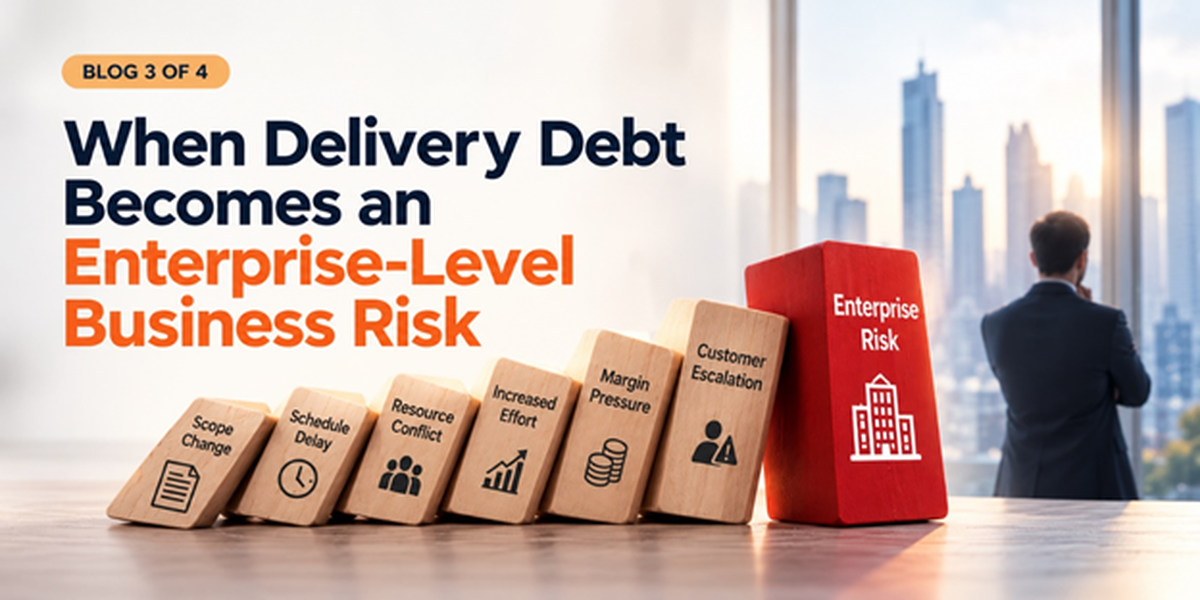
The Domino Effect of Delivery Debt
Consider a strategic customer program that needs a specialist already supporting several projects.
The organization chooses to stretch the resource temporarily.
Delivery slows elsewhere. Another team compensates with additional effort. Timesheet variance increases. A milestone slips. Billing moves into the next period. The account margin falls.
Meanwhile, leadership may still be looking at each event separately.
This is the enterprise danger of delivery debt: the originating decision and the eventual financial impact can occur in completely different parts of the organization.
The Solution: Govern the Chain, Not Just the Projects.
Enterprise governance needs to connect four dimensions:
Delivery: Are milestones, risks, issues and dependencies changing?
Resources: Does the organization actually have the capacity and skills required by current and upcoming commitments?
Financials: What are effort variance, cost, billing and profitability telling us?
Governance: Are exceptions, changes and approvals being resolved before they affect outcomes?
The goal is not more reporting. It is connected decision intelligence.
Whizible positions its project operations environment around integrated project lifecycle management, resource optimization, risk management, financial controls and real-time analytics, allowing leadership to examine execution through a common information framework. Whizible
Read more about fixed-price profitability and project risk and how execution decisions can translate into financial consequences.
You can also explore Dr. Vishwas Mahajan’s leadership insights.
The Leadership Shift
The important question is no longer:
“Which projects are red?”
It becomes:
“Which apparently small compromises could make tomorrow’s projects red?”
Once leadership can answer that question, delivery governance becomes preventive rather than reactive.
The final blog in this series explores exactly that: how to prevent delivery debt from becoming embedded in the operating model.
FAQs
How does delivery debt affect profitability?
It can create additional effort, rework, overtime, inefficient resource allocation, schedule delays and scope leakage, all of which can increase delivery costs or delay revenue.
Why might a green project still carry delivery debt?
A project can meet current milestones by using overtime, borrowing resources or postponing activities. Its status may therefore look healthy while underlying compromises accumulate.
Who should own delivery debt?
Ownership is shared. Project managers manage local execution, while PMO, resource, finance and delivery leadership need enterprise visibility into cross-project consequences.