


Delivery predictability is one of the most fragile advantages in growing IT services organizations. When teams are small, projects are fewer, and leaders remain close to execution, predictability feels natural. Status updates are informal, risks surface quickly and corrective action happens instinctively. But as organizations scale across accounts, geographies, delivery models and portfolios this predictability quietly erodes. What once felt manageable suddenly becomes uncertain, and leadership finds itself reacting to surprises rather than steering outcomes.
The breakdown does not happen because teams stop working hard or because leaders stop caring. It happens because systems fail to scale at the same pace as ambition. Fragmented tools, delayed visibility and disconnected decision-making layers turn execution into a guessing game. Unified PSA platforms exist to solve precisely this problem not by adding more process, but by restoring real-time clarity and alignment across delivery, resources and financials.
The Illusion of Control in Early-Stage Growth
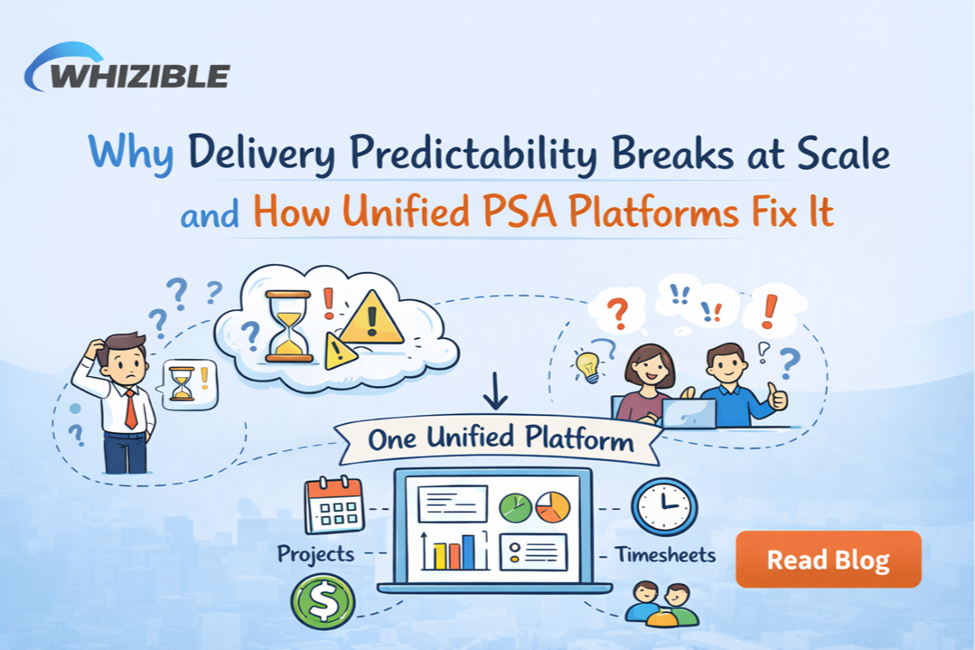
In the early stages of scale, many organizations believe they still have control simply because reports are being generated and review meetings are happening. Project dashboards may look healthy, utilization reports appear acceptable, and financial summaries show no immediate red flags. Yet beneath this surface, cracks begin to form. Delivery managers track progress in one system, finance monitors margins in another, and resource teams juggle availability in spreadsheets. Each function optimizes locally, but no one sees the complete picture.
This illusion of control is dangerous because it delays action. Problems are not invisible they are simply detected too late. By the time leadership sees a margin drop, delivery teams have already absorbed scope changes. By the time utilization issues surface, burnout has already begun. This is where predictability starts to break not suddenly, but gradually and silently.
Why Delivery Predictability Breaks as Organizations Scale
Fragmented Systems Create Fragmented Truth
At scale, predictability fails first at the data layer. When project tracking, timesheets, resource allocation, invoicing, and forecasting live in separate systems, leadership receives multiple versions of reality. None of them are wrong in isolation but together, they are incomplete. Decisions made on partial truth inevitably lead to surprises.
Unified PSA platforms like Whizible eliminate this fragmentation by creating a single version of truth across delivery, resources, and financials. Instead of reconciling reports across tools, leaders operate from one consistent, real-time view.
🔗 https://www.whizible.com/unified-psa-platform-single-version-of-truth/
Manual Governance Does Not Scale
Weekly status reports, slide decks, and review meetings work when portfolios are small. At scale, they become bottlenecks. Information becomes stale before it reaches leadership, and teams start reporting what is safe instead of what is true. Governance becomes ceremonial rather than corrective.
Unified PSA platforms shift governance from manual reporting to system-driven visibility. Progress, risks, cost overruns and effort burn are captured automatically as work happens. This removes dependency on human memory and intent, allowing CXOs to govern without micromanaging.
🔗 https://www.whizible.com/eliminate-delivery-surprises-without-micromanaging/
Resource Misalignment Becomes Invisible Until It’s Costly
As organizations grow, resource complexity multiplies. Skills become distributed, teams span locations, and demand fluctuates constantly. Without real-time visibility into who is working on what and at what cost delivery predictability collapses. Projects appear staffed but skills may be mismatched. Utilization looks high but critical work is delayed.
Whizible addresses this by integrating resource management directly with project execution and financial outcomes. Leaders can see not just availability, but impact how resource decisions affect delivery timelines and margins simultaneously.
🔗https://www.whizible.com/resource-optimization-guide/
The Compounding Effect of Poor Predictability
The true cost of broken predictability is not a single delayed project, it is systemic erosion. Client confidence weakens when timelines slip without warning. Teams lose trust in planning when priorities change reactively. Finance teams struggle to forecast margins when effort data arrives late or inaccurate. Over time, leadership shifts from proactive steering to constant firefighting.
This is why predictability must be treated as a system-level capability, not a project-level outcome. Organizations that rely on heroics eventually burn out their best people. Organizations that rely on systems scale sustainably.
How Unified PSA Platforms Restore Predictability at Scale
Real-Time Visibility Instead of Retrospective Reporting
Unified PSA platforms replace lagging indicators with leading signals. Instead of waiting for monthly or weekly reports, leaders see deviations as they emerge schedule drift, effort variance, margin erosion, or resource overload. This enables course correction while options still exist.
Whizible’s real-time dashboards give CXOs continuous insight without requiring constant check-ins, enabling confident decision-making even across large portfolios.
Predictive Intelligence Replaces Firefighting
At scale, reacting is expensive. Predictability improves when systems surface risks early enough to act. Unified PSA platforms use historical and live data to forecast delivery outcomes highlighting projects likely to overrun, resources at risk of burnout or margins under threat.
This predictive layer allows leaders to intervene selectively, not broadly protecting delivery without disrupting teams.
🔗 https://www.linkedin.com/in/vishmahajan/
Alignment Across Delivery, Finance, and Leadership
One of the most overlooked benefits of unified PSA platforms is organizational alignment. When delivery teams, finance leaders, and CXOs operate on the same data, conversations change. Reviews focus on decisions, not debates. Escalations are based on evidence, not emotion. Strategy and execution stay connected even as scale increases.
Whizible acts as the connective tissue across these functions, ensuring that growth does not come at the cost of control.
Predictability Is Not About Control, It’s About Confidence
Many leaders fear that stronger governance will slow teams down. In reality, the opposite is true. When teams trust the system to surface risks, they spend less time explaining status and more time delivering value. When leaders trust the data, they stop asking for redundant reports. Predictability creates confidence across leadership, teams, and clients.
Unified PSA platforms enable this confidence by embedding governance into everyday work rather than layering it on top. This is how high-performing service organizations scale without chaos.
Conclusion – Scale Breaks Predictability Only When Systems Don’t Scale
Delivery predictability does not fail because organizations grow. It fails because execution systems remain fragmented while complexity increases. Unified PSA platforms like Whizible fix this by restoring real-time visibility, aligning decisions across functions, and enabling proactive governance without micromanagement.
For CXOs navigating scale, predictability is no longer optional. It is the foundation of trust
Request a Demo of Whizible Now : Book a Demo →
Connect with Industry Experts
🤝 Vishwas Mahajan on LinkedIn →
👉 Book a personalized demo → https://calendly.com/vishw/30min/invitees
Connect with us on LinkedIn
👉 Learn more about Whizible : www.whizible.com
📧 Email: info@whizible.com
Address: Mrugank, Level 3, Kothrud, Pune, Maharashtra, 411038