
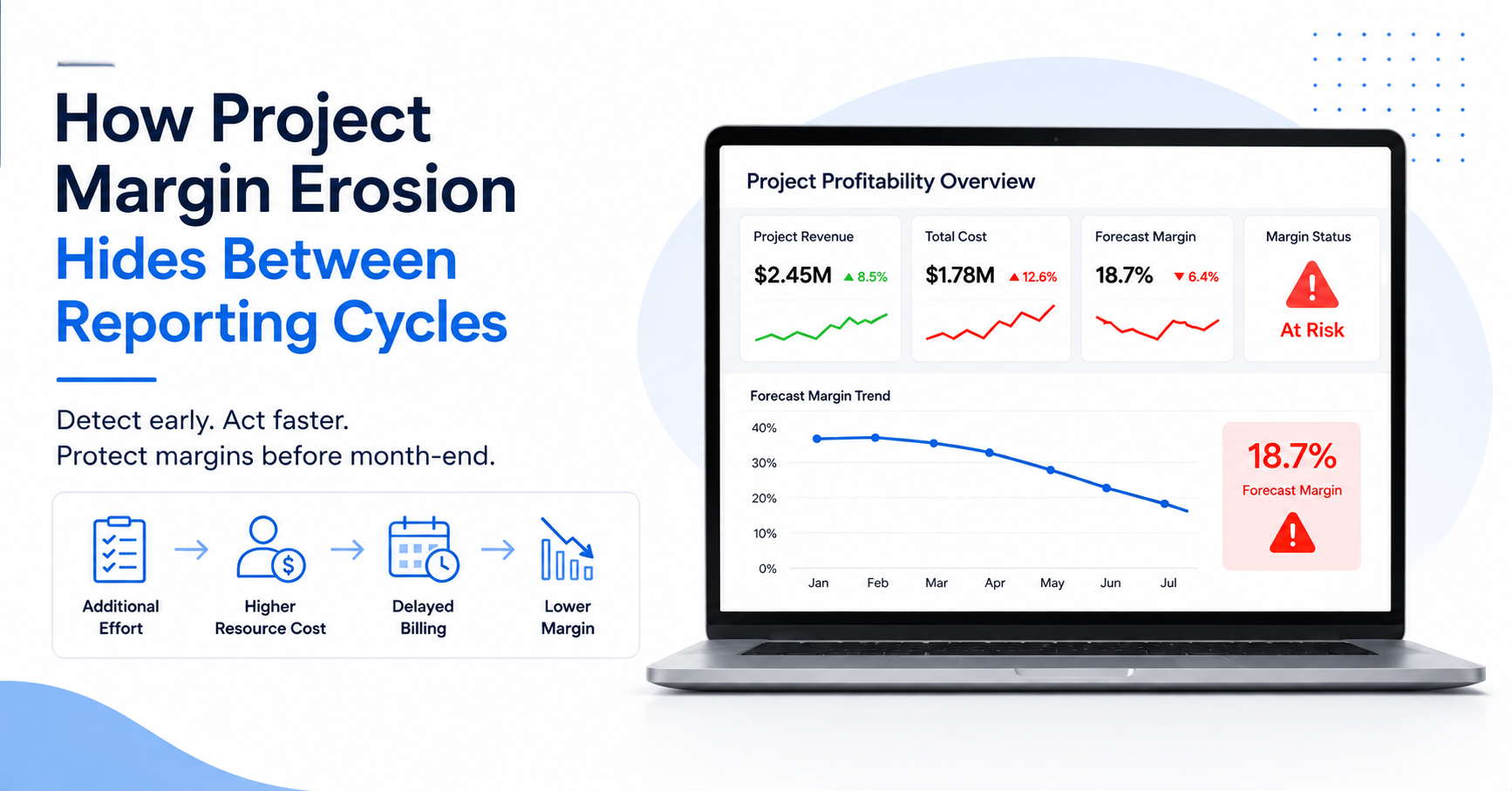
Projects rarely become unprofitable overnight. Margin erosion usually begins with small operational changes additional effort, expensive resources staying longer than planned, scope expansion, delayed billing or missed timesheets.
Individually, these issues may appear manageable. Together, they can significantly change project economics before finance sees the impact.
The Problem: Margin Problems Begin Before They Reach Finance.
Imagine a project estimated at 1,000 hours. Halfway through execution, the delivery team realizes another 200–250 hours may be required.
The profitability problem already exists.
But if project forecasts, actual effort and resource costs are disconnected from financial reporting, the CFO may discover the impact only at month-end.
The same happens when scope changes are delivered without commercial adjustment, billing milestones are delayed, or higher-cost resources remain allocated longer than expected.
The challenge is therefore not simply calculating profitability accurately. It is detecting when profitability starts changing.
The Solution: Make Project Margin a Live Metric.
CFOs need a connected view of:
Planned Effort → Actual Effort → Resource Cost → Revenue → Billing → Forecast Margin
This makes it possible to understand not only that margins are declining, but why.
Whizible connects project execution, resource information, timesheets, billing and financial data, helping organizations identify potential profitability issues earlier.
Internal Reading: From Revenue Leakage to Revenue Leadership
Instead of manually reviewing every project, finance can focus on exceptions projects with rising effort variance, declining forecast margins, delayed billing or unexpected resource costs.
This shifts profitability management from month-end investigation to early intervention.
Suggested Picture
A profitability trend dashboard showing Project Revenue, Cost, Forecast Margin and an early-warning indicator for margin decline.
FAQs
What causes project margin erosion?
Common causes include effort overruns, resource-cost changes, scope creep, project delays and billing inefficiencies.
Is high utilization equal to high profitability?
No. Utilization should be evaluated alongside resource cost, billing rates, revenue and project margins.
How can CFOs identify margin problems earlier?
By connecting project execution, resource, effort, billing and financial information rather than waiting for consolidated month-end results.
Coming Next
Early margin detection depends on connected data. But what happens when project, resource, timesheet and billing information lives in different systems?
Part 3 explores why CFOs need one connected financial view.
Explore: Whizible
Leadership Perspective: Dr. Vishwas Mahajan