
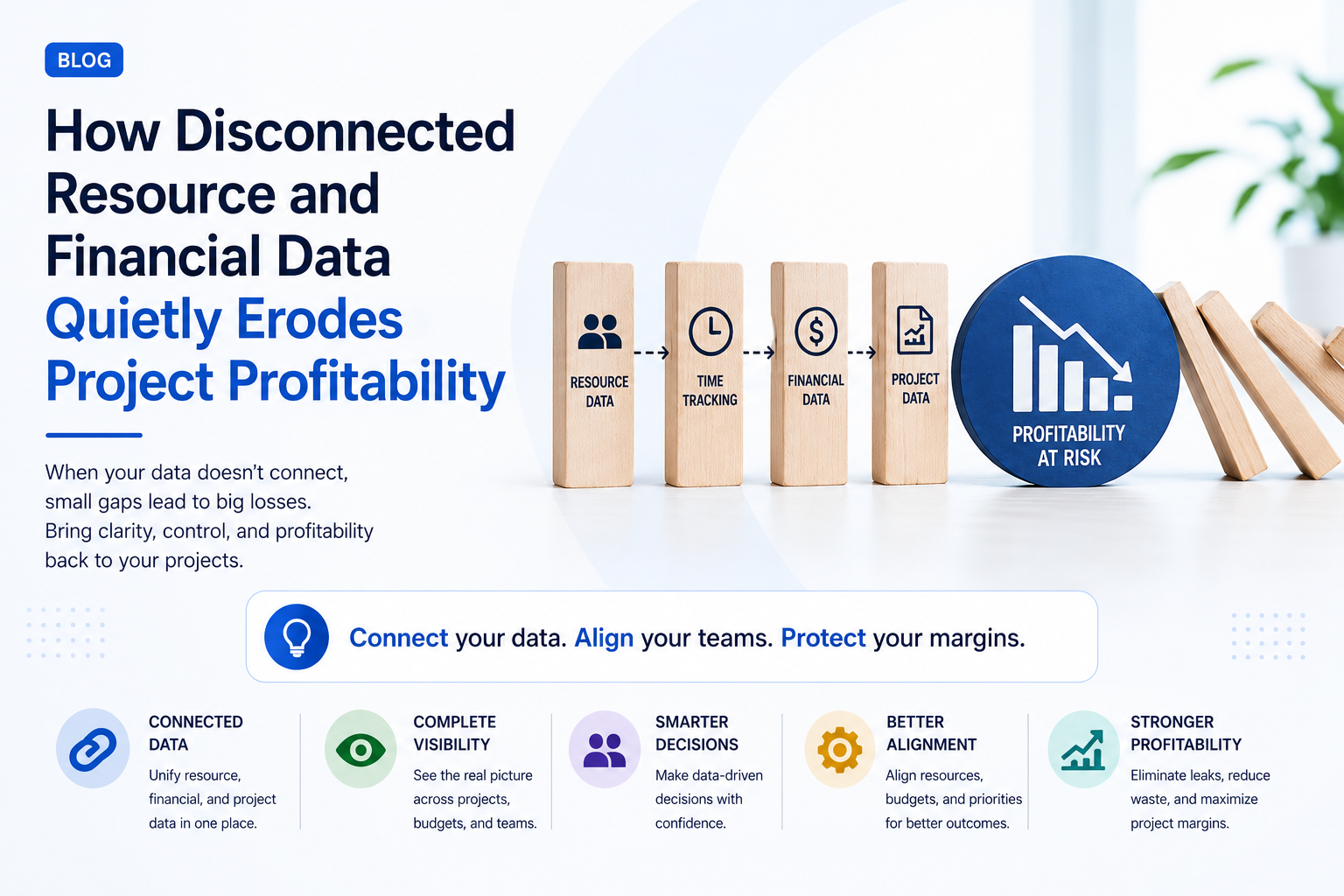
Project profitability rarely disappears because of one dramatic decision.
It often erodes through hundreds of small operational gaps.
An employee remains underutilized longer than expected. Actual effort exceeds estimates but finance sees it late. A scope change consumes additional hours without being reflected in billing. Timesheets are delayed. Project managers and finance teams calculate project health using different information.
Individually, each issue may look manageable.
Together, they can quietly change project economics.
The Problem: Delivery and Finance See Different Realities.
Project managers naturally focus on milestones, effort and delivery.
Resource managers focus on skills, availability and utilization.
Finance focuses on cost, billing and margins.
When their systems are disconnected, each function optimizes its own view without necessarily seeing the downstream impact.
Whizible’s existing guidance on revenue leakage highlights issues such as missed timesheets, delayed invoicing, unbilled changes and underutilized resources as examples of operational gaps that can affect revenue.
The same challenge becomes particularly important in fixed-price projects, where additional effort or resource cost may directly pressure project margins.
The Solution: Connect Resource Decisions to Project Economics.
Every important resource decision has a financial consequence.
That means organizations need to connect:
Allocation → Effort → Cost → Billing → Margin
For example, when a senior resource is assigned to a project, leaders should eventually be able to understand not only whether that person is available, but how the allocation affects project cost and margin.
When actual effort increases, its financial impact should become visible without waiting for month-end reconciliation.
And when employees become available, resource managers should be able to identify upcoming demand rather than discovering idle capacity after utilization has already fallen.
Turn Utilization Into Business Intelligence
Resource utilization should not simply answer:
“How busy is the team?”
It should help answer:
“Are we deploying our capacity where it creates the right business outcome?”
Whizible’s resource management approach centralizes workload, availability and utilization information, while integrated project and financial capabilities help organizations connect execution with commercial performance.
That creates a stronger foundation for proactive margin management.
Read Next
Once visibility, resources and financial information are connected, the final question becomes: How should organizations redesign their project operating environment?
Related Whizible insight: Are Your Projects Agile, But Your Billing Isn’t?
For leadership perspectives, visit Dr. Vishwas Mahajan on LinkedIn.
FAQs
-
How do disconnected tools affect project profitability?
They can delay visibility into effort, utilization, scope changes, costs and billing, making margin problems harder to identify early.
-
Why should resource management be connected with finance?
Because resource allocation determines a significant portion of project delivery cost and therefore directly influences project economics.
-
Can timesheet problems cause revenue leakage?
Yes. Missing or delayed effort records can create problems in billing, utilization reporting, cost calculations and project profitability analysis. Whizible also highlights the connection between time tracking, billable hours and financial visibility.
-
What should leaders monitor?
Useful indicators include estimated versus actual effort, utilization, resource cost, project revenue, unbilled effort and projected project margin.