
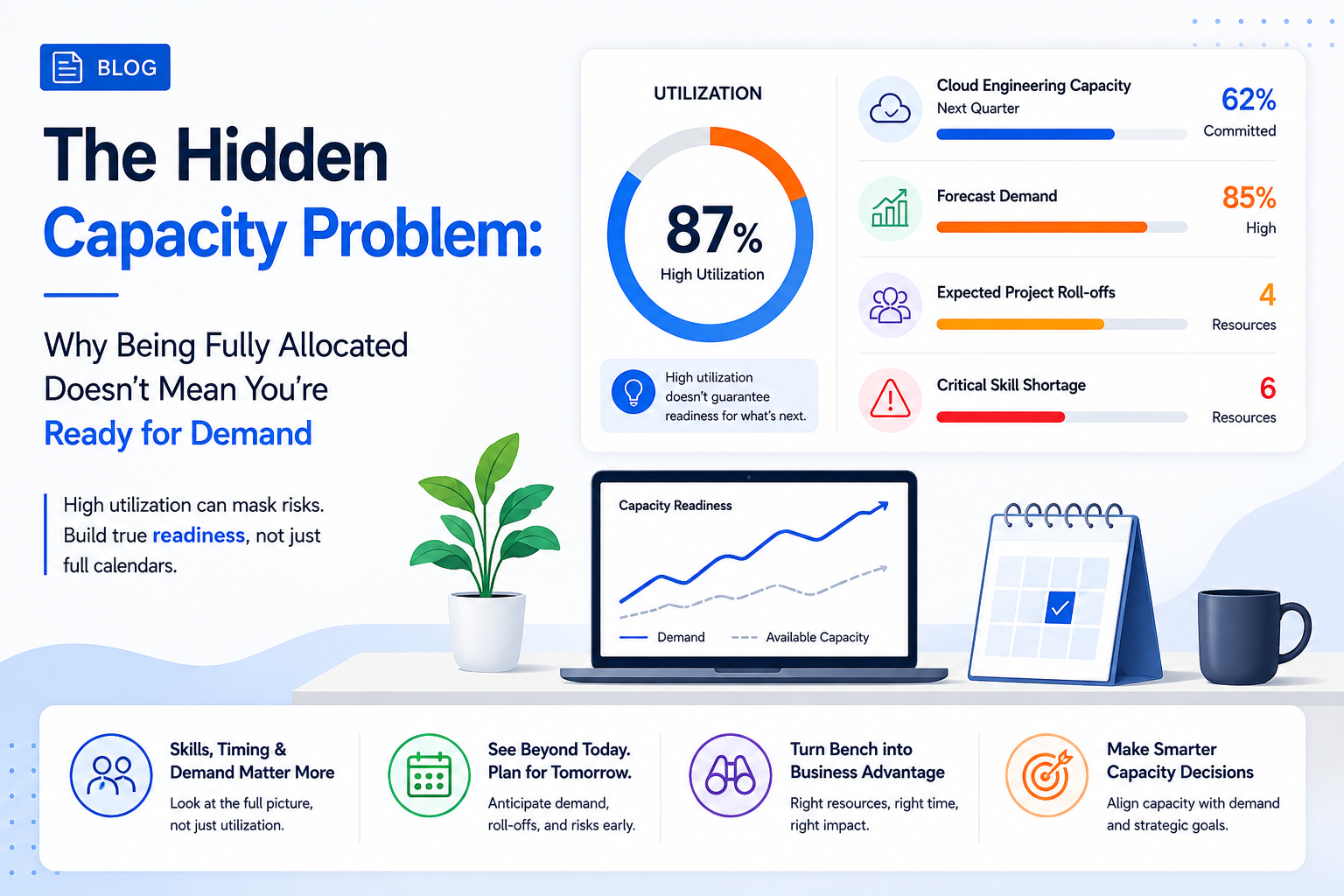
A delivery dashboard showing high utilization can look reassuring.
People are busy. Billability is strong. Bench numbers are low.
But what happens when three new projects arrive next month?
An organization can have excellent utilization today and still have a serious capacity problem tomorrow.
The Problem: Utilization Shows Activity, Not Readiness.
Utilization is valuable, but it answers a relatively narrow question: How much of our available time is being used?
It doesn’t automatically tell leaders whether the organization has the right skills, at the right time, to absorb upcoming demand.
Consider a team operating near maximum utilization. On paper, the numbers look excellent. Then a high-priority project requiring cloud architects and data engineers enters the pipeline.
Overall headcount may be sufficient.
Relevant capacity may not be.
This is why optimizing every available hour can become counterproductive. Whizible’s resource-allocation guidance similarly argues that maximizing utilization without adequate buffers can increase the risks of burnout, bottlenecks and delivery problems.
The Solution: Measure Capacity in Multiple Dimensions.
Delivery leaders need to look beyond one utilization percentage.
A more intelligent capacity view connects availability + skills + demand + timing + cost.
Imagine seeing that:
Current utilization: 87%
Cloud engineering capacity next quarter: 62% committed
Forecast demand: 85%
Expected project roll-offs: 4 resources
Critical skill shortage: 6 resources
Suddenly, resource planning becomes a business decision rather than a staffing exercise.
Leaders can decide whether to hire, cross-skill, subcontract, shift project dates or redeploy people before the shortage affects delivery.
Turn Bench Visibility Into Capacity Opportunity
The same thinking applies to bench management.
Bench should not simply be treated as unused capacity. Delivery leaders need to understand which skills are becoming available, when they become available, and where future demand could absorb them.
Whizible’s discussion of Bench Management 2.0 emphasizes visibility into upcoming roll-offs, skills and staffing demand as a way to make bench capacity more forecastable.
Explore Whizible to understand how connected resource and delivery visibility can support this shift.
You can also follow Dr. Vishwas Mahajan’s leadership insights for perspectives on project execution and services organizations.
Capacity Is About Readiness
A highly utilized organization isn’t automatically an agile organization.
Modern delivery leaders need enough visibility to know what capacity exists, what capacity is becoming available, and whether that capacity matches future demand.
That moves the conversation from utilization to readiness.
FAQs
-
Is high utilization always good?
Not necessarily. Excessively high utilization can reduce flexibility and leave little capacity for unexpected requirements or changing priorities.
-
What is skill-based capacity?
It measures available capacity within specific skills or competencies instead of treating every available employee as interchangeable.
-
How does bench management support capacity planning?
Upcoming bench and project roll-offs can reveal talent that may be redeployed against future requirements.
-
What should delivery leaders monitor besides utilization?
Future availability, skill capacity, demand forecasts, project roll-offs, workload and cost are important complementary indicators.