
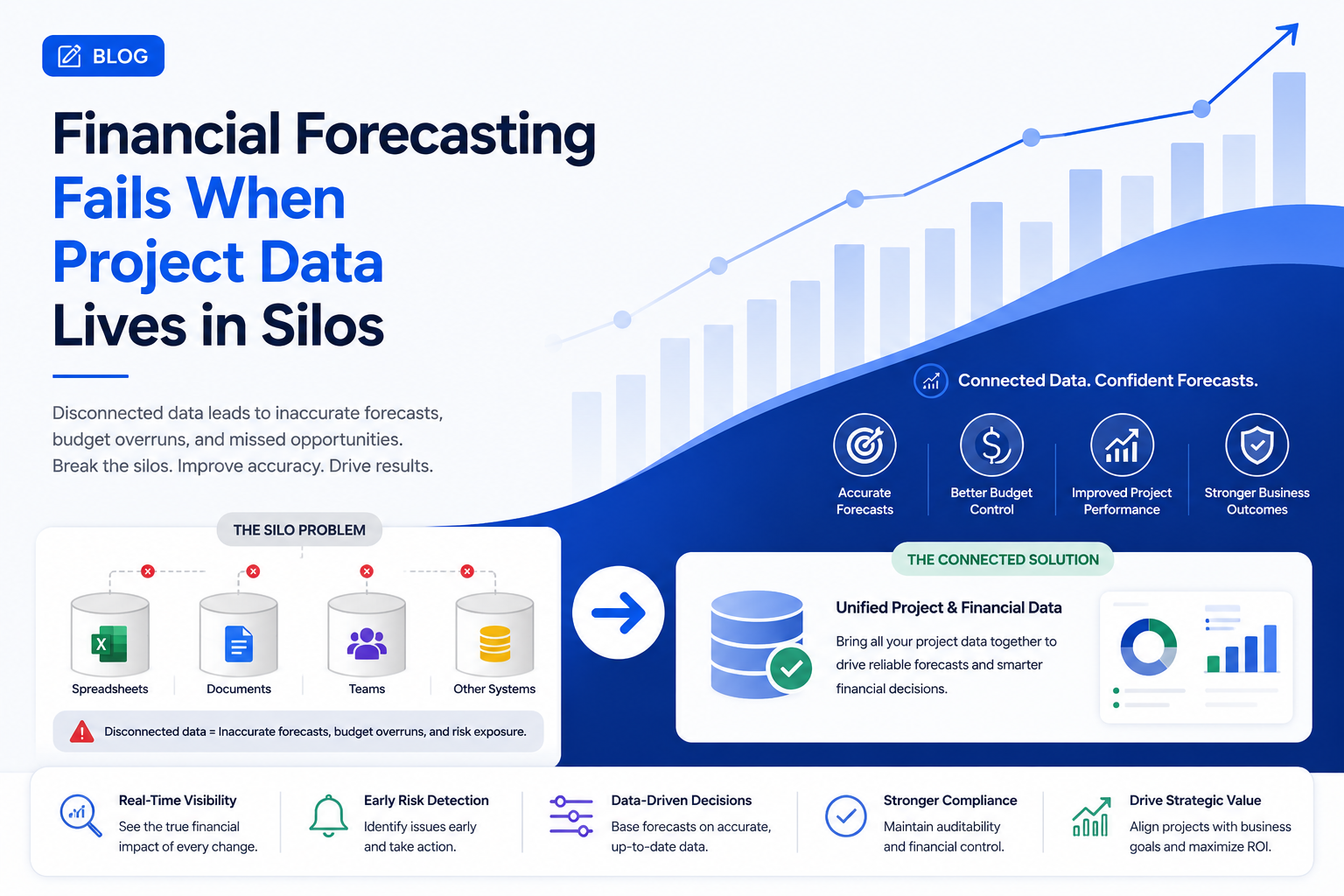
Financial forecasts are only as accurate as the operational data behind them.
Unfortunately, many organizations calculate project revenue using outdated assumptions while delivery teams are already working under new realities.
Project delays, additional effort, scope expansion, and changing resource costs rarely flow into financial projections immediately.
The consequence is declining profitability with very little warning.
The Problem
Finance teams often receive project updates after delivery has already changed.
This creates:
- Incorrect revenue forecasts
- Margin surprises
- Budget overruns
- Delayed executive decisions
- Poor portfolio visibility
The Solution
Financial forecasting should combine operational and financial intelligence.
Connected platforms continuously synchronize:
- Project progress
- Budget consumption
- Resource costs
- Revenue recognition
- Billing
- Profitability
Leadership receives a forecast that reflects today’s execution reality rather than last month’s assumptions.
Whizible helps organizations combine delivery intelligence with financial visibility, enabling proactive portfolio management.
Explore more:
https://www.whizible.com/blog/
Leadership insights:
https://www.linkedin.com/in/vishmahajan/
Conclusion
Financial forecasting should evolve alongside project execution.
Connected operational intelligence enables organizations to identify financial risks before they affect business outcomes.
FAQs
Why do revenue forecasts frequently change?
Because delivery execution changes faster than financial reporting processes.
What data should finance monitor?
Projects, resources, budgets, billing, utilization, costs, margins, and forecast variance.
Can PSA platforms improve financial forecasting?
Yes. Integrated PSA platforms provide continuous visibility across operational and financial processes.
Why is executive visibility important?
Leadership can make earlier decisions that protect profitability and delivery commitments.