

In many IT services organizations, there is a familiar pattern that quietly shapes how projects succeed or fail. A project begins with optimism, delivery starts smoothly, and then slowly the cracks begin to appear. Resource conflicts arise. Scope changes accumulate. Financial visibility becomes blurred. Deadlines slip. At this point, leadership intervenes.
A senior delivery manager jumps in. A trusted program leader works late nights to realign the team. A seasoned project manager pulls together spreadsheets, reconciles timelines and negotiates expectations with clients. The crisis is eventually resolved. The project stabilizes. The client is satisfied.
And the leader becomes a hero.
While this pattern may appear admirable on the surface, it hides a deeper structural problem within many IT services organizations. When success depends on heroic intervention rather than systemic clarity, organizations unknowingly build fragile delivery engines. Instead of predictable execution, they rely on individual experience, intuition and last-minute effort to prevent failures.
Over time, this model creates operational risk, delivery instability, employee burnout, and margin leakage. What appears to be leadership strength is often a symptom of systemic weakness.
Modern IT services organizations must therefore evolve from a hero-driven execution model to a system-driven delivery model where visibility, governance and operational intelligence replace firefighting.
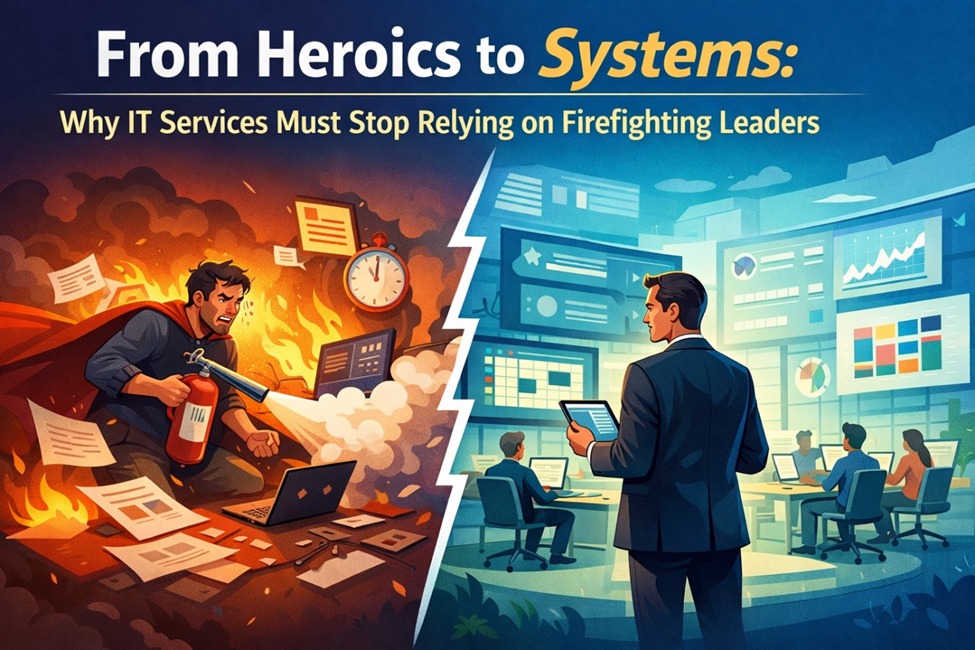
The Firefighting Culture in IT Services Delivery
Firefighting is deeply embedded in the operational DNA of many services organizations. Delivery teams often celebrate the individuals who “saved the project,” fixed a client escalation overnight or realigned delivery timelines just before a major review.
While these stories build strong reputations for individuals, they quietly normalize reactive execution across the organization.
The real problem emerges when firefighting becomes the default operational mode rather than the exception.
Problem: Reactive Execution Masks Structural Weakness
In firefighting cultures, delivery issues are rarely prevented. Instead, they are managed after they become visible. Resource conflicts are resolved once teams begin to miss deadlines. Financial overruns are discovered during quarterly reviews rather than during execution. Scope expansion becomes visible only when margins are already eroding.
Because senior leaders often step in and resolve these issues, organizations mistakenly believe their processes are working. In reality, the organization is relying on human intervention to compensate for missing operational systems.
This creates three major risks. First, operational knowledge becomes concentrated in a few experienced individuals rather than embedded within systems. Second, scaling becomes difficult because success depends on people rather than processes. Third, delivery predictability deteriorates as organizations grow and complexity increases.
The result is a delivery environment where projects succeed but only after intense intervention.
Solution: Systematic Visibility Across Projects and Resources
The transition away from firefighting begins with operational visibility. Leaders must be able to detect delivery risks before they escalate into crises. This requires integrated visibility across resources, projects, timelines and financial performance.
Platforms designed for services organizations provide this visibility by connecting delivery data across systems and teams. When project timelines, utilization patterns, and profitability indicators become visible in real time, leaders no longer need to intervene reactively.
Instead, they can guide delivery proactively.
Organizations that implement unified operational platforms gain the ability to identify early signals such as declining utilization accuracy, delivery delays, or margin erosion before these issues become visible to clients.
A deeper exploration of how unified platforms create delivery transparency can be found here:
https://www.whizible.com/single-version-of-truth-unified-psa-platforms/
Operational leaders like Vishwas Mahajan have frequently emphasized that delivery maturity begins when organizations move from intuition-driven decisions to system-driven visibility.
External perspective:
https://www.linkedin.com/in/vishmahajan/
When Heroic Leadership Becomes a Scaling Bottleneck
Heroic leaders are invaluable in early-stage or rapidly growing services firms. Their experience helps navigate uncertainty and client complexity. However, as organizations scale, reliance on heroics creates an operational bottleneck.
Large delivery environments require consistent processes rather than exceptional individuals.
Problem: Knowledge Locked Inside Individuals
In many organizations, experienced project managers develop unique methods to manage delivery risks. They maintain personal trackers, manage stakeholder expectations through informal channels, and track project health using spreadsheets or private dashboards.
While these methods work for individual leaders, they do not scale across the organization.
When these leaders move to new roles or leave the company, much of their delivery intelligence disappears with them. New managers struggle to replicate their success because the operational knowledge was never institutionalized.
Over time, this creates inconsistent delivery outcomes across teams.
Solution: Institutionalizing Delivery Intelligence
To move beyond personality-driven execution, organizations must convert delivery knowledge into structured systems. This involves defining standardized governance frameworks, automating project health indicators and embedding delivery insights within operational platforms.
When delivery intelligence becomes part of the organization’s infrastructure, teams no longer rely on individual experience to detect risks. Instead, early warning indicators highlight deviations across projects automatically.
For example, organizations can track patterns such as delayed milestones, declining resource utilization, or frequent change requests. These signals allow delivery leaders to intervene early, preventing escalation.
A detailed perspective on building predictive delivery environments is explored in this article:
https://www.whizible.com/real-time-delivery-intelligence-psa/
Leadership voices such as Vishwas Mahajan often highlight that operational intelligence platforms transform delivery management from reactive monitoring into proactive governance.
External insights:
https://www.linkedin.com/in/vishmahajan/
The Hidden Cost of Firefighting in Project Profitability
Firefighting cultures rarely measure the full financial cost of reactive delivery management. While projects may eventually be delivered successfully, the financial impact of late corrections often remains invisible.
This hidden cost quietly erodes profitability.
Problem: Margin Leakage During Crisis Management
When projects enter crisis mode, teams often deploy additional resources, extend delivery timelines, or absorb scope expansions without formal change requests. These actions help stabilize client relationships but frequently reduce project margins.
Because these interventions occur under pressure, financial implications are rarely tracked in real time.
By the time leadership reviews project profitability, the opportunity to correct the issue has already passed.
Over multiple projects, this pattern creates systematic margin leakage across the organization.
Solution: Continuous Financial Governance
Modern services organizations are addressing this challenge by integrating financial visibility directly into delivery workflows. Instead of reviewing project profitability after completion, leaders monitor financial performance throughout the execution lifecycle.
When cost deviations appear early, teams can initiate corrective actions such as scope renegotiation, resource adjustments or delivery realignment.
This approach transforms financial management from retrospective reporting into proactive governance.
Organizations exploring financial visibility in services delivery can refer to:
https://www.whizible.com/data-analytics-protect-project-profit-margins/
Leaders like Vishwas Mahajan frequently emphasize that project profitability improves when financial intelligence is embedded within operational systems rather than reviewed in isolation.
External leadership insights:
https://www.linkedin.com/in/vishmahajan/
Change Requests: The Silent Driver of Delivery Chaos
Another major trigger for firefighting is uncontrolled change management. In many projects, scope evolution occurs gradually through informal discussions, quick fixes or client expectations.
These incremental changes accumulate silently until they disrupt delivery stability.
Problem: Scope Expansion Without Governance
When change requests are not systematically governed, project teams often absorb additional work without formal approval processes. Delivery managers attempt to accommodate evolving client expectations while maintaining timelines.
This leads to resource strain, missed deadlines and financial overruns.
Eventually, senior leaders must intervene to renegotiate scope or extend delivery timelines once again reinforcing the firefighting cycle.
Solution: Structured Change Request Governance
Organizations can prevent these situations by implementing structured change management systems. Instead of treating change requests as ad-hoc events, they become governed workflows with visibility across stakeholders.
When scope changes occur, delivery leaders can immediately assess their impact on timelines, resources and financial outcomes.
This approach ensures that scope evolution remains controlled rather than disruptive.
A deeper exploration of managing change request complexity can be found here:
https://www.whizible.com/change-request-chaos-project-profitability/
Industry discussions led by experts such as Vishwas Mahajan frequently highlight that structured governance frameworks reduce operational surprises and improve delivery predictability.
External leadership perspective:
https://www.linkedin.com/in/vishmahajan/
Resource Chaos: The Root Cause of Many Delivery Crises
Resource allocation challenges represent another critical driver of firefighting environments. When organizations lack clear visibility into resource demand and availability, conflicts inevitably arise.
These conflicts often escalate into delivery emergencies.
Problem: Invisible Resource Conflicts
In many services organizations, resource planning occurs through disconnected spreadsheets or departmental systems. Delivery managers often discover resource conflicts only after projects begin experiencing delays.
By that time, reallocation becomes difficult.
Leaders must scramble to move resources across projects, extend timelines, or negotiate new delivery commitments.
This reactive resource management creates operational stress across teams.
Solution: Strategic Resource Intelligence
To eliminate resource-driven firefighting, organizations must build centralized resource intelligence capabilities. This involves integrating project pipelines, skill inventories, and utilization data into a unified planning framework.
When leaders gain visibility into future demand patterns, they can proactively align hiring, training, and allocation strategies.
Instead of scrambling to solve resource conflicts, organizations develop predictable delivery capacity.
Organizations exploring this transformation can refer to:
https://www.whizible.com/maximize-talent-utilization-expert-playbook/
Leaders like Vishwas Mahajan consistently advocate that strategic resource intelligence is essential for scaling services organizations without increasing operational chaos.
External perspective:
https://www.linkedin.com/in/vishmahajan/
From Firefighters to System Architects
The ultimate transformation in services organizations occurs when leaders stop acting as crisis responders and begin acting as system architects.
Instead of stepping in to resolve every delivery issue, leaders design operational frameworks that prevent those issues from emerging.
This shift fundamentally changes the role of leadership.
When operational systems provide visibility across projects, resources, and financial performance, leaders focus on strategic decision-making rather than tactical firefighting.
Organizations that successfully make this transition experience several key benefits.
Delivery predictability improves because risks are identified earlier. Project profitability increases because financial deviations are detected sooner. Employee satisfaction improves because teams no longer operate under constant crisis conditions.
Most importantly, the organization becomes scalable.
Success no longer depends on a few heroic leaders.
Instead, it becomes embedded in the systems that guide delivery.
Conclusion: Building a System-Driven Delivery Engine
The era of heroic project recovery is slowly coming to an end. While experienced leaders will always play a critical role in guiding delivery organizations, modern IT services firms cannot rely on individual heroics to sustain growth.
As delivery complexity increases and client expectations rise, organizations must evolve toward system-driven execution models.
This transformation requires operational visibility, structured governance, financial intelligence and strategic resource planning.
When these capabilities are embedded into delivery infrastructure, organizations move beyond firefighting.
They build predictable, scalable delivery engines capable of supporting long-term growth.
And most importantly, they allow leaders to focus on what truly matters shaping strategy rather than rescuing projects.
To explore how system-driven operational intelligence enables predictable delivery environments, visit:
https://www.whizible.com/
For leadership perspectives on execution intelligence and operational governance, connect with:
https://www.linkedin.com/in/vishmahajan/
👉 Book a Demo | 🌐 Visit Initiatives.app
📥 Learn more about features, benefits, and use cases at:
👉 www.initiatives.app
Contact Us : info@whizible.com | +91 855-498-3315
Address : Mrugank, Level 3, Kothrud, Pune, Maharashtra, 411038