

Introduction: The Tyranny of the Timesheet
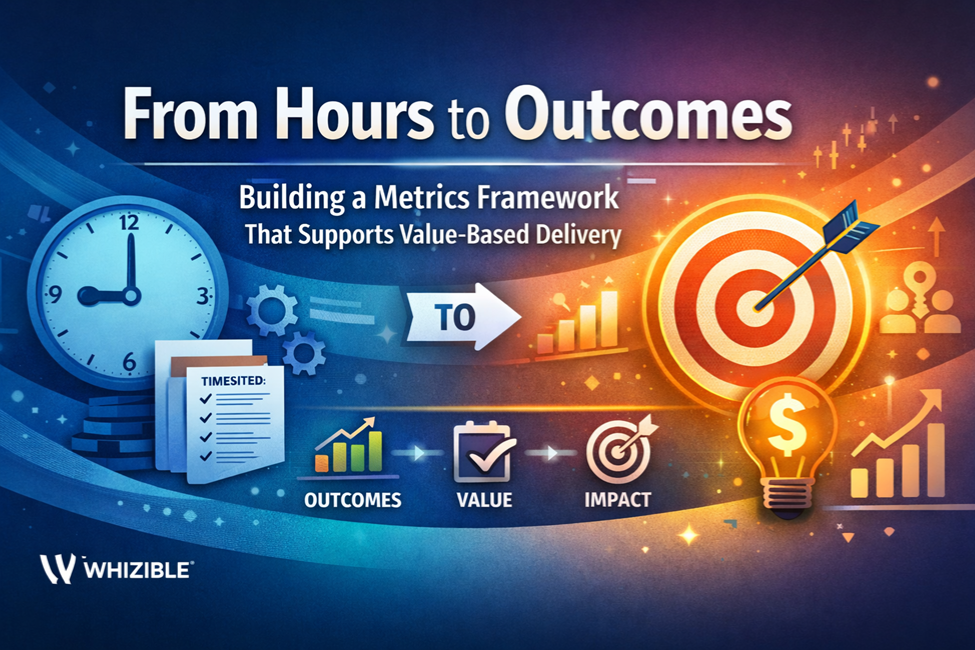
For decades, IT services organizations have managed performance through the lens of hours billable vs. non-billable, resource utilization percentages, timesheet compliance. But in an era of digital transformation, these input-centric metrics are becoming obsolete. Clients no longer measure value in time spent they measure it in outcomes achieved. Delivering a feature on time and within budget isn’t enough if it doesn’t drive the intended business result.
Yet most firms continue to anchor their delivery operations to lagging, tactical metrics. This leads to a fundamental misalignment: while leadership speaks the language of growth, impact and business KPIs, the delivery organization is still managed like a factory floor counting inputs instead of tracking value. It’s time for a shift. From hours to outcomes. From effort to effect.
In this blog, we’ll explore how IT services firms can engineer a value-based delivery metrics framework one that aligns resource planning, project governance and customer success around measurable business impact. Not more data better data. Not more dashboards more decisions. Not more tracking more trust.
Let’s unpack the transformation.
Why the Hour-Based Model Is Broken
Most Professional Services Automation (PSA) systems default to tracking hours as the foundational unit of delivery. This model assumes that more hours = more revenue and better utilization = better performance. But this approach collapses under strategic complexity. Here’s why:
- Effort ≠ Value: A senior consultant may deliver exponential business value in a few hours, while a junior resource may log 60 hours with marginal impact. Yet the metrics treat them the same.
- No Correlation to Outcomes: Clients care about the resolution of a problem or the realization of a goal not how many hours were spent solving it. Measuring effort without outcomes is like measuring fuel consumption without checking if the car moved.
- Encourages Inefficiency: When hours become the currency of performance, teams are subtly incentivized to stretch timelines instead of compressing them through innovation.
- Obscures Forecasting: Hour-based metrics are reactive. They tell you what already happened. But they rarely provide forward-looking insight into whether delivery is on track to achieve business KPIs.
It’s not that hours are irrelevant they’re just insufficient. The future lies in metrics that reflect impact, not just input.
What Is Value-Based Delivery?
Value-based delivery is a framework where success is measured by the outcomes delivered to the customer, not the time or effort expended by the delivery team. It aligns execution with business goals and builds accountability into every phase of the project lifecycle from planning and scoping to implementation and measurement.
In value-based delivery:
- Teams are rewarded for solving the right problems, not just for staying busy.
- Projects are structured around outcomes and success criteria, not just milestones and Gantt charts.
- Clients and vendors co-own KPIs, which go beyond delivery timelines and cost adherence.
For this shift to work at scale, organizations need a robust metrics framework that quantifies and tracks these outcomes in real-time not post-mortem.
Building the Right Metrics Framework: A 3-Layer Approach
Designing a metrics framework that supports value-based delivery involves three interlinked layers Outcome Metrics, Execution Metrics and Enablement Metrics. Let’s break these down.
1. Outcome Metrics: Defining What Success Looks Like
This is the north star of value-based delivery. These metrics should directly tie project success to business value. They should be co-created with the customer during the scoping phase, and revisited throughout the engagement.
Examples:
- Increase in process efficiency (% reduction in manual steps)
- Uptime improvements (downtime hours saved)
- Conversion rate improvement (for a digital transformation project)
- Reduction in turnaround time (TAT) for a specific process
- Customer experience (NPS or CSAT score changes post-deployment)
- Cost savings or revenue impact driven by the implementation
At Whizible®, we embed outcome metrics into the Initiatives governance module, ensuring that every digital initiative whether internal or client-facing is tied to measurable KPIs right from intake.
2. Execution Metrics: Tracking Progress Toward the Outcome
Once outcomes are defined, you need operational visibility into whether current activities are moving the needle. This is where execution intelligence comes in.
Execution metrics are not just about task completion. They focus on flow efficiency, throughput, and risk flags that indicate whether the delivery engine is aligned and accelerating toward the desired outcome.
Examples:
- Initiative velocity (how many outcome-linked work items are delivered per sprint)
- Risk-adjusted schedule variance
- Value delivered per resource per sprint
- Earned Value against Business Value
- Bottlenecks and rework patterns
- Dependency delays
With Whizible®’s Real-Time Governance dashboards, CIOs and COOs can monitor these signals without micromanaging. Execution becomes a feedback loop, not a post-project audit.
3. Enablement Metrics: Ensuring the Conditions for Value Creation
The third layer is often ignored but it’s crucial. Enablement metrics track whether your delivery system is equipped to create value in the first place. Think of them as the soil quality before planting the seeds.
Examples:
- Resource availability vs demand (especially for cross-functional skills)
- Bench-to-deployment time
- Skill utilization heatmaps
- Project onboarding duration
- Cross-team collaboration scores
- Reuse of IP and assets (e.g., solution accelerators)
Whizible’s Resource Management and Bench Optimization features ensure that capability, capacity and context are always aligned.
Discover how to transform idle capacity into strategic advantage →
Moving from Lagging to Leading Indicators
One of the key shifts in a value-driven metrics framework is the transition from lagging indicators (past performance) to leading indicators (future trajectory). This doesn’t mean abandoning traditional KPIs, it means adding context and foresight.
For instance:
- Instead of just tracking actual vs estimated hours, track scope change patterns and their impact on business value delivery.
- Instead of only measuring timesheet compliance, measure time-to-value from project kickoff.
- Instead of tracking utilization %, track value density how much business impact was delivered per unit of effort.
This predictive orientation is what allows services firms to become strategic partners—not just vendors. It’s what enables operational excellence that’s client-facing, not just internally efficient.
Vishwas Mahajan, a transformation evangelist and advisor to multiple services companies, often emphasizes that “visibility without foresight is just noise.” True governance comes from metrics that inform action, not just reporting.
Reimagining Timesheets and Utilization
Does value-based delivery mean abandoning timesheets and utilization metrics? Not necessarily but it does require rethinking their role.
Timesheets should evolve from a billing tool to a contextual data point. When mapped to outcome-linked tasks, timesheet data becomes useful for analyzing effort-to-impact ratios, highlighting inefficiencies, and optimizing future resource allocations.
Similarly, utilization should no longer be about “how many hours someone worked” but how many of those hours contributed to an outcome. This shifts the focus from full capacity usage to smart capacity deployment.
Platforms like Whizible enable this transformation by integrating timesheets, project financials, and outcome tracking into a unified system. When data speaks the same language across modules, insight becomes automatic.
Learn how Whizible helps prevent revenue leakage across delivery phases →
Embedding Value Metrics into Governance Rituals
Having the right metrics isn’t enough they need to be embedded into the rhythm of execution. That means:
- Linking initiative approval workflows to outcome KPIs
- Reviewing value realization in weekly delivery reviews not just project timelines
- Connecting PMO dashboards to business impact dashboards
- Having account managers report on value delivered, not just effort spent
At Whizible, our Initiatives.app platform is designed to integrate governance and delivery especially for digital transformation and change requests. By embedding value metrics into workflows inside Microsoft Teams, organizations can close the loop between strategy and execution.
Explore how Initiatives.app turns Teams into a delivery engine →
Cultural and Behavioral Shifts Required
No metrics framework will succeed without addressing the behavioral layer. Moving from hours to outcomes requires:
- Training teams to think in terms of customer success, not just task completion
- Incentivizing value delivery, not just effort tracking
- Creating psychological safety for teams to highlight delivery risks early
- Equipping delivery managers to interpret and act on new metrics not just report them
Technology enables but culture sustains. Which is why Whizible is not just a tool, it’s an execution operating system that integrates process, platform and people.
Conclusion: Metrics That Matter
As services firms scale, the complexity of delivery increases. But that doesn’t mean the answer is more metrics, it means better metrics. A metrics framework that supports value-based delivery isn’t just about tracking what happened, it’s about engineering what should happen next.
By shifting from hours to outcomes, organizations unlock a new level of transparency, trust, and transformation. They stop measuring work and start measuring worth. They stop reporting effort and start delivering impact.
And in doing so, they don’t just survive the shift toward outcome-based contracts
they lead it.
Call to Action:
👉 Ready to move from effort tracking to value engineering?
Book a demo with Whizible today and see how your metrics can drive real business outcomes.
👉 Connect with Vishwas Mahajan to explore how your organization can reimagine delivery for the next decade.
Request a Demo of Whizible Now : Book a Demo →
Connect with Industry Experts
🤝 Vishwas Mahajan on LinkedIn →
👉 Book a personalized demo → https://calendly.com/vishw/30min/invitees
Connect with us on LinkedIn
👉 Learn more about Whizible : www.whizible.com
📧 Email: info@whizible.com
Address: Mrugank, Level 3, Kothrud, Pune, Maharashtra, 411038