

Why Utilization Alone No Longer Tells the Full Story
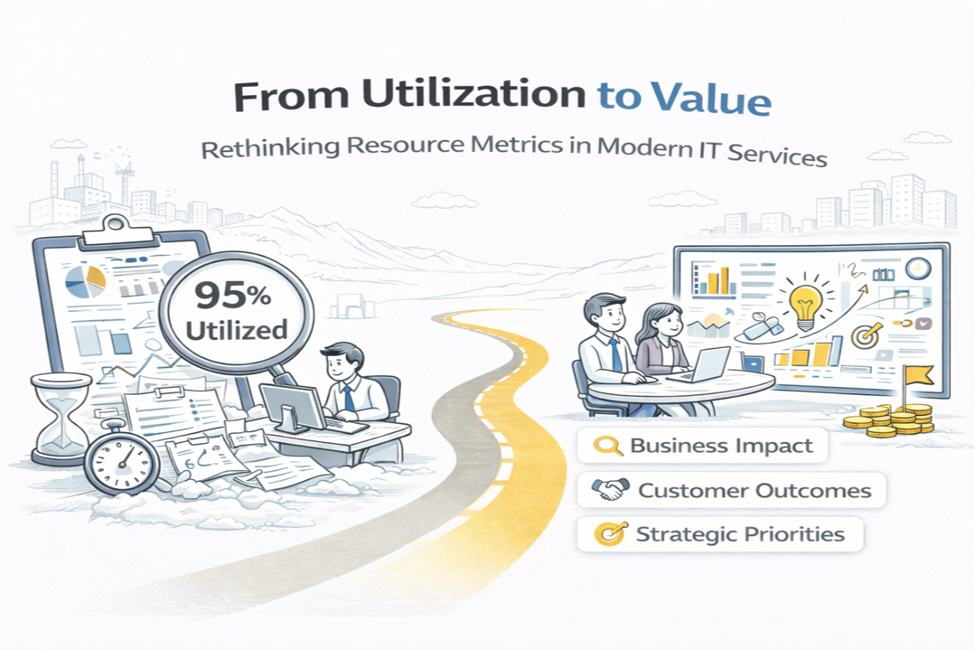
In traditional IT services delivery, utilization has long been the golden metric. A simple calculation of billable hours divided by available hours, it provided a sense of how efficiently your resources were being deployed. But in today’s hyper-competitive, outcome-oriented environment, utilization alone is no longer sufficient. In fact, over-reliance on utilization can often mask deeper problems burnout, misalignment, skill mismatch or even a slow erosion of customer value.
As services firms evolve from being body shops to strategic partners, the question is no longer “how busy are our people?” but “how much value are our people creating?” This paradigm shift demands a radical rethink of how resource metrics are tracked, analyzed, and acted upon. It’s time to move from utilization to value and that’s precisely where forward-thinking firms are headed.
The Utilization Fallacy: When Efficiency Obscures Effectiveness
On paper, a utilization rate of 90% sounds impressive. It signals productivity, discipline, and profitability or so it seems. But a deeper inspection often reveals troubling realities. High utilization may come at the cost of innovation, team well-being, or delivery quality. Worse, it can incentivize the wrong behaviors such as stretching work to fill hours or allocating resources to non-strategic tasks just to meet targets.
Even in data-centric organizations, utilization is often tracked in isolation. It’s treated as an operational metric rather than a strategic one. As a result, it fails to capture the real cost of misaligned effort: delivery rework, employee churn, poor knowledge reuse and missed cross-sell opportunities. These hidden costs don’t appear on utilization graphs but wreak havoc on business value.
The Shift Toward Outcome-Based Metrics
IT services firms that compete on value not volume understand that true performance is measured by outcomes delivered, not hours consumed. A developer contributing to a high-value innovation project but logging fewer hours is far more valuable than one working 100% on low-margin support tasks.
This is why modern organizations are starting to incorporate value-based delivery metrics. These may include revenue per skill, effort-to-value ratio, project contribution index, and delivery impact score metrics that correlate effort with strategic business outcomes.
Platforms like Whizible® are helping IT leaders define and track these new-age metrics by providing real-time visibility into project alignment, skill-to-demand fit, and delivery profitability. When resource dashboards go beyond time logs to show value creation patterns, leaders can optimize for impact, not just activity.
What Value-Oriented Metrics Look Like in Practice
Moving from utilization to value doesn’t mean discarding utilization, it means contextualizing it within a larger framework. This shift requires combining traditional indicators with strategic ones. For instance:
- Skill Leverage Index: How often are your niche or high-margin skills being allocated to strategic initiatives versus BAU maintenance?
- Revenue per Allocation: Which resource assignments generate the highest return per hour or per month?
- Delivery Contribution Score: How closely does a resource’s output map to the milestones and success criteria defined in the client SOW?
These kinds of indicators require integrated systems not spreadsheets to correlate timesheet data, project delivery progress, skill taxonomy, and financial outcomes. That’s why unified platforms like Whizible® are replacing disconnected tools, enabling IT services leaders to view effort through the lens of outcomes.
The Hidden Cost of Utilization Obsession
Blind pursuit of utilization often results in reactive staffing, last-minute firefighting, and chronic misalignment. Resources are moved not based on capability or value-add but availability. This creates a misallocation spiral where top talent is burnt out on low-value work, while strategic programs suffer from under-allocation or talent gaps.
Moreover, high utilization rates can block flexibility. When everyone is booked at near-full capacity, it leaves no room for change requests, innovation sprints or strategic pivots. Leaders are forced to delay opportunities because their systems are tuned for full-throttle utilization, not value-led agility.
Whizible’s advanced Resource Intelligence module gives real-time visibility into capacity vs. value match, enabling leaders to create ‘value buffers’ for critical teams and projects. This is especially vital in hybrid and global delivery models, where time zone constraints, cultural nuances and collaboration challenges must be factored in.
Rethinking Bench Management: From Idle to Strategic Reserve
Another casualty of outdated resource metrics is the treatment of the bench. Traditional thinking sees bench time as a cost. But in a value-driven approach, the bench becomes a strategic reserve ready to be mobilized for high-impact projects, learning initiatives or pre-sales support.
Bench visibility, when tied to skill heatmaps and project pipelines, enables proactive deployment of talent not reactive placement. It also allows for skill incubation, where bench resources can be trained or certified in emerging areas like AI, data analytics or platform engineering, making them future-ready.
You can explore more on this in our blog: Bench Management 2.0: Turning Idle Talent into Strategic Advantage
Breaking Silos: Unified View Across Skills, Projects and Profitability
One major barrier to value-based resourcing is fragmented data. Skills often sit in HRMS, timesheets in project tools, billing in finance systems and project plans in PMOs. This makes it nearly impossible to trace how a specific skill contributes to a specific outcome across portfolios.
Whizible solves this by acting as a single version of truth across skills, effort, cost, and project outcomes. Its integrated platform connects the dots so delivery, finance and HR stakeholders operate from a unified resource model. You can read more about this approach in our detailed post: Single Version of Truth: Why Whizible Is the Backbone of Agile Service Organizations
This eliminates guesswork, enables intelligent forecasting and ensures resource plans are aligned not just with demand but with strategic value.
Value-Centric Governance: Metrics for the CXO Suite
CXOs are no longer satisfied with monthly utilization reports. They want to know:
- Which teams are contributing to high-margin growth?
- Are we investing resource time in strategic vs. tactical work?
- What is the value velocity of our current projects?
- Can we predict revenue based on upcoming skill allocation?
These are not operational questions they are strategic governance mandates. And answering them requires value-aware dashboards, like those built into Whizible’s Resource and Profitability modules, which provide real-time analytics on effort-value-revenue alignment.
Connect with Vishwas Mahajan, Founder of Whizible, to explore how leading IT services firms are adopting this governance intelligence model at scale.
Whizible’s Value-First Resource Intelligence: What Makes It Different?
Unlike conventional PSA or staffing tools, Whizible is built on the idea that value is the new utilization. Its Resource Intelligence layer allows you to:
- Track not just hours, but purpose of hours
- Map resources to delivery milestones and business goals
- Prioritize based on value-weighted demand pipelines
- Identify under-leveraged high-value skills in real time
- Predict delivery risks based on resource alignment gaps
This isn’t theory, it’s operationalized across Whizible customers in BFSI, IT services, engineering, and government sectors. The platform enables CIOs, PMOs, RMGs and CFOs to speak a common language of resource value not just bookings.
Transforming Culture: From ‘Busy’ to ‘Valuable’
Finally, moving from utilization to value is not just a metric shift, it’s a mindset shift. It changes how teams are staffed, recognized, and incentivized. It pushes delivery teams to ask: Is this work moving the needle? rather than Am I filling my timesheet?
This cultural transformation can only happen when systems reinforce the right behaviors. When dashboards highlight outcomes, not just effort. When rewards align with impact, not activity. When planning meetings start with value priorities, not resource calendars.
Whizible is engineered for exactly this kind of transformation where every resource becomes a value node in your delivery network.
Final Thoughts: Are You Measuring What Matters?
As IT services move up the value chain, firms that continue to optimize for utilization will be outpaced by those that optimize for value delivery. Utilization tells you who is busy. Value tells you who is impactful.
It’s time to stop asking how many hours were logged and start asking what those hours achieved. Time to stop celebrating 100% utilization and start enabling 100% alignment. Time to shift from traditional resourcing to Resource Intelligence.
Explore how Whizible helps you make that shift at www.whizible.com.
Want to See Resource Intelligence in Action?
Schedule a live demo to explore how Whizible enables real-time visibility into resource value.
📩 Contact Us to request a personalized walkthrough.
🔗 Connect with Vishwas Mahajan on LinkedIn to dive deeper into the future of value-based IT delivery.
👉 Book a Demo | 🌐 Visit Initiatives.app
📥 Learn more about features, benefits, and use cases at:
👉 www.initiatives.app
Contact Us : info@whizible.com | +91 855-498-3315
Address : Mrugank, Level 3, Kothrud, Pune, Maharashtra, 411038