
Resource management in IT services has traditionally been treated as a scheduling exercise.
But modern delivery environments have made that approach obsolete.
Today’s organizations must continuously balance workforce skills, customer demand, project priorities, utilization targets, margin expectations, and delivery timelines simultaneously. Yet many firms still rely on static planning cycles that cannot adapt to rapidly changing execution realities.
This is why resource planning increasingly fails at scale.
The issue is not simply operational complexity.
The issue is visibility fragmentation.
When demand forecasting operates separately from workforce intelligence, organizations lose the ability to respond dynamically to execution changes. Project managers begin competing for the same resources. Bench planning becomes inaccurate. Skill shortages emerge too late. Hiring decisions become reactive instead of strategic.
Eventually, delivery predictability begins to collapse.
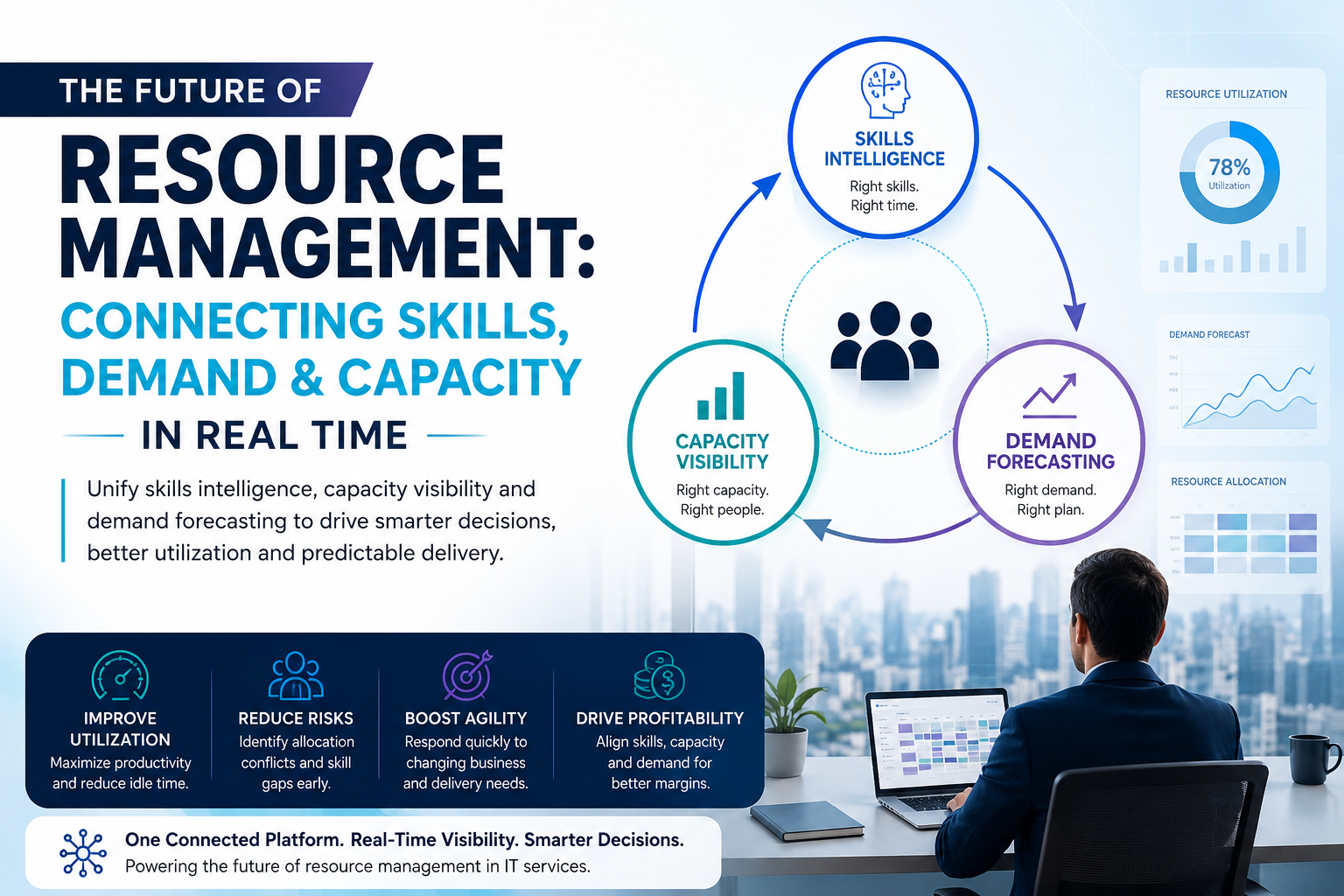
The future of resource management depends on connecting three critical operational layers in real time:
- Skills intelligence
- Capacity visibility
- Demand forecasting
Without these elements functioning together, organizations cannot achieve execution stability.
A unified planning model enables firms to continuously evaluate whether future project demand aligns with current workforce capabilities. It helps leadership identify allocation risks early, improve workforce utilization, reduce idle capacity, and accelerate staffing decisions.
More importantly, it creates organizational agility.
With integrated platforms like Whizible, IT services firms gain continuous visibility into project demand, workforce competencies, utilization trends, delivery risk exposure, and staffing readiness from a single connected operational system.
This transforms workforce planning from periodic administration into live execution governance.
Organizations no longer need to wait for weekly allocation meetings or manually consolidated reports to understand workforce readiness. Decision-makers can identify operational risks immediately and respond proactively before delivery disruptions occur.
In increasingly competitive delivery environments, execution speed alone is no longer enough.
Organizations also need execution clarity.
And that clarity begins when skills, capacity, and demand operate within one intelligent system.
For more perspectives on execution intelligence, workforce visibility, and operational transformation, follow Vishwas Mahajan.
FAQs
What is real-time resource management?
Real-time resource management provides continuous visibility into workforce skills, resource capacity, live allocations, and evolving project demand across the organization.
Why is demand forecasting important in resource planning?
Demand forecasting helps organizations proactively prepare for future staffing requirements instead of reacting only after delivery gaps or skill shortages emerge.
How does unified planning improve operational agility?
Unified planning enables faster staffing decisions, improved workforce utilization, reduced planning delays, and quicker responses to changing delivery priorities.
What industries benefit most from unified resource management?
Industries such as IT services, consulting, GCCs, engineering services, software delivery organizations, and project-driven enterprises benefit significantly from integrated workforce planning systems.