
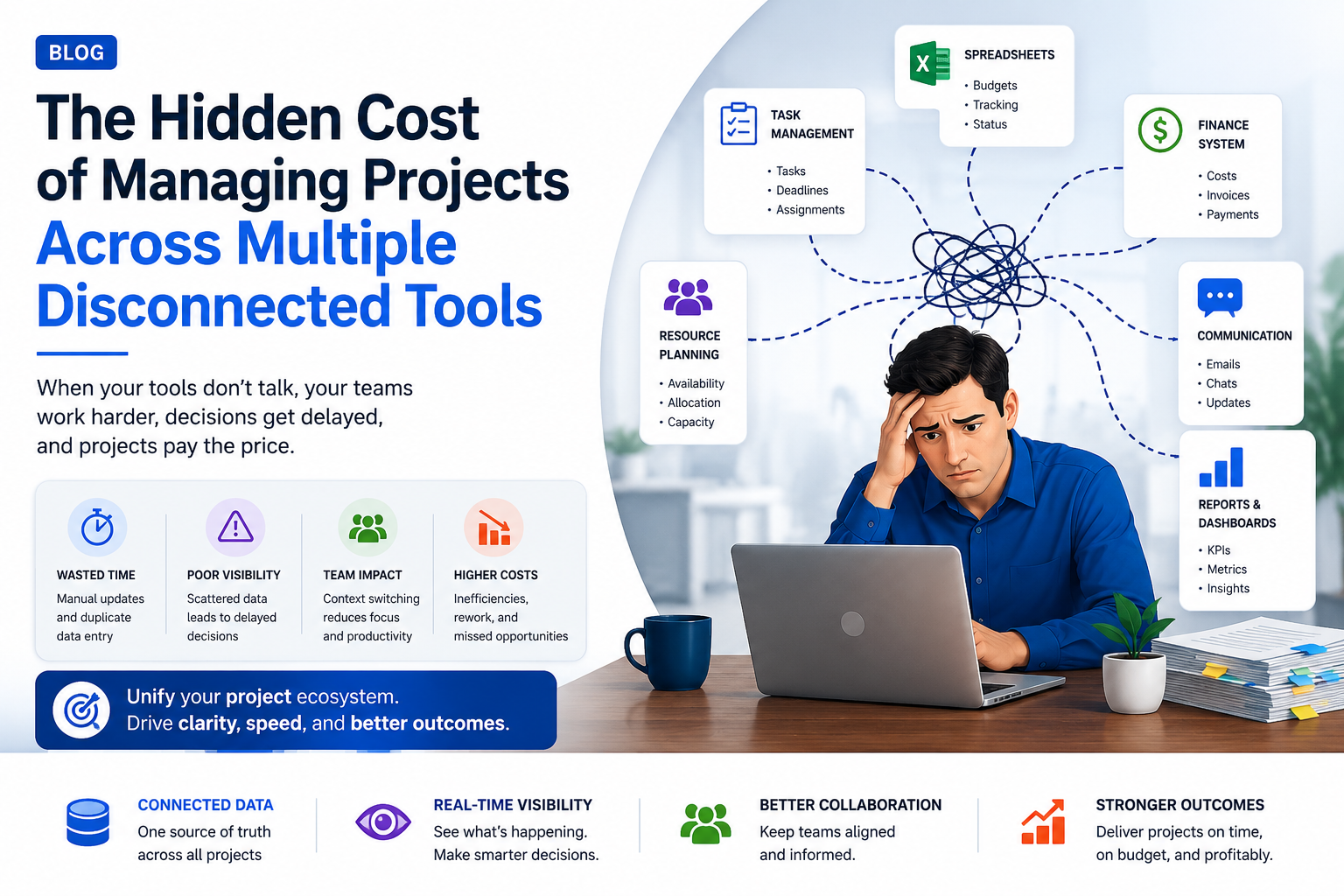
Modern project teams rarely suffer from a lack of software. In fact, the opposite is often true.
One application manages tasks. Another captures timesheets. Spreadsheets support resource planning. Finance works in a separate system. Teams communicate through email or collaboration platforms, while leadership receives information through dashboards created from yet another data source.
Individually, every tool may work perfectly well. The problem begins when the project itself has to move across all of them.
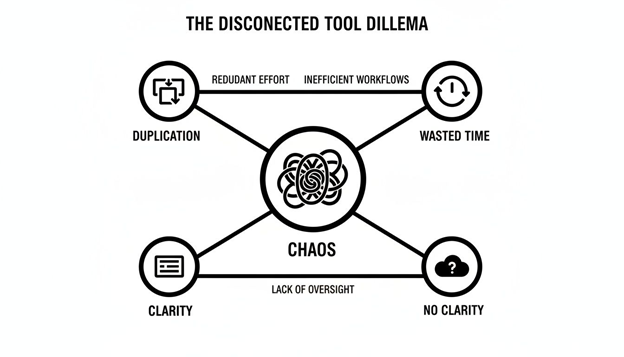
The Problem: Tool Fragmentation Becomes Process Fragmentation
Consider a project manager trying to answer a seemingly simple question:
“Is this project on track?”
The schedule may indicate yes. Resource data may show that a critical employee is already overloaded. Timesheets may reveal that actual effort is exceeding estimates. Finance may discover that the project’s cost is rising faster than expected.
When these signals live in separate systems, nobody sees the complete situation at the right time.
The cost is not simply additional software licenses. It appears through manual reconciliation, repeated data entry, inconsistent reports, delayed decisions and management effort spent validating information rather than acting on it.
The Invisible Administrative Layer
Disconnected tools create an additional layer of work around actual project execution.
Project managers export information. PMOs consolidate spreadsheets. Finance requests effort details. Resource managers verify availability manually. Leadership waits for reports.
Every handoff introduces another opportunity for information to become outdated.
This is particularly important because project information is interconnected. A resource allocation decision can affect delivery capacity, project cost, utilization and eventually profitability.
When these elements are separated technologically, their business impact becomes harder to see.
The Solution: Connect the Project Operating Model
Organizations do not necessarily need to eliminate every specialized application they use. They need a connected operating model in which project, resource, effort, financial and governance information can flow together.
Whizible, for example, brings project management, resource management, timesheets, financial controls, dashboards and integrations into a connected environment. Its existing approach to operational visibility includes cross-system data flow, third-party API integration and real-time analytics.
For organizations beginning this journey, the objective should be simple:
- Identify where project information is duplicated.
- Determine where manual reconciliation occurs.
- Connect operational and financial project information.
- Create consistent definitions for project health.
- Give leadership access to current information instead of periodically assembled reports.
The result is not merely fewer tools. It is less friction between decisions and execution.
Read Next
The first consequence of fragmentation is usually not failure, it is a loss of visibility.
From Revenue Leakage to Revenue Leadership
For more leadership perspectives on project execution and operational governance, follow Dr. Vishwas Mahajan on LinkedIn.
FAQs
-
What are disconnected project management tools?
They are applications that manage different parts of project execution but do not exchange information effectively, forcing teams to manually transfer or reconcile data.
-
Is using multiple tools always a problem?
No. Specialized tools can be valuable. The problem arises when important project information remains isolated and requires significant manual effort to create a complete picture.
-
What is the biggest hidden cost of tool fragmentation?
Decision latency is one of the most significant costs. Leaders may receive accurate information, but only after the opportunity for early intervention has passed.
-
Can PSA software reduce project tool fragmentation?
A PSA platform can connect areas such as projects, resources, timesheets, financials and reporting, reducing dependence on manually assembled project information.