
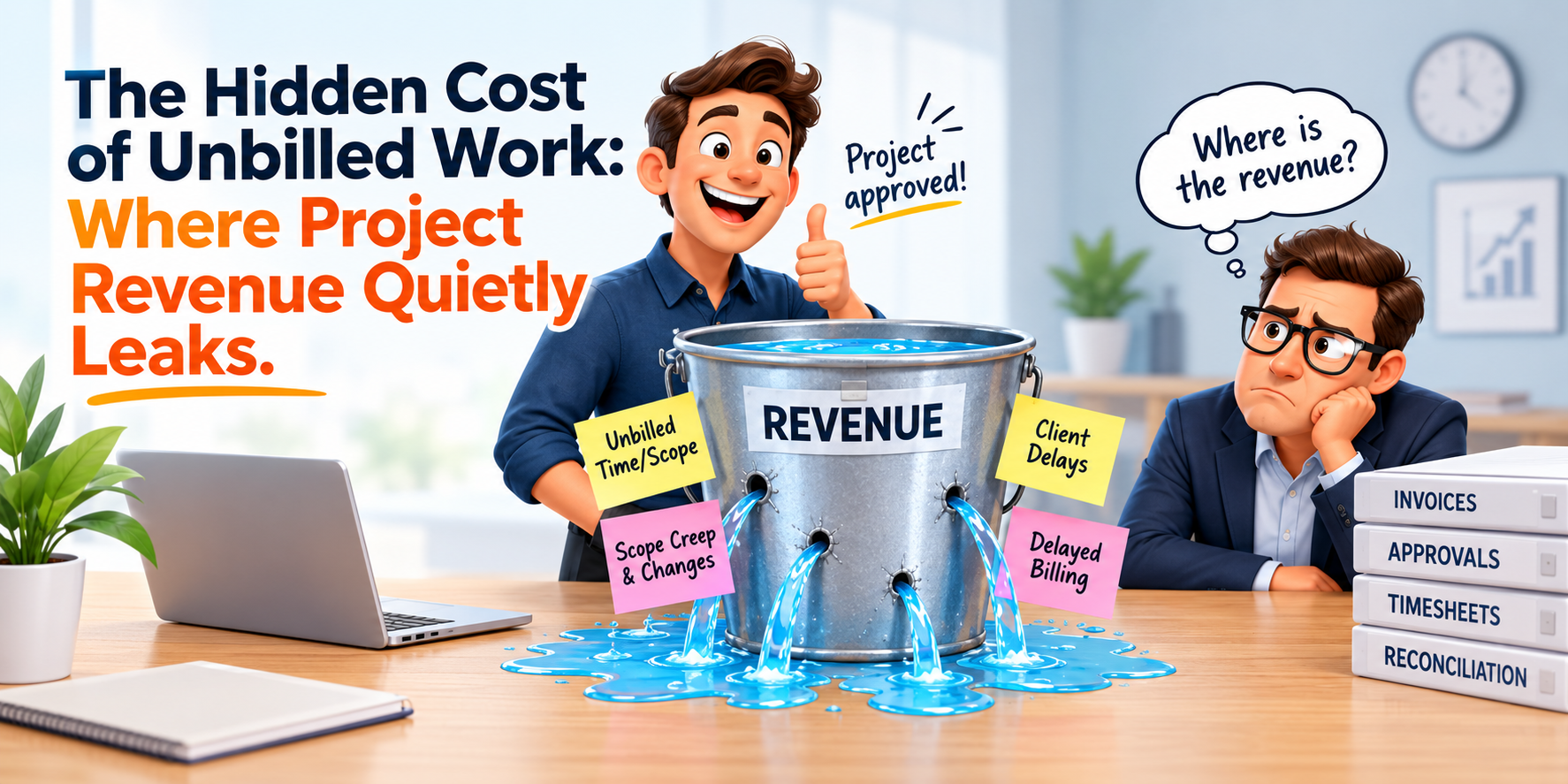
A project can be delivered successfully, the client can be satisfied, and the team can appear fully utilized yet the project may still generate less revenue than expected.
The reason is often surprisingly simple: not all work performed becomes work billed.
For professional services and IT services organizations, revenue leakage rarely arrives as one large financial event. It accumulates quietly through missing timesheets, delayed approvals, incorrect billing classifications, unrecorded change requests, work performed beyond contracted scope, and gaps between delivery and finance systems.
By the time Finance identifies the difference, the work may already be weeks old and difficult to recover.
The Problem: Work Is Happening, but Revenue Is Disappearing.
Consider a consultant who spends five additional hours resolving a client issue. The work is legitimate and necessary. But if those hours are recorded late, categorized incorrectly, or never connected to the billing process, the organization absorbs the cost without realizing the corresponding revenue.
Multiply this across hundreds of employees, projects, clients, and billing cycles, and seemingly insignificant gaps can become a material profitability problem.
The challenge becomes greater when project information is fragmented. Delivery knows what was completed. Employees know how much time they spent. Project managers know which additional requests were accepted. Finance knows what was invoiced.
But does anyone have a single view connecting all four?
Whizible highlights the importance of accurate time capture because billable-hour data directly affects invoicing and project profitability. Its approach connects time tracking with project and workforce information rather than treating timesheets as an isolated administrative process.
Where Does Unbilled Work Usually Hide?
Revenue leakage frequently originates in ordinary operational activities:
- Billable hours recorded after billing cut-offs
- Incorrect billable/non-billable classifications
- Additional client requests completed without approved change requests
- Milestones completed but not communicated to Finance
- Approval bottlenecks delaying billing
- Contract terms disconnected from actual project execution
- Manual reconciliation between project, timesheet and finance systems
None of these issues individually looks catastrophic. That is precisely why they are dangerous.
The Solution: Connect Work Performed to Revenue Realization.
Preventing leakage starts by establishing a traceable path between project work → effort → approval → billing → revenue.
Project managers should be able to see whether actual effort is moving beyond planned effort. Finance should know when billable milestones or hours become eligible for invoicing. Delivery leaders should be alerted when work is being performed without commercial coverage.
Instead of discovering leakage during month-end reconciliation, organizations need visibility while the work is still happening.
A connected PSA environment such as Whizible can bring project execution, resource utilization, timesheets and financial information closer together. This creates an operational trail between the effort being delivered and the revenue expected from it.
For organizations managing fixed-price engagements, this becomes even more important. Additional effort does not automatically create additional revenue; uncontrolled scope expansion can directly reduce project margins. Whizible discusses this challenge further in its guide to managing fixed-price contracts profitably.
Revenue Leakage Is Ultimately a Visibility Problem
The goal is not simply to invoice faster. It is to understand whether every commercially eligible unit of work has a clear financial outcome.
Leadership should be able to ask:
What work has been delivered? What should be billable? What has actually been billed? And where is the gap?
When those answers come from disconnected spreadsheets and systems, leakage remains hidden. When project and financial information is connected, exceptions become visible early enough to act.
The broader leadership perspective on execution, project economics and services-business visibility is also regularly discussed by Vishwas Mahajan on LinkedIn.
Conclusion
Unbilled work is not merely a billing issue. It is a project profitability issue.
Organizations can have strong demand, busy teams and apparently healthy utilization while still losing revenue between execution and invoicing. Closing that gap requires more than month-end reconciliation, it requires continuous visibility into effort, scope, approvals and billing.
Next in the series: From Timesheets to Invoices: Why Billable Hours Get Lost in the Process.
FAQs
-
What is unbilled work?
Unbilled work is project effort or completed deliverables that should potentially generate revenue but have not yet been correctly captured, approved or invoiced.
-
How does unbilled work affect project profitability?
The organization continues to incur employee and delivery costs while the corresponding revenue is delayed or lost, reducing project margins.
-
Can timesheet problems cause revenue leakage?
Yes. Missing, late or incorrectly classified timesheets can prevent legitimate billable effort from reaching Finance accurately.
-
How can PSA software help reduce unbilled work?
A PSA platform can connect project plans, actual effort, timesheets, approvals and financial information, making discrepancies easier to identify before billing cycles close.
Explore how Whizible connects project execution and financial visibility to help services organizations protect project profitability.