
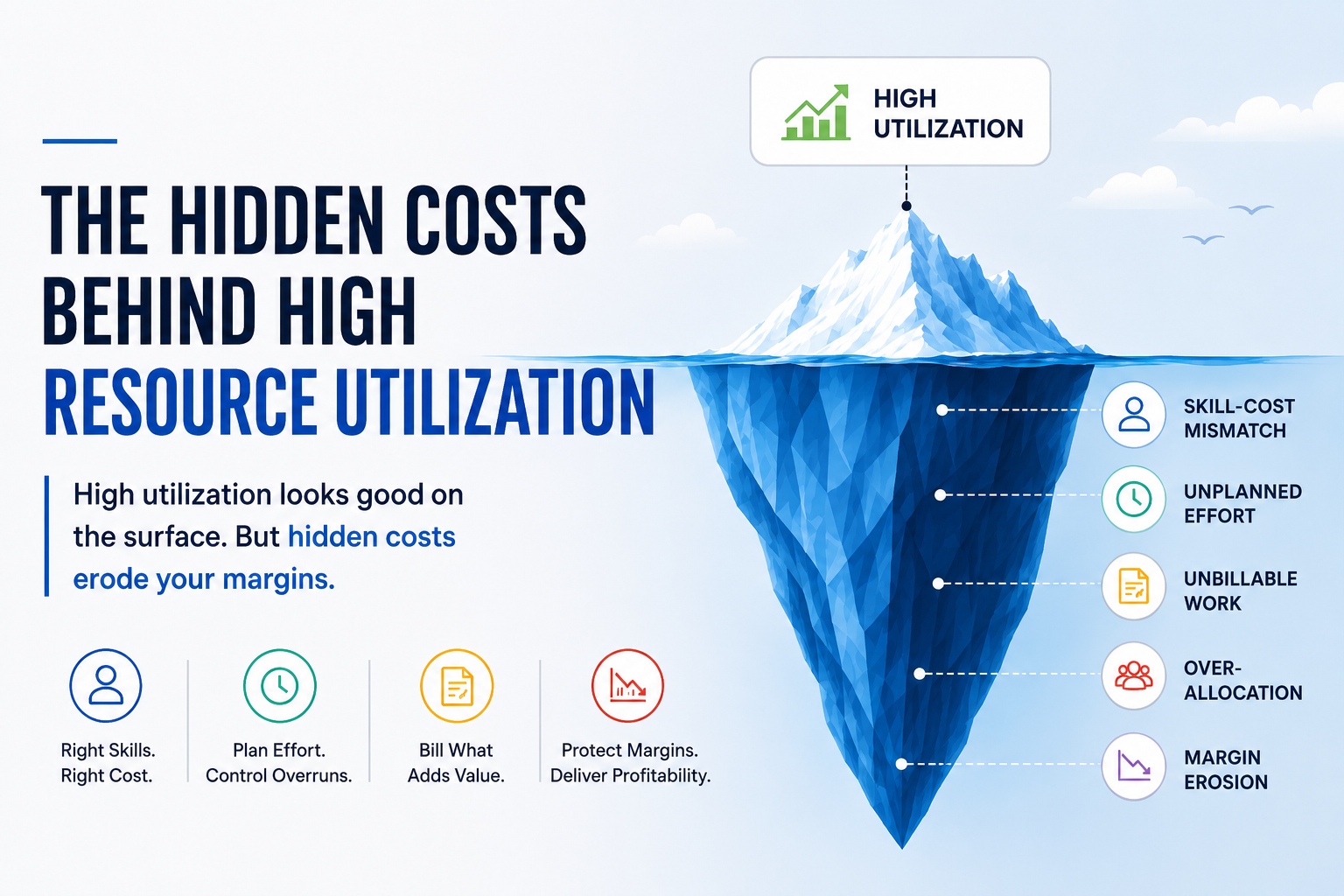
When a Busy Team Becomes an Expensive Team
After recognizing that utilization alone cannot define profitability, the next question is obvious:
Where does the margin actually disappear?
Often, it disappears inside everyday resource decisions.
A highly experienced consultant assigned to low-complexity work is still “utilized.” A developer spending additional hours fixing preventable rework is utilized. A project team absorbing an unapproved client request is also utilized.
But each situation can increase cost without producing equivalent revenue.
Four Costs Hidden Behind the Utilization Percentage
Skill-cost mismatch occurs when expensive or specialized resources are assigned to activities that could be delivered effectively by another resource profile.
Unplanned effort occurs when actual hours begin exceeding estimates. Under fixed-price contracts, those extra hours can directly reduce margins because revenue remains fixed while delivery cost continues increasing.
Unbillable work inside billable projects creates another blind spot. Meetings, corrections, internal coordination and rework consume capacity without necessarily creating billable value.
Finally, over-allocation can create longer-term costs through bottlenecks, quality problems and delivery delays.
These are reasons why resource allocation should focus on fit, availability and cost not merely filling every available hour. Whizible’s resource-allocation guidance similarly focuses on skill matching, availability forecasting and workload visibility.
The Solution: Make Resource Cost Visible Before Allocation.
Project managers should not discover the financial consequences of staffing decisions at month-end.
Before allocating someone, managers need visibility into the person’s skills, availability, cost, existing workload and suitability for the requirement.
During delivery, actual effort should continuously be compared against planned effort and financial performance.
Whizible’s resource-management approach brings resource availability, workload and skill information together to support better allocation decisions. Its broader PSA approach connects these decisions with project and financial controls.
Organizations also need visibility into upcoming bench capacity. Instead of treating bench exclusively as a cost problem, forecasted roll-offs and skill availability can help organizations staff upcoming opportunities faster. Whizible has explored this approach in its guidance on strategic bench management.
FAQs
-
What is resource cost leakage?
It occurs when resource expenditure does not produce the expected billable or commercial value for example, through rework, incorrect staffing or excessive effort.
-
Can an employee be billable but still reduce project profitability?
Yes. If the person’s cost is too high relative to the revenue generated or the project requires more effort than planned, the margin can decline.
-
How can PSA software help?
A PSA platform can connect resource availability, skills, project allocation, timesheets, cost and financial information so decisions are based on more than utilization alone.
Don’t wait until month-end to discover that today’s resource decisions damaged tomorrow’s margin.
Explore Whizible to see how connected resource and project visibility can support better decisions.
For leadership perspectives on project execution and resource intelligence, follow Vishwas Mahajan on LinkedIn.
Next in the series → From Utilization to Realization: The Metrics That Actually Protect Project Margins