
For many project-based organizations, resource utilization is one of the first numbers leadership looks at. If most employees are allocated and billable, the assumption is simple: people are productive, revenue is being generated, and profitability should improve.
Unfortunately, the economics of project delivery are more complicated.
A project can show excellent utilization and still deliver a disappointing margin. Expensive resources may be performing work that could have been handled by a lower-cost skill mix. Teams may spend more hours than estimated. Fixed-price projects may consume additional effort without generating additional revenue. Uncontrolled scope changes can also quietly increase delivery cost.
This creates an important distinction:
Utilization tells you how much capacity is being used. Profitability tells you whether that capacity is creating sufficient financial value.
Whizible’s own resource-management guidance similarly emphasizes that pushing utilization too aggressively can create burnout, quality problems, delays and other delivery risks.
The Problem: Measuring Activity Instead of Economics.
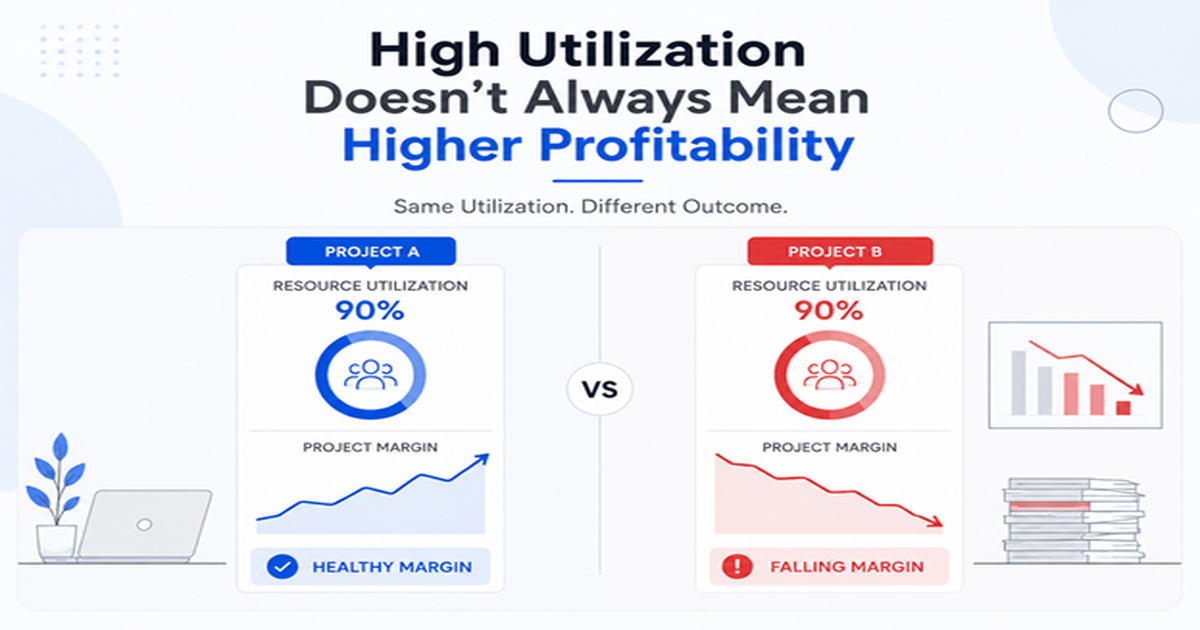
Consider two projects operating at 90% utilization.
Project A has the right skill mix, controlled effort, strong billing realization and predictable delivery.
Project B also has 90% utilization but senior resources are doing routine work, additional effort is being absorbed without billing, and the project is already exceeding its planned cost.
The utilization dashboard may make both projects look equally healthy.
Their margins tell a completely different story.
This is particularly dangerous with fixed-price projects, where additional effort does not automatically generate additional revenue. Whizible’s guidance on fixed-price contracts highlights scope creep, resource misallocation, cost overruns and delays as direct profitability risks.

The Solution: Connect Utilization With Financial Outcomes
Instead of asking only, “How utilized are our people?”, leadership needs to ask:
- Are the right-cost resources assigned to the right work?
- How much billable revenue is being realized from utilized capacity?
- Is actual effort exceeding planned effort?
- What is the current project margin?
- Which projects are consuming more resource cost than expected?
This requires resource, project and financial information to exist in one connected environment.
Platforms such as Whizible help organizations connect resource allocation, timesheets, project execution, cost and financial information, enabling managers to evaluate utilization in the context of actual business outcomes.
The objective should therefore move from maximum utilization to profitable utilization.
As Vishwas Mahajan’s LinkedIn insights frequently explore, modern project leadership increasingly depends on better visibility and decision-making rather than simply generating more operational data.
FAQs
-
Does higher utilization improve profitability?
It can, but only when utilized resources generate sufficient revenue relative to their cost and the project remains within planned effort and budget.
-
Is 100% utilization desirable?
Not necessarily. Extremely high utilization can reduce flexibility and create workload and delivery risks. Whizible’s resource-allocation guidance recommends balancing utilization with team health and delivery needs.
-
What should companies measure alongside utilization?
Project margin, realization, billability, resource cost, effort variance, revenue leakage and forecast profitability should all provide context.
Your utilization dashboard may be green while your margins are quietly turning red.
Explore how Whizible connects resource decisions with project and financial visibility.
Next in the series → The Hidden Costs Behind High Resource Utilization