

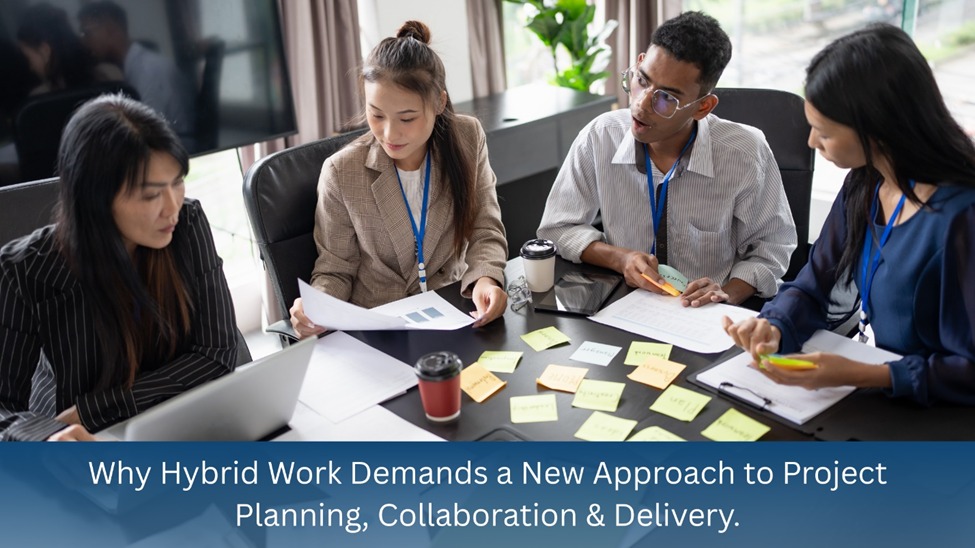
The rise of hybrid work is not a temporary trend or a reactive policy born out of necessity. It is a tectonic shift in how organizations operate, collaborate, and deliver value. What began as a response to crisis has now evolved into a defining feature of the modern workplace. But this transformation brings with it a set of challenges that traditional project planning and delivery models are ill-equipped to handle. When teams are dispersed across geographies, time zones, and even contractual arrangements blending full-time employees with gig workers, offshore developers, and outsourced vendors the assumptions that underpinned legacy project models begin to unravel. The Gantt charts, status update calls, and manual spreadsheets that once held projects together are now strained under the weight of constant context-switching, fragmented communications and blurred lines between synchronous and asynchronous work.
The problem isn’t just logistical, it’s existential. The hybrid workplace is exposing cracks in the very foundations of how we define success in project delivery. Visibility, accountability and alignment three core pillars of execution excellence are harder to achieve when your team isn’t co-located, when progress is shared in silos and when governance operates on delay rather than real time. In the pre-hybrid world, project managers could walk over to someone’s desk, teams could huddle in war rooms and delivery heads could rely on instinct backed by hallway conversations. In the hybrid era, these informal mechanisms have disappeared, leaving leaders grappling with questions they can’t easily answer: Who is working on what? Are we on track? Is this initiative still strategically relevant?
These are not just tactical challenges they are strategic vulnerabilities. As hybrid work becomes the default, organizations that fail to adapt their project management and collaboration frameworks risk operational drift, delivery delays, and erosion of client trust. The answer lies not in adding more tools or meetings, but in reimagining the very architecture of execution for a distributed world.
The Illusion of Control in a Fragmented Workplace
One of the biggest myths of hybrid work is the illusion of visibility. With more collaboration tools than ever Teams, Slack, Zoom, Jira, Asana, and dozens of others, it feels like there is constant chatter, constant updates, constant activity. But this noise often obscures rather than clarifies. Activity is not the same as progress. Presence is not the same as productivity. And visibility into one tool or one team doesn’t mean visibility across the initiative. Project managers are now forced to stitch together updates from disparate tools, people, and geographies, acting more like data brokers than execution leaders.
This fragmentation of visibility leads to reactive decision-making. By the time a delivery issue surfaces in a dashboard, it’s already impacted timelines, budgets, or client expectations. By the time a resource bottleneck is identified, the damage is already done in the form of burnout or missed SLAs. Hybrid work amplifies this lag by reducing face-to-face feedback loops and increasing reliance on asynchronous communication, which while efficient for individual productivity can be deadly for cross-functional coordination.
The only way out of this illusion is to unify work streams, stakeholders, and systems into a single version of truth. Not another dashboard, but a digital command center that gives leadership the clarity, context, and control to steer execution proactively. This is exactly what platforms like Whizible® are built for connecting project planning, resource allocation, financial visibility, timesheets, and initiative governance into one integrated fabric.
From Meetings to Meaning: Rethinking Collaboration in Hybrid Work
Traditional collaboration relied heavily on meetings standups, check-ins, steering committees, retrospectives. In an office, these rituals served both operational and social functions. But in hybrid setups, they often become a burden. Scheduling across time zones, accommodating different work styles, and battling video fatigue has rendered the old meeting culture obsolete. At the same time, purely asynchronous collaboration while ideal in theory can result in misalignment, loss of urgency, and delayed escalations if not governed carefully.
The future of collaboration in hybrid work is neither synchronous nor asynchronous, but intelligent. It requires a redefinition of what collaboration means: not just talking about work, but moving work forward. This shift demands context-rich environments where conversations are tied to actions, decisions are logged with traceability, and ownership is visible without micromanagement. It means embedding collaboration into the tools where execution happens not toggling between chat windows and planning boards, but converging them into one operational layer.
This is where integrated platforms like Initiatives.app are reshaping the game. By turning Microsoft Teams into a strategy execution hub, it allows hybrid teams to discuss, decide, and deliver all without leaving the collaborative environment they already use. You no longer have to ask, “What’s the status of this?” or “Who approved that?” because the answers live alongside the work itself. This isn’t just a better UX it’s a different mindset: collaboration as a function of governance, not just communication.
Planning in a Fluid World: From Static to Scenario-Based Project Management
Hybrid work has introduced a new kind of volatility into project environments. Tasks get reprioritized overnight, resources are shared across multiple projects, and client expectations evolve in real time. The rigid planning methods of yesterday defined upfront, rarely revisited collapse under this dynamism. What hybrid work demands is planning that is adaptive, multi-scenario, and continuously recalibrated based on real-world inputs.
This means moving beyond static project plans and adopting living models plans that can adjust for resource availability, shifting dependencies, and unforeseen blockers. It also means building forecasting intelligence into planning tools so that what you plan is not just aspirational, but executable. Tools like Whizible® now offer predictive analytics that help delivery leaders simulate what-if scenarios, identify risk hotspots before they become bottlenecks, and course-correct with agility.
In this new paradigm, planning is no longer a one-time activity; it’s a living, breathing discipline. Leaders must continuously ask: “Is this plan still valid given our current context?” and “What are the downstream impacts of this change?” The ability to answer these questions in real time, with data-backed confidence, is what separates adaptive organizations from rigid ones in the hybrid era.
👉 Ready to bring predictability and visibility to your hybrid delivery model?
Governance Without Micromanagement: Enabling Accountability in Distributed Teams
One of the deepest concerns leaders have about hybrid work is accountability. When you can’t see your team, how do you ensure work gets done? But the answer isn’t surveillance, it’s structured transparency. Accountability doesn’t come from checking in more; it comes from designing systems where ownership is clear, outcomes are visible, and progress is tracked automatically.
Modern governance in hybrid setups is about reducing ambiguity. Everyone should know what’s expected of them, by when, and how their work contributes to the larger goal. This requires initiative-level alignment, task-level visibility, and stakeholder-level traceability. Without this, hybrid work becomes fertile ground for blame games, missed handoffs, and duplicated effort.
That’s why digital initiative governance platforms are now critical infrastructure. Solutions like Whizible and Initiatives.app don’t just track tasks; they codify accountability. They let you assign OKRs, link workstreams to strategic objectives, and audit every decision or delay in a central system. The result isn’t more control, it’s smarter control. Governance that scales with your teams, rather than slowing them down.
The Human Element: Balancing Autonomy and Belonging in Hybrid Teams
Even as we optimize processes and platforms, we must not forget the human dimension of hybrid work. Distributed teams face isolation, miscommunication, and cultural disconnect. People miss the informal touchpoints coffee chats, casual recognition, hallway brainstorming that once drove belonging and creativity. In their absence, leaders must intentionally build rituals that promote engagement, connection, and psychological safety.
This is not just HR’s responsibility, it’s a project delivery issue. A disengaged team member is more likely to miss deadlines, drop communication, or resist change. Delivery predictability, therefore, is not just about process maturity; it’s about team health. Modern project environments must bake in empathy not as a soft skill, but as a core competency of execution.
Hybrid work requires managers to lead with visibility, not proximity. To recognize effort, not just output. To create room for flexibility without losing sight of accountability. And to invest in platforms that allow people to do their best work without being overwhelmed by complexity.
👉 Want to align your hybrid teams around outcomes, not just tasks? See how Initiatives.app can help.
Conclusion: A New Operating Model for a New World
Hybrid work is not just about where people work, it’s about how work works. It challenges every assumption baked into traditional project management: that visibility can be achieved through meetings, that planning is a one-time event, that collaboration is best done face-to-face, and that governance must always be top-down. The organizations that thrive in this new reality will not be the ones that replicate office workflows over Zoom. They will be the ones that rethink execution from first principles.
This requires courage: to abandon outdated tools, to consolidate systems into unified platforms, and to empower teams with clarity rather than control. It requires investment: in project intelligence, in initiative governance, and in platforms like Whizible® that offer real-time visibility, resource forecasting, and delivery governance across geographies. And it requires vision: to see hybrid work not as a constraint, but as an opportunity to build more resilient, adaptable, and outcome-driven organizations.
Because in the end, hybrid work is not a challenge to be managed. It’s a catalyst for transformation.
👉 Explore how Whizible® is enabling hybrid project delivery at scale
👉 For deeper insights on strategy-to-execution alignment
👉 Follow Vishwas Mahajan
👉 Book a personalized demo → https://calendly.com/vishw/30min/invitees
Connect with us on LinkedIn
👉 Learn more about Whizible : www.whizible.com
📧 Email: info@whizible.com
Address: Mrugank, Level 3, Kothrud, Pune, Maharashtra, 411038