


The Illusion of Control in a Scaling Services Business
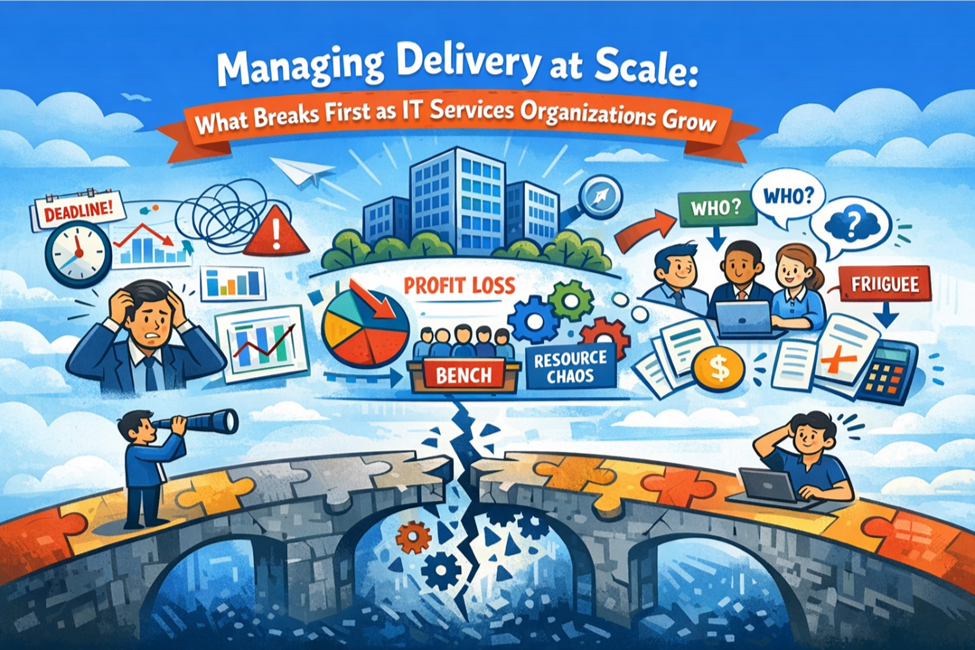
In the early stages of an IT services company, delivery is often manageable with spreadsheets, war rooms and a few reliable project managers. Everything feels under control until it doesn’t. Growth brings more projects, larger teams, multiple geographies, overlapping responsibilities, and an exponential increase in complexity. Somewhere in this transition, delivery begins to wobble. Margins shrink, customers escalate issues more frequently, talent becomes harder to allocate efficiently, and executives lose visibility. But the cracks don’t appear all at once. There’s a pattern. Certain parts of the delivery system break first and if you can identify and address them early, you can scale predictably without chaos.
The First Fault Line: Visibility Vanishes
One of the earliest casualties of scale is visibility. What once took a 30-minute status call now takes a multi-layered reporting mechanism. And even then, leaders often find themselves acting on stale or inconsistent data. Delivery reviews become reactive rather than proactive.
The lack of a single version of truth becomes a silent killer. Data lives in disconnected tools PM software, timesheet systems, Excel sheets, and HRMS. Without unification, no one can answer simple questions like: What’s the current delivery risk profile across accounts? Which teams are overcommitted? Where are we leaking margins?
This is where platforms like Whizible step in to establish centralized execution visibility with real-time project health metrics so risks surface before they spiral out of control.
Governance Doesn’t Scale Automatically
As companies grow, delivery governance doesn’t scale on its own. Many organizations mistakenly believe that adding more people, checklists and meetings equates to stronger governance. But without automation, audit trails, and real-time metrics, governance becomes performative more noise, less signal.
Approvals take too long. Change requests pile up. Resource plans become obsolete by the time they’re circulated. Inter-departmental handoffs lack clarity. There’s no standard method to monitor deviations or enforce accountability. This not only affects project timelines but also erodes client trust.
What’s needed is governance intelligence a structured, real-time control layer that ensures delivery isn’t just happening, but happening right. With Whizible’s delivery governance suite, organizations can embed governance across workflows, risks and change requests at scale.
Resource Allocation Becomes Political
In small teams, everyone knows who’s good at what. Resource allocation is intuitive. But as delivery scales, so do teams and so do the challenges of matching the right skills to the right demand. Allocation becomes reactive, favoring availability over suitability. Bench talent gets overlooked. Star performers get overloaded. New hires are underutilized.
This leads to missed deadlines, reduced morale, higher attrition and excessive hiring.
Predictive resource planning becomes critical. This means not just reacting to current availability, but forecasting demand, identifying skill gaps, and proactively reallocating capacity. Whizible’s Resource Management module brings intelligence into resourcing decisions, reducing firefighting and enabling smarter staffing across projects.
The Bench Turns into a Burden
What starts as strategic capacity can quickly become a hidden cost center. The bench intended as a buffer for delivery continuity bloats silently. Without visibility into who’s idle, for how long and with what skill sets, it becomes nearly impossible to align talent to revenue-generating work.
This isn’t just a cost issue. It’s a strategic risk. Companies pay for talent they can’t deploy. And in high-growth scenarios, this inefficiency multiplies.
As Vishwas Mahajan puts it, “The true opportunity cost of a bloated bench isn’t just salary, it’s lost billability, delayed delivery and eroded agility.” The solution lies in bench intelligence: dashboards that track utilization trends, flag idle talent and allow managers to allocate based on forecasted demand.
Whizible supports this with real-time utilization visibility and proactive redeployment tools that turn idle capacity into strategic leverage.
Project Financials Drift from Control
In high-growth delivery environments, profitability often becomes an afterthought. Leaders celebrate new deals, but execution silently bleeds margin. Why? Because financial governance hasn’t kept up with delivery scale. Billing mismatches, unbilled hours, unapproved scope creep and time logging inconsistencies all contribute to what Whizible calls “revenue leakage.”
To fix this, IT services organizations must operationalize profitability. Financial data must integrate seamlessly with delivery data. Are hours being tracked as planned? Are we billing accurately? Are we capturing CRs as new revenue?
Whizible’s Project Profitability Tracker connects timesheets, billing, cost, and earned value in real time so margin risks are visible early, not discovered too late.
Change Requests Spiral Out of Control
With bigger clients and more complex projects, change requests are inevitable. But in many organizations, CRs are treated as mere administrative tasks emails, notes or tickets rather than delivery pivots that impact timelines, cost and resourcing.
Without a centralized system to log, assess and approve CRs, chaos ensues. PMs scramble to update plans. Teams are reshuffled mid-sprint. Revenue is lost.
With Whizible’s Change Request Management, organizations can structure their CR workflows, include impact analysis and ensure auditability and traceability. So CRs become value opportunities not value leakages.
Communication Breakdowns Across Functions
As delivery spans across business functions sales, PMO, delivery, finance, HR the risk of misalignment grows. Sales commits timelines without consulting delivery. Delivery delays aren’t communicated to finance in time. HR’s hiring doesn’t match project demand.
In small firms, personal relationships fill these gaps. But in large organizations, systemic misalignment becomes inevitable.
The answer lies in cross-functional orchestration. Whizible becomes the execution-native system that connects all departments via a unified data layer so everyone speaks the same operational language, from sales to delivery to finance.
Siloed Tools Create Fragmented Realities
Growing companies tend to adopt a mix of tools one for time tracking, another for project plans, another for HR data. While each solves a micro-problem, collectively they create fragmented realities. PMOs can’t reconcile plans with actuals. Finance doesn’t trust the numbers. Leadership is left blind.
Whizible’s Unified Platform solves this by offering a single source of truth where projects, timesheets, resources and financials coexist. No reconciliation. No duplication. Just clarity.
What You Measure Is What You Scale
Smaller firms track simple metrics utilization, on-time delivery, CSAT. But at scale, these aren’t enough. You need predictive metrics risk exposure, margin threats, capacity health, governance compliance.
You can’t scale what you can’t see. And you certainly can’t fix what you don’t measure. Whizible enables organizations to define and track governance KPIs and KRIs, turning delivery into a measurable, improvable, and scalable system.
Explore how to build your own governance KPIs and move from gut-driven management to data-driven delivery.
Delivery Becomes People-Dependent, Not System-Driven
Without standardized delivery processes and platform governance, execution becomes dependent on a few seasoned PMs. These “heroes” manage by instinct. But as scale increases, even they can’t carry the weight. Their exits create massive delivery shocks.
This people-dependence is a risk. It introduces inconsistency, restricts scalability and lowers margins.
Whizible helps organizations build system-driven delivery models with embedded workflows, alerts, templates and auto-governance. Projects become self-regulating. Outcomes become predictable.
Scaling Without Cracking: Your Next Move
So what breaks first when IT services firms scale?
Visibility. Governance. Bench. Profitability. Communication. Tools. But these aren’t signs of failure they’re signs of success. The cracks simply indicate that it’s time to upgrade from tools to systems.
Whizible was built for exactly this inflection point. It is not just a PSA tool, it’s a delivery command center that unifies resource management, project governance, financial control and cross-functional execution.
From managing change request chaos to turning bench into strategic advantage, from fixing revenue leakage to governing delivery in global teams, Whizible is how modern IT services firms deliver with discipline at scale.
Want to see Whizible in action?
📩 Request a Demo | 🤝 Connect with Vishwas Mahajan for a strategic conversation
Request a Demo of Whizible Now : Book a Demo →
Connect with Industry Experts
🤝 Vishwas Mahajan on LinkedIn →
👉 Book a personalized demo → https://calendly.com/vishw/30min/invitees
Connect with us on LinkedIn
👉 Learn more about Whizible : www.whizible.com
📧 Email: info@whizible.com
Address: Mrugank, Level 3, Kothrud, Pune, Maharashtra, 411038