


In IT services firms, time is literally money. Every billable hour recorded (or missed) directly impacts revenue. Yet, many organizations still rely on manual timesheets a process prone to delays, errors, and incomplete data.
This outdated approach doesn’t just waste time; it silently drains profitability, disrupts project planning, and frustrates employees.
With automation, firms can capture time effortlessly, increase billing accuracy, improve compliance, and free up skilled employees for higher-value work. Let’s explore why manual timesheets are costing you far more than you think and how automation changes the game.
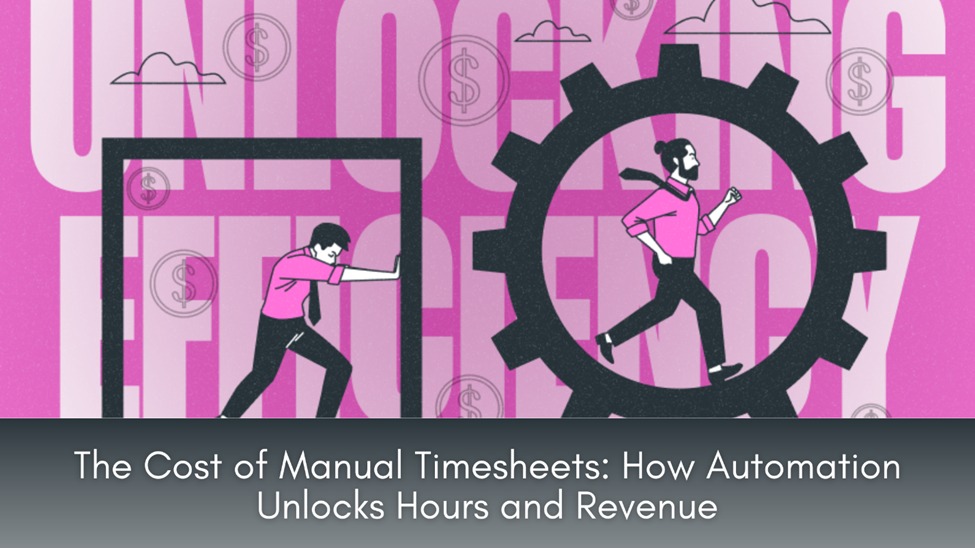
Why Manual Timesheets Are Still Common and Why That’s a Problem
Despite decades of technological progress, many IT services organizations still rely on Excel sheets, emails, or even paper forms to log hours. Why?
- Legacy processes: “We’ve always done it this way” thinking.
- Perceived cost of change: Fear that automation will be expensive to implement.
- Low priority: Timesheet inefficiencies are often invisible until they become costly.
Unfortunately, the hidden costs pile up:
The Hidden Costs of Manual Timesheets
- Revenue Leakage – Missed billable hours go unrecorded due to delays or forgetfulness.
- Low Accuracy – Recollection-based entries can be off by hours, impacting billing integrity.
- Approval Bottlenecks – Manual reviews delay invoicing and cash flow.
- Compliance Risks – Lack of audit trails makes it harder to meet client and regulatory requirements.
📌 Example: If a 200-person IT services firm loses just 15 minutes per day per employee in unrecorded work, that’s over 12,500 hours per year worth hundreds of thousands of dollars.
The True Cost of Manual Timesheets in IT Services
Manual timesheets cost far more than the administrative effort they impact revenue, margins, and client trust.
1. Lost Billable Hours
Time not logged is time not billed. According to a Harvard Business Review study, professionals lose up to 10% of billable hours due to delayed or inaccurate time tracking.
2. Delayed Cash Flow
Manual submission and approval cycles can delay invoicing by weeks, slowing working capital and project reinvestment.
3. Increased Admin Overhead
Finance and project management teams spend hours chasing timesheets, correcting errors, and reconciling mismatches.
4. Poor Resource Planning
Without accurate time data, utilization metrics are flawed leading to overstaffing or under-allocation.
🔗 Internal Link: Learn more about how utilization impacts delivery and profitability.
How Automation Transforms Timesheet Management
Automation removes friction from time tracking, making it seamless, accurate, and integrated into daily workflows.
1. Integrated Time Capture
Automated timesheets can pull data directly from:
- Project management tools
- Task boards
- Calendar events
- Communication platforms like Microsoft Teams
This ensures that every meeting, task, and milestone is captured in real time no manual entry required.
2. Auto-Reminders and Approvals
Smart systems send automated reminders to employees and managers, speeding up approvals and preventing delays.
3. Instant Billing and Reporting
With real-time data, invoices can be generated instantly upon approval accelerating cash flow.
🔗 Internal Link: Explore how Whizible integrates timesheets into project governance.
Revenue Impact Numbers Don’t Lie
Let’s break down the financial advantage.
Scenario:
- 150 employees in a mid-sized IT services firm
- Average billable rate: $50/hour
- Manual system loses ~5% of billable hours
Revenue loss per year:
150 employees × 1600 billable hours/year × 5% × $50/hour = $600,000 lost annually
Automation recaptures most of this loss, delivering immediate ROI.
Beyond Cost Savings Strategic Advantages of Automation
While the financial ROI is compelling, automation also delivers strategic advantages:
1. Higher Employee Satisfaction
Employees spend less time on admin and more time on impactful work.
2. Better Client Trust
Accurate, detailed timesheets improve transparency and justify invoices.
3. Stronger Data for Decision-Making
Reliable utilization and productivity metrics help leaders optimize staffing and project bidding.
How Whizible’s Timesheet Automation Works
Whizible’s platform offers seamless timesheet automation that integrates with project tracking, billing, and reporting.
Key Features
- Auto-capture from project tasks
- Mobile-friendly submission
- One-click approvals
- Integration with billing systems
- Analytics dashboards for utilization & revenue tracking
📌 Example: A Whizible client reduced timesheet collection time by 80% and accelerated invoicing cycles by 2 weeks
Steps to Transition from Manual to Automated Timesheets
- Audit Your Current Process – Identify bottlenecks, errors, and delays.
- Select the Right Platform – Look for integration with your existing project and billing tools.
- Pilot with One Department – Test workflows and refine settings before company-wide rollout.
- Train and Onboard Employees – Show them how automation saves time and benefits them directly.
- Measure ROI – Track time saved, hours recovered, and revenue impact.
Common Objections to Automation and How to Overcome Them
“It’s too expensive.”
💡 Reality: The revenue recovered often outweighs the software cost within months.
“Our process works fine.”
💡 Reality: “Fine” usually hides inefficiencies costing hundreds of thousands annually.
“It’s hard to change habits.”
💡 Reality: Modern tools integrate into existing workflows, making adoption easier.
The Future AI-Driven Time Tracking
The next evolution goes beyond automation to AI-assisted time tracking, where:
- AI predicts time allocation needs based on past projects.
- Systems automatically tag time entries with project codes.
- Resource allocation becomes predictive instead of reactive.
Conclusion Stop Leaving Money on the Table
Manual timesheets are a hidden revenue drain for IT services firms. Automation not only recovers lost hours but also:
- Speeds up cash flow
- Improves accuracy and compliance
- Strengthens client trust
- Enables data-driven staffing decisions
With solutions like Whizible’s integrated timesheet automation, the benefits extend far beyond cost savings they create a culture of efficiency and transparency.
💡 Ready to see the impact of timesheet automation in action?
Book a Free Demo with Whizible : https://calendly.com/vishw/30min/invitees
Connect with us on LinkedIn
👉 Learn more about Whizible : www.whizible.com
📧 Email: info@whizible.com
Address: Mrugank, Level 3, Kothrud, Pune, Maharashtra, 411038