
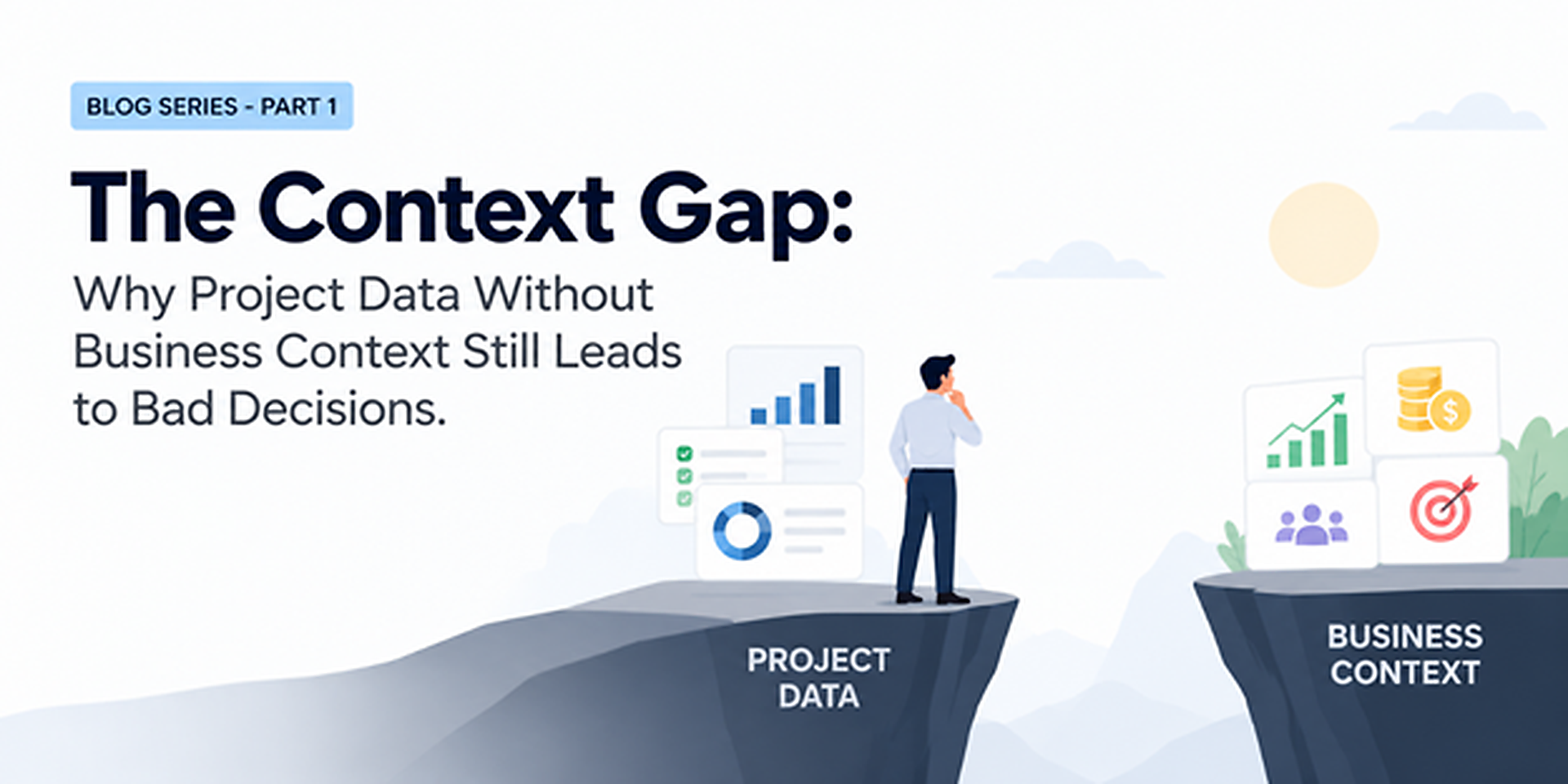
Organizations today have access to more project information than ever before. Dashboards display progress, timesheets capture effort, and reports provide updates on schedules, resources, and milestones.
Yet business leaders continue to face a familiar challenge: Despite having access to extensive data, critical decisions are still made with incomplete understanding.
The problem is not necessarily a lack of information. It is the absence of business context that makes the information meaningful.
The Problem Data Visibility Without Business Understanding.
Consider a project reporting 90% completion with every milestone on schedule. From a project management perspective, the situation appears healthy.
However, what if the project has already consumed 110% of its planned resource budget? What if additional work has reduced the expected profit margin? What if the same resources are needed for a more strategically important customer engagement?
These questions cannot be answered through project progress indicators alone.
In many organizations, project management, resource planning, financial systems, and customer information operate independently. Each system provides accurate information within its own boundaries, but leadership lacks a connected view of the overall business impact.
This creates a context gap where operational metrics look positive while business outcomes gradually deteriorate.
The Solution Connect Project Performance With Business Priorities.
Closing the context gap requires organizations to move beyond isolated project reporting.
Project information should be evaluated alongside financial performance, resource commitments, customer priorities, and organizational objectives.
For example, a project dashboard becomes significantly more valuable when it connects delivery progress with budget consumption, resource costs, forecasted margins, and future capacity requirements.
This allows leaders to understand not only what is happening but also why it matters.
Platforms such as Whizible bring project management, resource management, timesheets, and project financials into a connected environment, helping organizations evaluate operational performance within a broader business framework.
From Reporting Activity to Understanding Impact.
A contextual decision-making approach enables leaders to:
- Identify projects that are progressing but losing profitability.
- Understand the financial consequences of resource allocation.
- Evaluate delivery decisions against business priorities.
- Recognize risks before they affect customer commitments.
The objective is not to create more dashboards. It is to make existing information more useful for business decisions.
Conclusion
Data tells organizations what is happening. Context explains what those developments mean for the business.
As project environments become increasingly complex, organizations that connect operational information with commercial and strategic priorities will be better positioned to make timely, informed decisions.
Explore more perspectives on enterprise project governance through Whizible’s insights and leadership discussions by Dr. Vishwas Mahajan.
Is your organization measuring project activity or understanding business impact?
Explore Whizible’s connected project management platform.
FAQs
Q1. What is the context gap in project management?
The context gap occurs when project data is available but disconnected from financial, resource, customer, or strategic information needed for business decisions.
Q2. Why are project dashboards sometimes misleading?
Dashboards may accurately display schedule and task performance while overlooking profitability, resource costs, or business priorities.
Q3. How can organizations reduce the context gap?
By connecting project execution, resource planning, financial management, and business reporting into a consistent decision-making framework.