
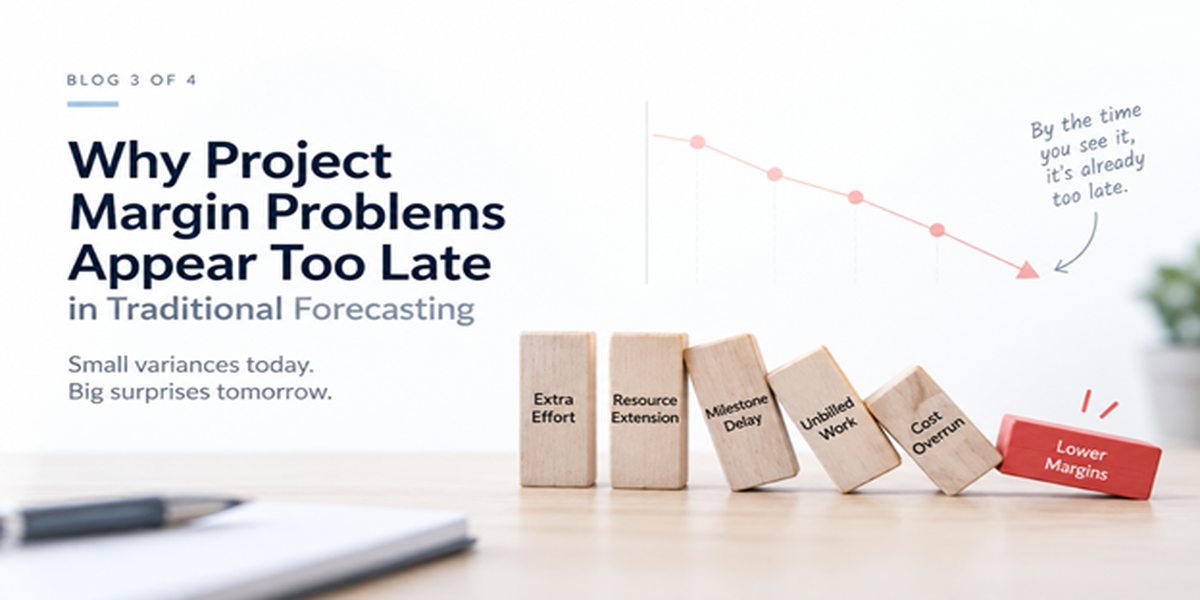
Most project margin problems do not appear overnight.
They accumulate.
A few extra hours here. A senior resource retained longer than planned. A milestone delayed. Unapproved work absorbed by the delivery team. A timesheet submitted late.
Individually, these events may look small. Together, they can materially change project economics.
Yet many organizations only recognize the pattern when Finance closes the month.
The Problem: Financial Visibility Arrives After the Decision
Traditional reporting is retrospective.
Actual effort is collected. Timesheets are approved. Costs are consolidated. Revenue is recognized. Finance calculates the variance.
Only then does leadership see that the project margin has moved.
The problem is not the financial calculation.
The problem is timing.
Timesheet data, for example, affects project tracking, billable-hour visibility and invoicing. When time information is fragmented or delayed, the financial picture can also become less timely. Whizible’s Teams-integrated timesheet approach is designed to simplify capture and connect work-hour data with project and billing processes.
WEEK 1 → Effort variance
WEEK 2 → Resource extension
WEEK 3 → Milestone delay
MONTH END → “Why did margin fall?”
From Actual Margin to Forecast Margin
Actual margin answers:
“How profitable has this project been so far?”
Forecast margin asks:
“Based on what we know today, where is this project heading?”
That second question is far more actionable.
A connected forecasting environment combines actual effort with remaining effort, current allocations, planned resource costs, project schedules, revenue expectations and billing information.
When one assumption changes, leaders can understand its potential downstream effect.
Whizible’s broader PSA positioning connects project management, resource optimization, cost tracking, invoicing and profitability analysis to provide a more integrated view of project performance.
Explore: Whizible
The Solution: Manage Variance Before It Becomes Margin Erosion.
The goal is not to produce more reports.
It is to shorten the distance between operational change and financial awareness.
When projected effort increases, teams should see the impact. When an expensive resource remains allocated longer, the forecast should respond. When work exceeds approved scope, delivery and finance should not discover it independently weeks later.
This allows leaders to intervene while options still exist reallocate resources, review scope, accelerate approvals, revise estimates or discuss commercial changes with the customer.
Forecasting therefore becomes a management process rather than a month-end reporting exercise.
For more perspectives on execution governance, follow Vishwas Mahajan on LinkedIn.
FAQs
What is project margin erosion?
It is the gradual reduction in expected project profitability caused by factors such as additional effort, resource-cost changes, delays or unbilled work.
Why is margin erosion often detected late?
Because project, resource, timesheet and financial information may be consolidated only during periodic reporting cycles.
What is forecast margin?
It is an estimate of expected project profitability based on current actuals and assumptions about remaining work, cost and revenue.
How can organizations detect margin risk earlier?
By continuously connecting execution data with resource and financial forecasts.
Previous: Resource Forecasting Without Financial Context Creates False Confidence
Next: From Disconnected Forecasts to Continuous Project Profitability Intelligence.