
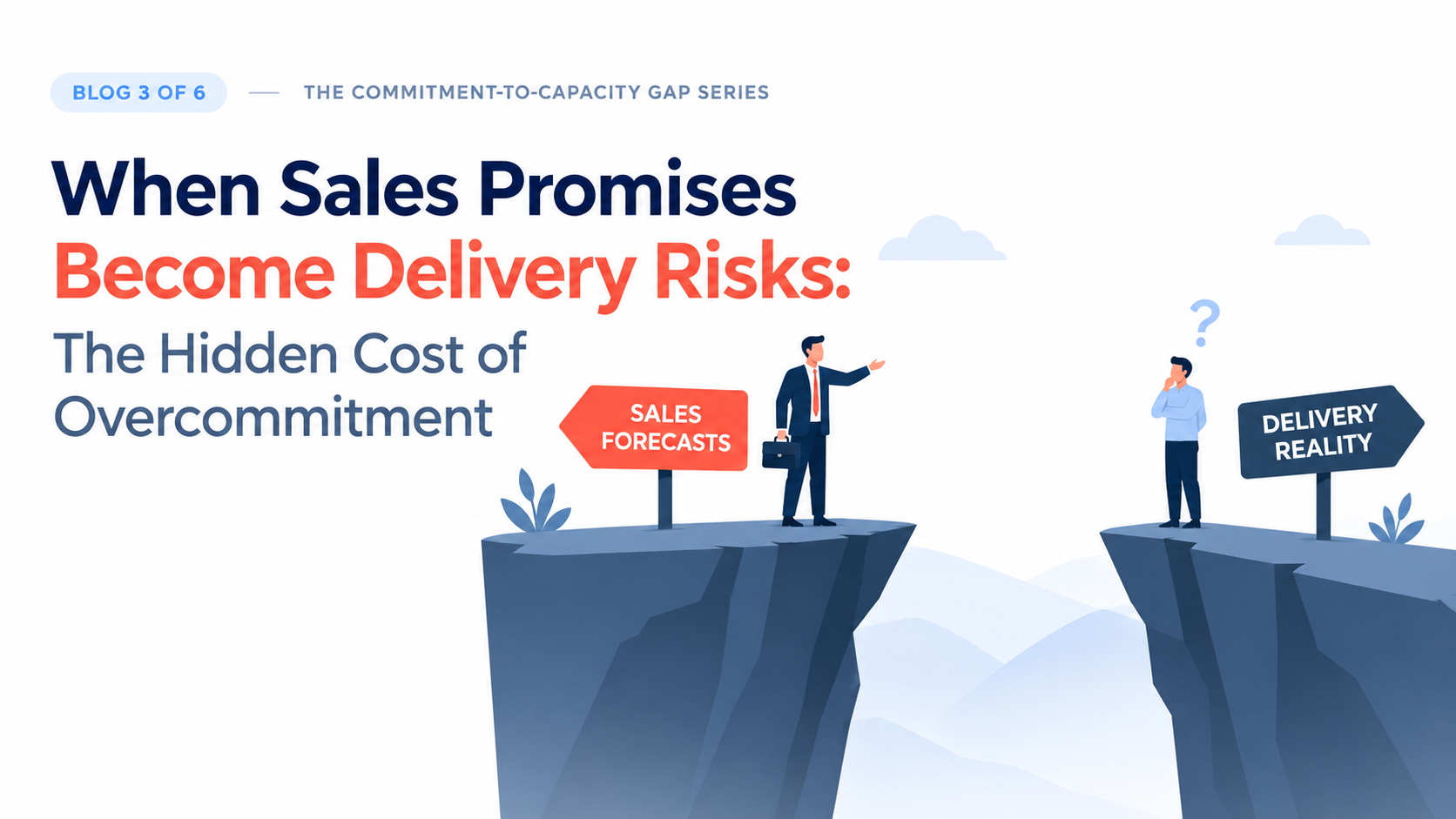
A project can appear profitable when the contract is signed and become financially challenging before delivery even begins.
The reason is often not poor execution. It is an unrealistic commitment made without understanding resource availability, delivery complexity, or operational constraints.
In project-driven organizations, commercial teams are understandably focused on winning business. But when delivery commitments are finalized without adequate capacity validation, the resulting pressure moves directly to project managers, resource managers, and delivery teams.
What begins as a successful sale can gradually become a delivery and profitability risk.
The Problem: Overcommitment Creates Costs That Are Difficult to See
Imagine an IT services company that commits to delivering a six-month implementation project using a particular team structure.
Once the project begins, the delivery manager discovers that two critical specialists are unavailable. The organization must either delay the project, hire external consultants, or reassign employees from other customer engagements.
Each option creates additional costs.
External hiring may increase the project’s resource expenses. Reassigning employees can disrupt existing commitments. Delaying delivery may affect customer satisfaction and milestone-based billing.
The financial impact becomes more significant when organizations operate under fixed-price contracts, where additional effort may not generate additional revenue.
Whizible’s article on fixed-price contract profitability challenges explores how resource misallocation, scope changes, and cost overruns affect project margins.
The Solution: Connect Delivery Governance With Financial Visibility
Preventing overcommitment requires more than accurate project schedules. Organizations need continuous visibility into resource consumption, project progress, cost variance, and delivery risks.
Instead of identifying financial problems after a project closes, leadership teams should monitor emerging indicators throughout execution.

How Whizible Helps Organizations Protect Project Margins
Whizible brings project management, resource allocation, timesheets, and project financial information into a connected environment.
This enables delivery and finance teams to monitor project performance with better operational context, rather than relying exclusively on periodic spreadsheets.
A connected governance approach helps organizations:
-
Identify resource conflicts and effort overruns earlier.
-
Compare project costs against planned budgets.
-
Monitor delivery milestones and emerging risks.
-
Improve coordination between delivery and financial stakeholders.
For example, if a project begins consuming more senior resource hours than planned, managers can investigate the impact on estimated margins and take corrective action before the variance becomes more expensive.
Conclusion: Winning Revenue Should Not Mean Sacrificing Margins
Organizations cannot eliminate every delivery risk. However, they can reduce the financial consequences of unrealistic commitments by connecting project execution with resource and financial governance.
The objective is not simply to deliver projects on time. It is to deliver them predictably, sustainably, and profitably.
Explore connected project financial management: www.whizible.com
For more insights into enterprise execution and operational governance, follow Dr. Vishwas Mahajan on LinkedIn.
Frequently Asked Questions
Q1. How does project overcommitment affect profitability?
Overcommitment can increase staffing costs, create unplanned effort, delay billing milestones, and reduce the margins originally estimated during commercial planning.
Q2. What are the early warning signs of delivery overcommitment?
Repeated resource conflicts, increasing effort variance, missed milestones, and dependence on overtime are common indicators.
Q3. How can project financial visibility reduce delivery risks?
By connecting project costs, resource utilization, and delivery progress, managers can identify unfavorable trends earlier and take corrective action.
Related reading: Smarter Resource Allocation in IT Projects.
Next in the series: From Sales Pipeline to Delivery Readiness: Building a Capacity-Driven Commitment Model.