
Most project-driven organizations have already invested in tools for project planning, resource management, financial reporting, and collaboration.
Yet leadership teams often struggle to answer fundamental business questions.
Which projects are likely to become unprofitable? Where will resource shortages affect upcoming commitments? Which customer engagements are consuming more effort than anticipated? What decisions should be prioritized before the next leadership review?
The answers may already exist across different systems.
The challenge is connecting those answers into a coherent understanding of business performance.
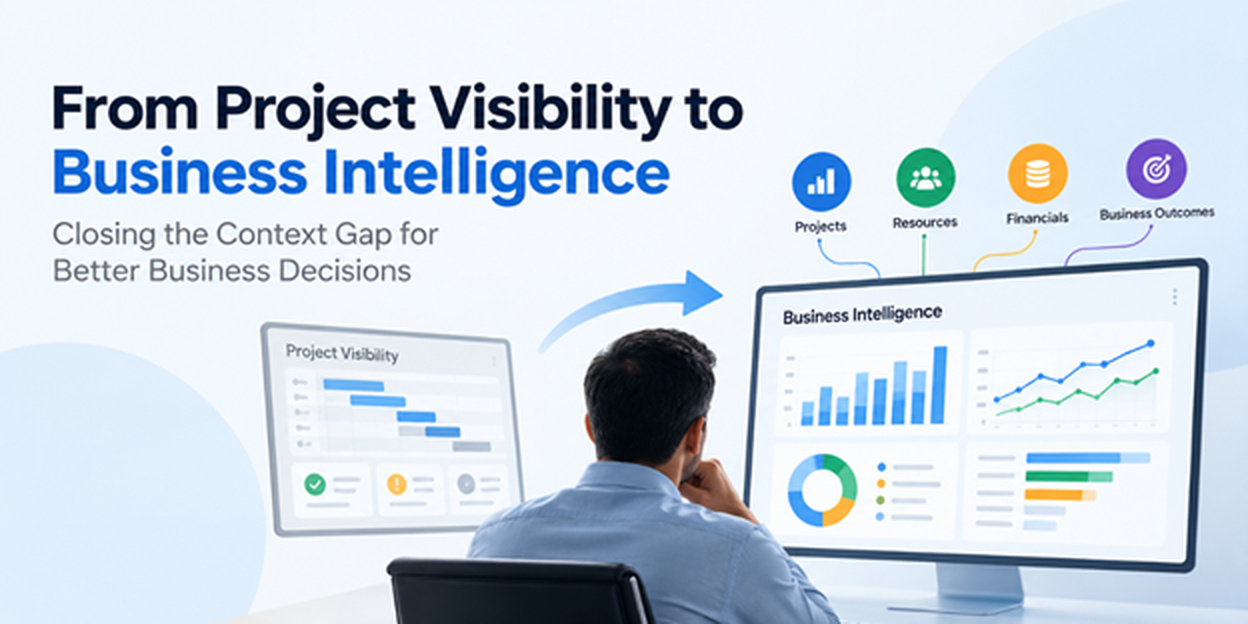
This is the final stage of closing the context gap: moving beyond operational visibility toward contextual business intelligence.
The Problem: Fragmented Systems Create Fragmented Decisions
In many organizations, project managers track delivery schedules, resource managers maintain allocation plans, finance teams analyze profitability, and business leaders review consolidated reports.
Each function may perform its responsibilities effectively. However, when information is disconnected, decisions become dependent on manual reconciliation.
A resource manager may allocate an available consultant without understanding the financial implications of the assignment. A delivery head may approve additional effort without knowing how it affects project margins. A CFO may discover profitability deterioration only after monthly financial consolidation.
These are not necessarily failures of individual teams.
They are consequences of business processes operating without sufficient shared context.
As organizations grow, the cost of fragmented decisions becomes more significant because individual choices affect multiple projects, departments, and customers.
The Solution: Establish a Connected Decision-Making Framework
Closing the context gap requires more than consolidating reports into a single dashboard.
Organizations need a connected operating framework where project execution, resource commitments, financial performance, and business priorities can be evaluated together.
This means ensuring that relevant information flows between operational systems and that leadership receives consistent, timely indicators.
For example, when a project requires additional resources, decision-makers should understand the impact on available capacity, project costs, future commitments, and expected profitability before approving the allocation.
Whizible supports this connected approach through project management, resource management, timesheets, project financials, and reporting capabilities.
Its Microsoft Teams integration also enables users to access supported workflows within a familiar collaboration environment, reducing the need to move repeatedly between applications.
Explore Whizible’s integrated enterprise PSA approach to understand how connected project operations can support more informed decisions.
Four Foundations of Context-Driven Business Intelligence
A practical framework should focus on four capabilities:
-
Connected information: Align project, resource, financial, and operational data.
-
Consistent governance: Establish common definitions, approval processes, and reporting standards.
-
Forward-looking visibility: Identify emerging capacity, delivery, and profitability risks.
-
Decision accountability: Ensure that business decisions have clear ownership and measurable outcomes.
Technology enables these capabilities, but effective implementation also requires disciplined processes and consistent data quality.
The objective is not simply to accelerate reporting. It is to improve the quality and timing of decisions.
Conclusion: Better Decisions Require More Than Better Data
The future of project-driven organizations will not be defined by how many dashboards they maintain or how frequently reports are generated.
It will be defined by how effectively they connect project activity with financial performance, workforce capacity, customer commitments, and strategic priorities.
Closing the context gap transforms operational information into business understanding.
And that understanding enables leadership teams to act earlier, allocate resources more effectively, and protect long-term business value.
For more insights into connected enterprise operations, visit the Whizible blog and follow the leadership perspectives of Dr. Vishwas Mahajan.
Your organization already has project data. The next opportunity is making that data meaningful for business decisions.
Discover how Whizible helps connect project execution with business intelligence.
Frequently Asked Questions (FAQs)
Q1. What is the difference between project visibility and business intelligence?
Project visibility focuses on operational progress. Business intelligence connects that information with financial, resource, and strategic factors to support broader decisions.
Q2. How can organizations connect fragmented project systems?
Through integrated platforms, APIs, consistent data structures, and governance processes that enable information sharing across business functions.
Q3. Can business intelligence improve project profitability?
It can help leaders identify cost overruns, resource inefficiencies, and commercial risks earlier, creating opportunities for corrective action.