


Professional Services Automation (PSA) platforms were introduced with a powerful promise to help service organizations gain control over delivery, resources and profitability. Yet, despite widespread PSA adoption, most IT services firms continue to face delivery slippages, margin erosion and customer escalations. The issue is not a lack of tools. It is the absence of real-time delivery intelligence.
Most PSA implementations focus on recording activity projects created, hours logged, invoices raised. What they fail to deliver is intelligence that helps leaders understand delivery as it unfolds. Without this layer, organizations operate reactively, relying on lagging indicators instead of real-time signals. This is why many PSA platforms look complete on paper but fail in practice.
Why Traditional PSA Implementations Plateau After Go-Live
A typical PSA rollout begins with high expectations. Processes are standardized, timesheets are enforced, and dashboards are configured. Initially, leadership gains visibility. However, within months, the same old problems resurface missed deadlines, stressed teams, and unpredictable margins.
The core reason is that traditional PSA systems are designed to answer what happened, not what is happening now. Reports are reviewed weekly or monthly, long after corrective action could have helped. Delivery managers rely on manual status updates, while risks surface only after escalation. At this stage, organizations often realize that their PSA has become a system of record, not a system of intelligence.
This limitation is precisely what modern platforms like Whizible aim to address by embedding real-time execution intelligence directly into delivery workflows.
👉 https://www.whizible.com
What Is Real-Time Delivery Intelligence
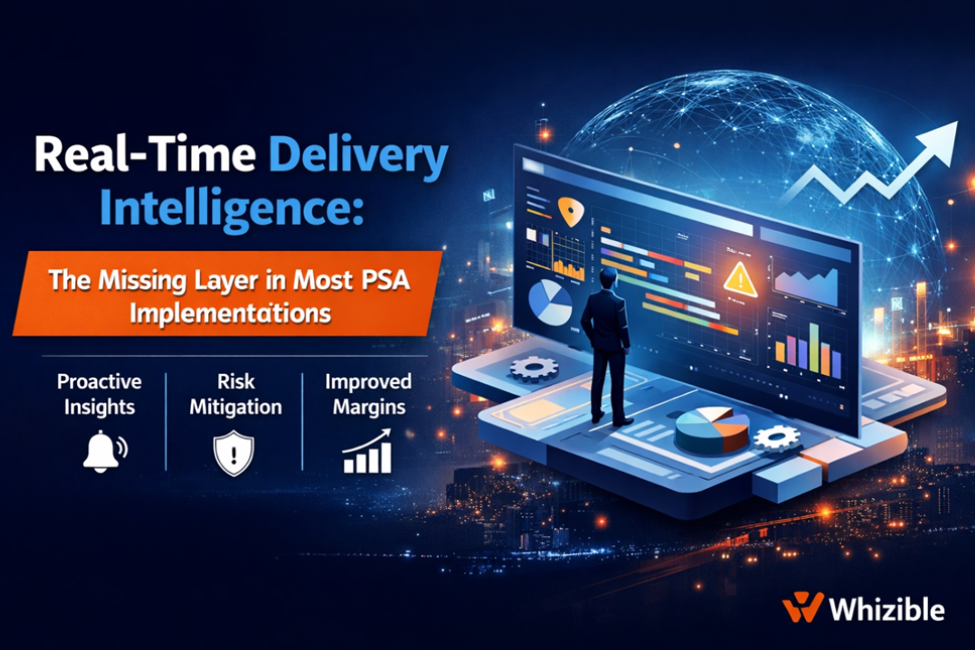
Real-time delivery intelligence is the capability to continuously monitor execution signals, interpret deviations and enable corrective action while delivery is still in motion. It connects project progress, resource behavior, financial performance and risk indicators into a unified, living intelligence layer.
Unlike static dashboards, delivery intelligence is contextual. It understands dependencies, predicts risk and highlights where leadership attention is needed right now. Instead of asking teams to analyze data, the system surfaces insights automatically making governance proactive instead of reactive.
The Hidden Cost of Operating Without Real-Time Intelligence
Organizations operating without delivery intelligence often believe they are in control because data exists somewhere in the system. In reality, the cost of delayed intelligence accumulates silently. Small delays compound into major overruns. Minor scope changes erode margins gradually. Resource fatigue builds unnoticed until attrition spikes.
Customer escalations rarely happen overnight. They are the result of early warning signals missed internal milestones, inconsistent effort burn, delayed approvals that go unnoticed in traditional PSA environments. By the time leadership reacts, trust is already damaged.
This is where real-time intelligence becomes a strategic necessity, not a nice-to-have.
Why Dashboards Are Not Enough
Dashboards are a visibility tool, not an intelligence layer. They assume users know what to look for and when. In high-pressure delivery environments, this assumption fails. Delivery teams are busy executing, not interpreting charts.
Real-time delivery intelligence works differently. It detects anomalies automatically. It understands relationships between delivery variables. It pushes insights into execution contexts instead of waiting for someone to pull a report. Without this shift, dashboards remain passive artifacts that rarely change outcomes.
The Resource Intelligence Gap in PSA
Utilization is one of the most tracked metrics in PSA systems and one of the most misunderstood. High utilization does not guarantee effective delivery. A fully booked resource can still deliver poor outcomes due to skill mismatch, burnout or constant context switching.
Real-time delivery intelligence connects utilization with capacity, skills, delivery risk, and financial impact. It highlights where intervention is required now, not where numbers looked bad last month. Platforms like Whizible unify resource intelligence with project and financial signals, allowing leadership to optimize outcomes instead of just occupancy.
👉 https://www.whizible.com
Financial Blind Spots Caused by Lagging Indicators
Project profitability rarely collapses in a single moment. It erodes slowly due to delayed approvals, scope creep, rework and inaccurate estimates. Traditional PSA financials operate retrospectively recognizing cost and revenue only after delivery milestones are crossed.
Real-time delivery intelligence links effort burn with milestone progress and revenue expectations continuously. It flags margin risk early and enables timely course correction. This transforms finance teams from scorekeepers into strategic partners.
Delivery Intelligence as a Governance Multiplier
Contrary to common belief, delivery intelligence reduces micromanagement. When systems surface objective, real-time signals, leaders no longer need frequent status meetings or manual follow-ups. Governance becomes lighter, faster and more precise.
Teams gain autonomy because risks are visible early and interventions are targeted. This is how modern PSA platforms evolve from control systems into execution enablement platforms.
Why Most PSA Tools Cannot Bolt on Delivery Intelligence
Delivery intelligence is not a feature, it is an architectural capability. Most legacy PSA tools were built for transactional efficiency, not continuous intelligence. Adding BI layers or custom dashboards does not solve the problem; it merely delays insight.
Platforms designed with intelligence at the core like Whizible treat execution data as a real-time stream. This allows them to correlate delivery, resources and finances dynamically, enabling action instead of post-mortem analysis.
👉 https://www.whizible.com
From Visibility to Foresight The Future of PSA
The future of PSA lies in foresight, not reporting. Organizations that succeed will be those that move beyond tracking work to understanding delivery dynamics in real time. Delivery intelligence becomes the nervous system of the organization constantly sensing, learning and adapting.
Industry leaders who have guided large-scale PSA and delivery transformations consistently emphasize this shift. Perspectives from practitioners like Vishwas Mahajan provide valuable insight into how execution intelligence changes delivery governance.
👉 https://www.linkedin.com/in/vishmahajan/
How Whizible Enables Real-Time Delivery Intelligence
Whizible unifies project execution, resource behavior, financial performance and governance into a single intelligence layer. Instead of fragmented modules, it delivers connected insights that reflect how delivery actually happens.
By embedding intelligence directly into workflows, Whizible enables early risk detection, proactive resource optimization, and margin protection without adding process overhead.
Learn how Whizible transforms PSA from a reporting system into an execution intelligence platform:
👉 https://www.whizible.com
Final CTA
Stop managing delivery in hindsight. Start steering it in real time.
If your PSA tells you what went wrong after it happened, it’s time to add the missing intelligence layer.
🔗 Explore real-time delivery intelligence with Whizible:
👉 https://www.whizible.com
👉 Book a Demo | 🌐 Visit Initiatives.app
📥 Learn more about features, benefits, and use cases at:
👉 www.initiatives.app
Contact Us : info@whizible.com | +91 855-498-3315
Address : Mrugank, Level 3, Kothrud, Pune, Maharashtra, 411038