
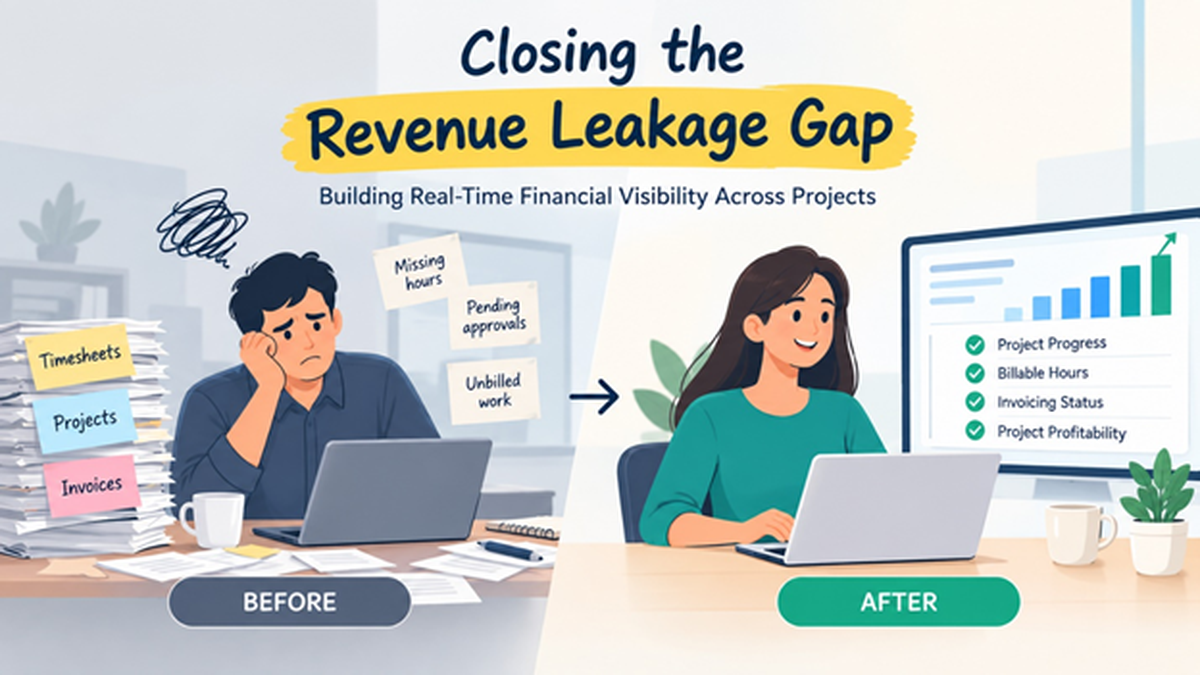
Revenue Leakage Is Rarely Caused by One Department
Timesheets may sit with employees and managers. Project progress sits with Delivery. Contracts sit with commercial teams. Invoices sit with Finance. Resource costs may come from HR or ERP systems.
Each function can perform its job correctly while revenue still leaks through the gaps between them.
That is why preventing unbilled work ultimately requires something broader than better invoicing.
It requires real-time project financial visibility.
The Problem: Finance Sees the Problem Too Late
Many organizations understand project profitability retrospectively.
At month-end, data is exported from multiple systems. Teams reconcile hours, costs, milestones, invoices and revenue. Variances are investigated. Explanations are requested from project managers.
The report may eventually be accurate.
But the opportunity to correct the underlying problem may already have passed.
A delayed invoice, excessive non-billable effort or uncontrolled scope expansion is far easier to address while the project is active than several weeks later.
The Solution: Create One Financial Story for Every Project
Project leaders and Finance need a common view that connects:
- Planned versus actual effort
- Billable versus non-billable hours
- Resource cost
- Project budget
- Change requests
- Billing milestones
- Invoiced amounts
- Revenue and margin trends
This does not mean everyone needs another dashboard.
It means the information used by Delivery, Resource Management and Finance needs to tell the same financial story.
Whizible’s project-management environment is built around integrated execution and real-time visibility into project performance, while its resource-management guidance also connects billability and utilization with project economics.
Move From Reconciliation to Exception Management
Traditional financial control asks Finance to reconcile everything.
Modern financial control should make exceptions visible automatically.
For example:
- A project has consumed substantially more effort than planned.
- A consultant has recorded significant client-facing time as non-billable.
- A milestone is complete but has not moved toward invoicing.
- A change request is being delivered before commercial approval.
- A large volume of billable effort remains unapproved close to billing cut-off.
These are not simply operational notifications. They are revenue-protection signals.
A connected PSA platform such as Whizible can help organizations bring project, resource, effort and financial information into a more unified operating model. This reduces dependence on manual reconciliation and helps leadership investigate financial exceptions earlier.
The New Question: What Revenue Is at Risk Right Now?
Historical profitability remains important.
But services organizations should increasingly be able to answer a forward-looking question:
Based on what is happening across active projects today, where is revenue or margin currently at risk?
That question changes project financial management from reporting into governance.
Instead of explaining last month’s leakage, organizations can identify today’s exposure.
It also brings Finance and Delivery closer together. Finance gains operational context behind financial variances, while project managers gain visibility into the financial consequences of everyday delivery decisions.
For further thinking on connected execution, governance and services-business performance, follow Vishwas Mahajan on LinkedIn.
From Unbilled Work to Revenue Intelligence
Across this four-part series, the pattern is clear.
Unbilled work starts with small operational gaps:
- Missing effort.
- Delayed approvals.
- Incorrect classifications.
- Uncontrolled scope.
- Disconnected financial information.
But the solution is not simply tighter administration. It is building an operating environment where every meaningful unit of project work can be connected to its commercial and financial outcome.
When that connection becomes visible continuously, revenue leakage stops being a month-end surprise.
It becomes something the organization can detect and manage.
Conclusion
Protecting project revenue requires more than accurate invoices.
It requires connecting the entire lifecycle from project planning and resource allocation to time capture, change control, billing and profitability.
The strongest financial governance therefore begins long before Finance creates an invoice.
It begins when the work is planned and continues until the revenue is realized.
FAQs
1. What Is Project Financial Visibility?
It is the ability to connect operational project information such as effort, utilization, costs and progress with billing, revenue and margin information.
2. Why Is Real-Time Visibility Important?
It allows teams to identify financial exceptions while projects are active rather than discovering them during retrospective month-end reporting.
3. Which Teams Should Own Revenue Leakage?
Revenue protection is cross-functional. Delivery, Finance, PMO, Resource Management and commercial teams all influence whether project work becomes profitable revenue.
4. What Information Should a Project Profitability Dashboard Include?
Useful indicators include planned versus actual effort, billable utilization, project costs, billing status, revenue, margin, change requests and financial variances.
5. How Does PSA Help Prevent Revenue Leakage?
PSA connects operational and financial project information, reducing manual handoffs and making exceptions such as missing billable effort, overruns or delayed billing easier to identify.