
The most expensive delivery problem is often not the one that leadership knows about.
It is the one that has been quietly developing for months.
By the time it appears in an executive review as a missed milestone, margin decline or customer escalation, several opportunities to intervene may already have passed.
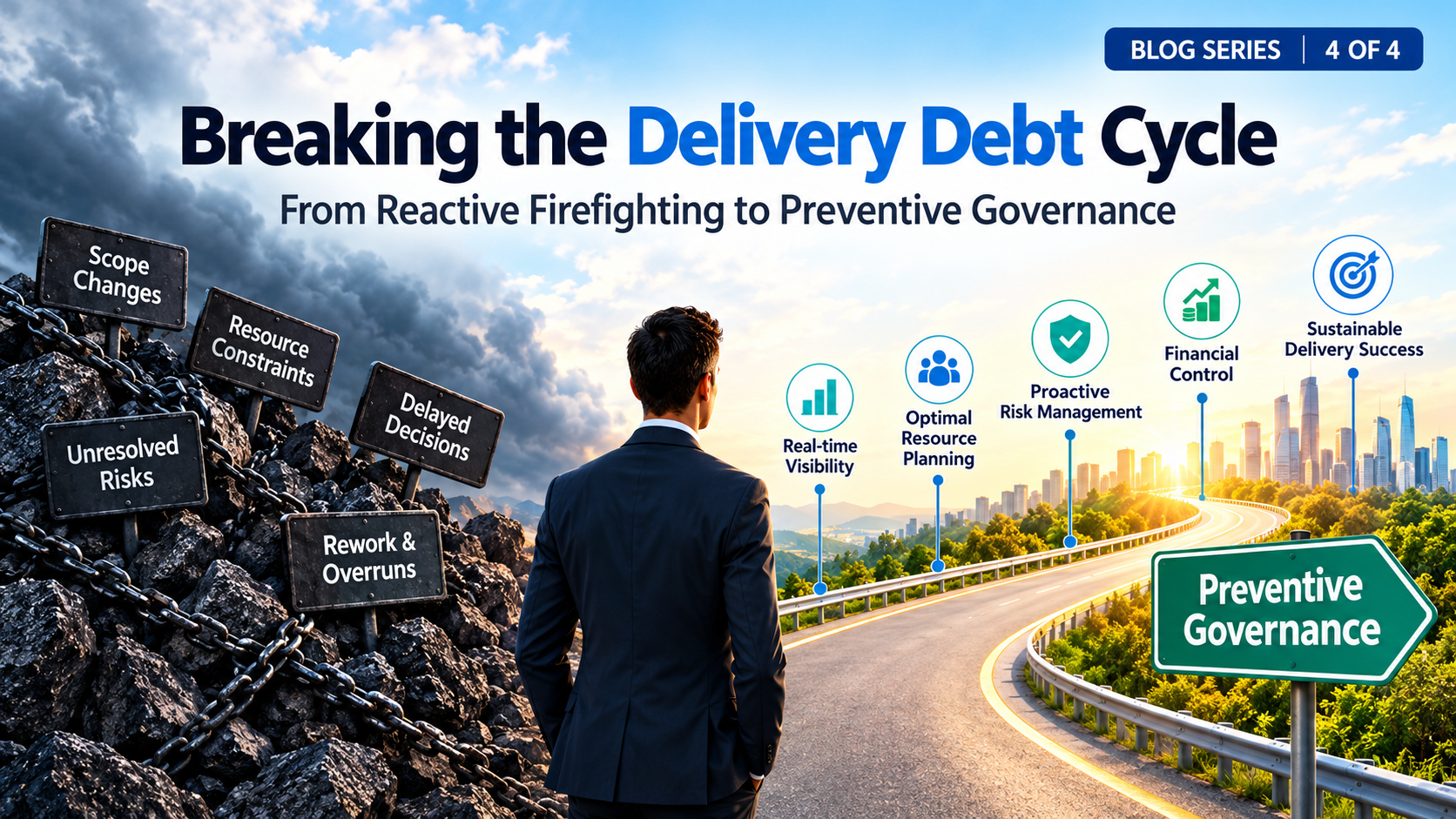
Preventing delivery debt therefore requires a different operating philosophy:
Do not wait for failure. Govern the signals that precede it.
The Problem: Traditional Reviews Are Often Backward-Looking
Many project reviews focus on what has already happened.
-
What was completed?
-
Which milestone slipped?
-
How much effort was consumed?
-
Which issue needs escalation?
Those questions are necessary, but insufficient.
Preventive governance asks another set of questions:
-
Which resources are becoming overloaded?
-
Which projects are repeatedly consuming more effort than planned?
-
Which unresolved risks are ageing?
-
Where are dependencies becoming vulnerable?
-
Which scope changes could affect future margins?
The difference is important: one model reports delivery debt after its consequences appear; the other attempts to identify its formation.
The Solution: Build an Early-Warning Delivery System
Preventing delivery debt requires information to move with execution.
1. Create One Connected Delivery View
Project progress, resources, timesheets, risks, issues, changes and financial information should be connected enough for leaders to understand cause and effect.
2. Govern Exceptions
Not every project needs executive attention.
Exceptions do.
A resource repeatedly operating beyond capacity, a milestone with growing effort variance, an unresolved high-impact risk or recurring unplanned scope should trigger attention before the project becomes critical.
3. Connect Capacity to Future Demand
Resource management should look forward, not simply report today’s utilization.
Whizible’s published resource-management guidance emphasizes availability forecasting and aligning skills and capacity with project demand, while its bench-management material discusses predictive visibility into capacity and upcoming requirements.
Whizible: Smarter Resource Allocation for IT Projects
4. Connect Delivery Health to Financial Health
A project can be on schedule and still become commercially unhealthy.
Leaders therefore need to evaluate effort, cost, billing, scope and profitability alongside conventional schedule indicators.
5. Make Governance Part of Everyday Execution
Governance should not depend entirely on another weekly spreadsheet.
The closer governance sits to everyday project activity, the earlier organizations can detect changes and act.
Whizible supports this connected approach through project and resource management, timesheets, risk management, financial controls, reporting and integrations including making timesheet access available through Microsoft Teams.
Whizible: Withdrawing Non-Performing Initiatives
Explore the Whizible platform and its connected project operations approach.
For broader perspectives on execution and governance, follow Dr. Vishwas Mahajan on LinkedIn.
From Paying Delivery Debt to Preventing It
Every organization will make project compromises.
The difference between resilient and reactive organizations is not whether compromises happen. It is whether those compromises remain visible, measurable and controlled.
A temporary workaround should remain temporary.
A risk should not disappear because a meeting ended.
An overloaded resource should not look productive simply because utilization is high.
And a green project should not be considered healthy if maintaining that status is quietly creating tomorrow’s problems.
That is the fundamental shift from managing project status to governing delivery health.
FAQs
What is preventive delivery governance?
It is an approach that uses current and forward-looking project, resource, risk and financial signals to intervene before problems become major delivery failures.
Does preventive governance require more reporting?
Ideally, no. The objective is to connect operational information and automate visibility rather than create additional manual reporting.
How can Whizible help reduce delivery debt?
Whizible connects project management, resource management, timesheets, risks, financial controls and management reporting so teams and leadership can identify execution deviations in a common operating environment.
Whizible: Withdrawing Non-Performing Initiatives
What should organizations track first?
Start with recurring scope changes, effort variance, resource over-allocation, ageing risks/issues, milestone slippage and project financial variance. Together, these can provide a useful early view of where delivery debt may be forming.