
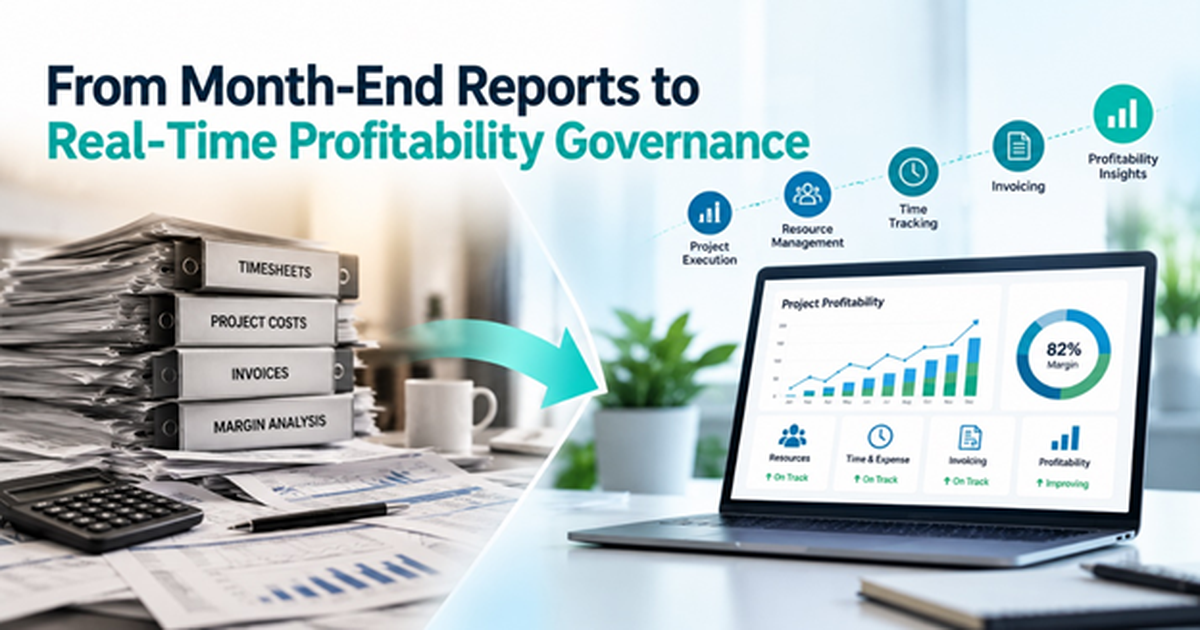
Month-end reporting answers an important question
“What happened to our project margin?”
Delivery leaders need another question answered much earlier:
“What is happening to our margin right now?”
That difference defines the transition from financial reporting to profitability governance.
The Problem: Retrospective Data Creates Reactive Decisions
Suppose a project was planned at a healthy margin.
During delivery, actual effort begins exceeding estimates. Resource costs increase. A milestone moves. Additional customer requests consume unplanned hours.
If these signals remain distributed across project tools, spreadsheets, timesheets and financial systems, leadership may not see their combined impact until the monthly profitability report arrives.
At that point, the report explains the problem.
It does not necessarily provide enough time to prevent it.
The Solution: Build a Connected Profitability View
Real-time profitability governance requires project execution and financial indicators to be viewed as parts of the same operating system.
Project progress tells leaders what is happening.
Resource data explains who is delivering it and at what capacity.
Timesheets show how much effort is actually being consumed.
Financial data reveals what that execution means for revenue, cost and margin.
Whizible describes its project environment around integrated execution and real-time visibility into project performance, while its PSA framework connects project planning, resource management, time tracking, invoicing and profitability monitoring. Whizible
Learn more at Whizible and explore leadership perspectives from Dr. Vishwas Mahajan.
Profitability Should Become an Early-Warning System
The real objective is not another dashboard.
It is creating an operating model where deteriorating profitability becomes visible early enough for someone to act.
When delivery, resource and financial information are connected, leadership can move from asking:
“Why did we lose margin?”
to:
“Where is margin beginning to move and what can we change now?”
That is when project profitability becomes more than a finance KPI.
It becomes a continuous delivery management metric.
FAQs
What is real-time project profitability?
It is the ability to evaluate current and forecast project economics using up-to-date delivery, effort, resource, revenue and cost information.
Why aren’t month-end reports enough?
They remain important for financial reporting, but delivery problems may have been developing for weeks before those reports are available.
Who should have visibility into profitability?
The appropriate level of visibility can extend across finance, delivery leadership, project management, resource management and executives, depending on governance and access controls.
What is the ultimate objective of profitability governance?
To detect financial risk while operational decisions can still influence the outcome, rather than explaining margin erosion after it has already occurred.
FAQs
What is continuous project forecasting?
It is the practice of updating forward-looking project expectations as underlying execution, resource and financial information changes.
How is profitability intelligence different from financial reporting?
Financial reporting primarily explains recorded performance. Profitability intelligence combines actual and forward-looking information to help teams understand where project economics may be heading.
Which data should be integrated?
Core inputs typically include project plans, allocations, availability, actual effort, timesheets, resource costs, budgets, revenue and billing information.
Does continuous forecasting eliminate monthly financial reviews?
No. It complements formal financial reviews by providing earlier operational signals between reporting cycles.
Series conclusion:
When project, resource and financial information operate as one connected data flow, forecasting becomes less about reconciling different versions of the past and more about seeing the financial consequences of today’s decisions before they become tomorrow’s results.