
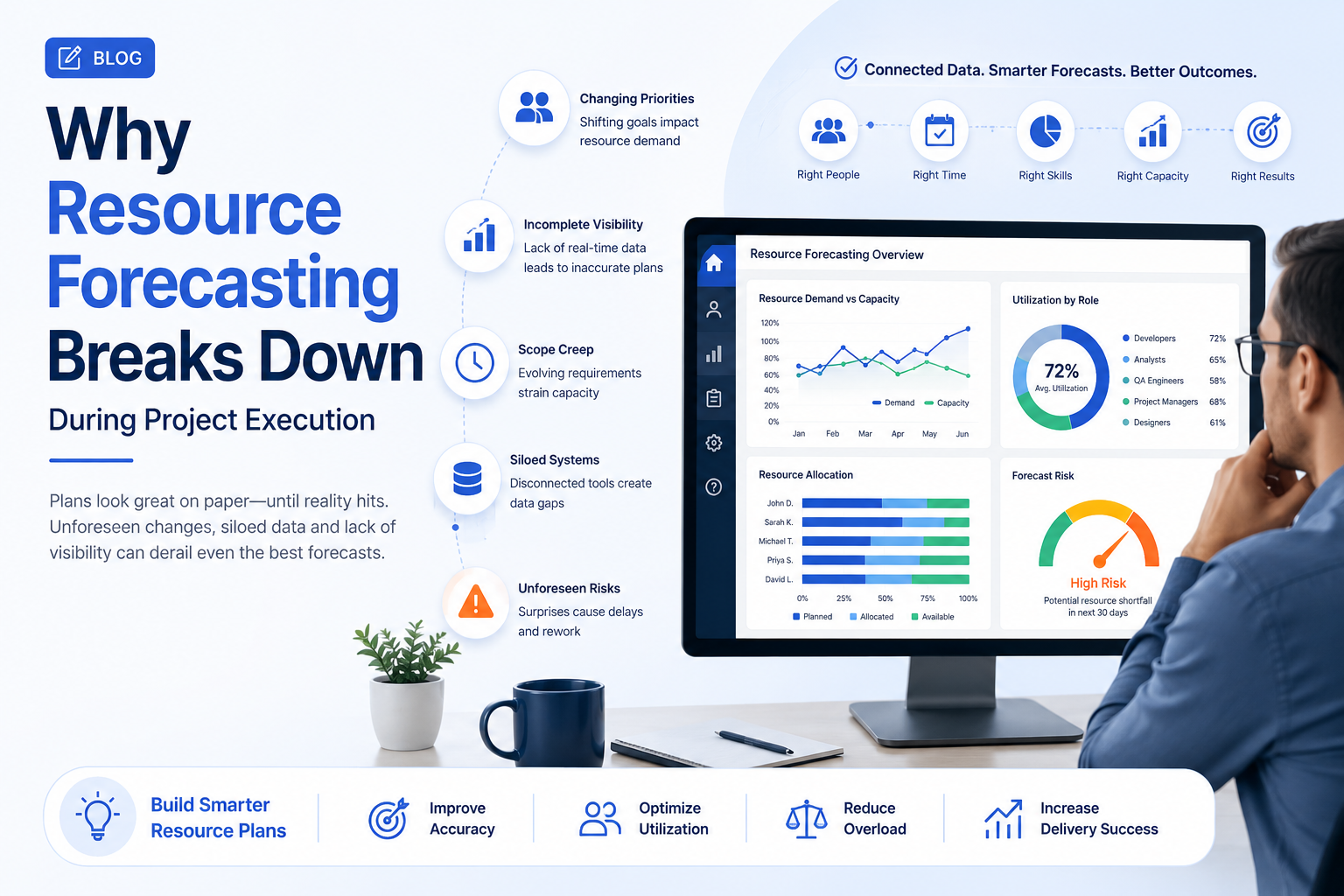
Most delivery leaders believe resource forecasting is primarily a staffing exercise.
In reality, it is an execution challenge.
Projects evolve every day. Scope changes, customer priorities shift, unexpected risks emerge, and delivery timelines move. However, resource plans often remain based on assumptions made weeks earlier.
The result is predictable.
Some teams become overloaded while others remain underutilized.
Bench resources remain hidden until the last moment, and hiring decisions become reactive instead of strategic.
The Problem
Disconnected planning creates multiple versions of resource availability.
Managers spend valuable time validating spreadsheets instead of making informed decisions.
Without continuous updates from project execution, forecasting becomes increasingly inaccurate as projects progress.
The Solution
Accurate resource forecasting requires continuous synchronization between:
- Project schedules
- Resource availability
- Skills inventory
- Timesheets
- Utilization
- Future demand
Instead of periodically rebuilding plans, organizations should allow forecasting to evolve automatically as delivery data changes.
Platforms like Whizible provide connected visibility that helps managers identify future capacity shortages before they become delivery risks.
Related reading:
https://www.whizible.com/resource-management/
Leadership perspective:
https://www.linkedin.com/in/vishmahajan/
Conclusion
Resource forecasting should never be a monthly planning exercise.
It should become a continuous operational capability driven by connected enterprise data.
FAQs
Why do utilization reports fail to predict capacity?
Because utilization measures the past, while forecasting requires visibility into future commitments.
How frequently should resource forecasts be updated?
Ideally, continuously as projects, allocations, and timesheets change.
Does connected data reduce bench time?
Yes. Better forecasting improves allocation decisions and reduces unnecessary idle capacity.
Which teams benefit most?
Professional services, IT services, engineering organizations, GCCs, consulting firms, and BFSI delivery organizations.