
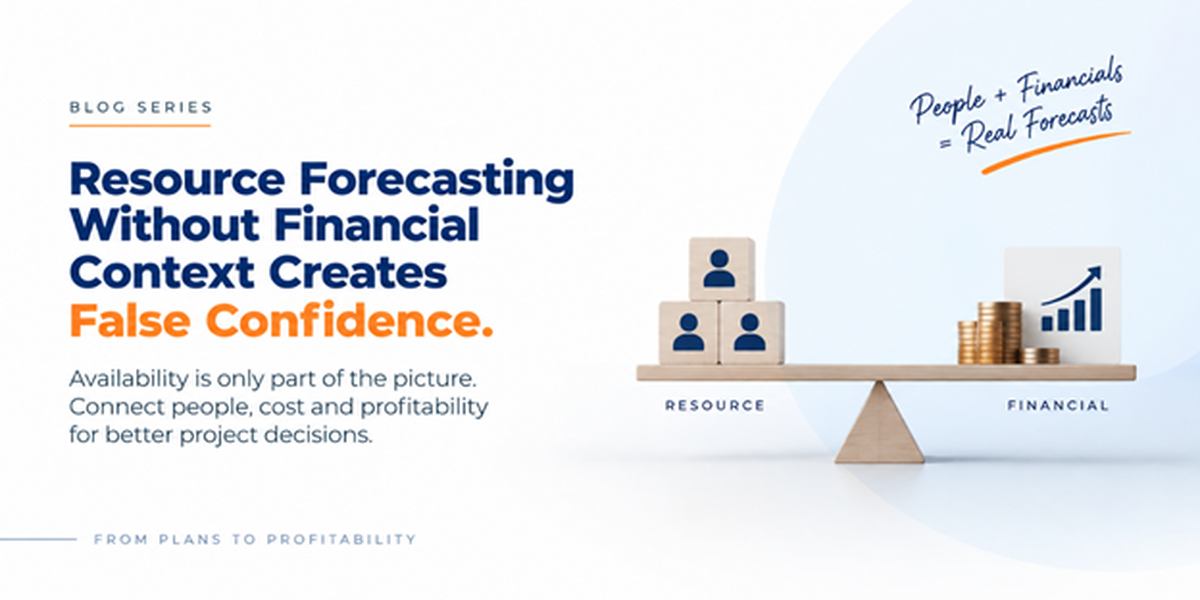
A resource plan can look perfect and still produce an unprofitable project.
This happens because traditional resource forecasting usually concentrates on three questions:
Who is available? What skills do they have? When can they join?
These are essential questions but they are not enough.
The Problem: Availability Is Not the Same as Viability
Imagine two resources are available for the same role.
Both have the required skills and both can join immediately. But one resource carries a significantly higher delivery cost.
From a capacity perspective, either allocation works.
From a profitability perspective, the choice may be very different.
The same issue occurs when a project repeatedly extends allocations. Resource management may simply update the end dates, while finance discovers weeks later that the additional effort has reduced the project’s expected margin.
Traditional resource allocation can also create problems when planning is fragmented between PMO, HR and finance, producing different views of workload, availability and billability.
The Missing Layer: Financially Aware Resource Planning
Resource forecasting becomes more valuable when allocation decisions can be understood alongside their commercial consequences.
That means connecting:
Demand + skills + availability + utilization + resource cost + billing/revenue + projected margin.
The objective is not simply to minimize resource cost. A more experienced resource may cost more but complete work faster or reduce delivery risk.
The real question is whether the proposed resource mix supports the project’s delivery and financial objectives.
Whizible’s resource management approach provides visibility into availability, workloads and utilization, while its broader PSA environment connects resource decisions with project and financial controls.
Explore Whizible’s project and resource management platform.
The Solution: Forecast Capacity and Economics Together.
A stronger forecasting model evaluates future capacity and future economics at the same time.
When a project requires another developer for eight weeks, leadership should be able to see not only whether that developer exists, but also what the allocation does to planned effort, cost and expected profitability.
This creates a much more useful conversation between delivery, resource management and finance.
Instead of Finance questioning resource decisions after the month closes, financial impact becomes part of the allocation decision itself.
That is how resource forecasting evolves from staffing administration into business intelligence.
Read more leadership perspectives from Vishwas Mahajan.
FAQs
Is high utilization always good for profitability?
No. Utilization must be considered alongside billability, resource cost, project pricing and delivery requirements.
What financial data should resource managers see?
Depending on governance and access controls, relevant indicators can include resource cost, project budget, billing assumptions and forecast margin.
Why connect resource planning with project financials?
Because every significant allocation decision changes the cost structure of project delivery.
Does integrated forecasting replace resource managers?
No. It gives resource managers better context for making allocation decisions.
Previous: Why Project Forecasts Fail When Resource and Financial Data Are Disconnected
Next: Why Project Margin Problems Appear Too Late in Traditional Forecasting.