
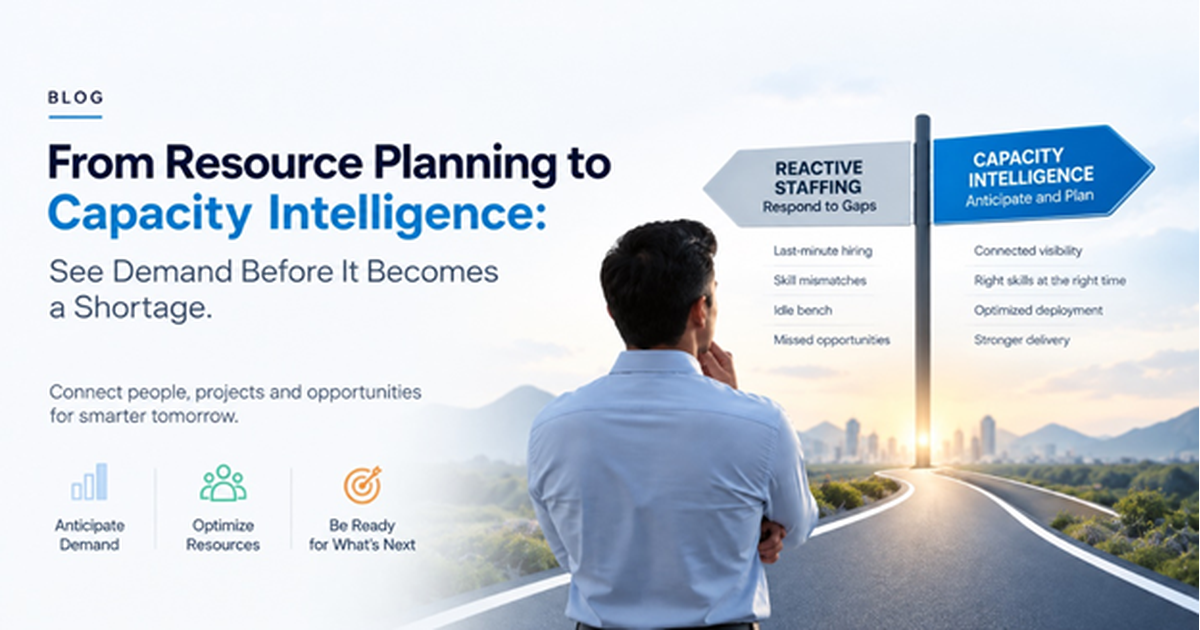
Traditional resource planning often begins when a project manager raises a staffing request.
“We need two developers.”
“We need a solution architect next month.”
“We need someone with this domain experience immediately.”
Resource managers search the available pool, contact business units and, when no suitable person can be found, send the requirement to recruitment.
The problem is not that this process cannot work.
The problem is that it starts after demand has already become urgent.
The Problem: Supply and Demand Live in Different Systems
In many organizations, sales has the pipeline. Project managers have delivery plans. HR maintains employee and skill information. Resource managers maintain allocation sheets. Finance tracks costs and billability.
Each function sees one piece of the resource equation.
Few see the complete picture.
As a result, organizations can simultaneously have employees approaching the bench and open recruitment requests for similar capabilities.
The issue is not necessarily a shortage of people.
It is a shortage of connected intelligence.
The Solution: Build a Capacity Intelligence Layer
Capacity intelligence brings workforce supply and business demand into the same planning view.
On the supply side, organizations need visibility into current allocation, future availability, skills, experience, location and planned project roll-offs.
On the demand side, they need confirmed projects, tentative requirements, pipeline opportunities, required roles, skill combinations and expected start dates.
When these dimensions are connected, resource management becomes predictive.
Suggested image placement: A “Capacity Intelligence Engine” visual with Resource Supply on the left, Project/Pipeline Demand on the right, and decisions such as Deploy, Upskill, Hire and Rebalance in the center.
Whizible’s PSA approach places forecasting, planning, scheduling and monitoring within resource management, creating the foundation for this connected view.
Explore: Whizible PSA Playbook
Better Capacity Decisions Start Earlier
Imagine an organization can see that six Java engineers will roll off projects within 30 days.
At the same time, the sales pipeline contains two opportunities requiring similar skills.
That insight creates several possible actions before anyone reaches the bench.
Resources can be tentatively mapped to demand. Skill gaps can be identified. Training can begin. Hiring requirements can be reduced or refined. Sales can understand whether the organization has the delivery capacity to support an expected start date.
Now consider the opposite situation.
The pipeline indicates strong demand for a specialized capability, while internal capacity forecasts show a shortage beginning in eight weeks.
Instead of discovering the problem after a deal closes, HR and delivery receive an early signal to hire, cross-skill or adjust deployment.
This is what makes capacity intelligence different from resource scheduling.
It creates decision time.
Move From “Available People” to “Available Capability”
Another important shift is to stop treating capacity purely as headcount.
Ten available employees do not equal ten useful resources for every project.
Capacity depends on the combination of skills, proficiency, domain experience, role, location, cost, availability and timing.
The better question is therefore not:
“How many people are available?”
It is:
“What capability will be available when the business needs it?”
Once organizations can answer that consistently, bench management, hiring, staffing and upskilling begin operating as parts of the same planning system.
For more perspectives on resource strategy and project execution, follow Vishwas Mahajan on LinkedIn.
FAQs
What is capacity intelligence?
Capacity intelligence is the use of connected workforce supply, skills, allocation and demand information to anticipate resource needs and support forward-looking decisions.
How is capacity planning different from resource allocation?
Allocation decides who works on specific work. Capacity planning looks ahead to determine whether sufficient capability will exist to meet expected demand.
Can pipeline data be used in resource planning?
Yes. Probability-adjusted or tentative demand can provide an early indication of future capacity requirements without treating every opportunity as confirmed work.
How does capacity intelligence reduce unnecessary hiring?
It can reveal internal resources becoming available, allowing organizations to evaluate redeployment or upskilling before recruiting externally.
Next in the series: Blog 4 – From Capacity Intelligence to Profitability: Connecting Resource Decisions With Business Outcomes.