
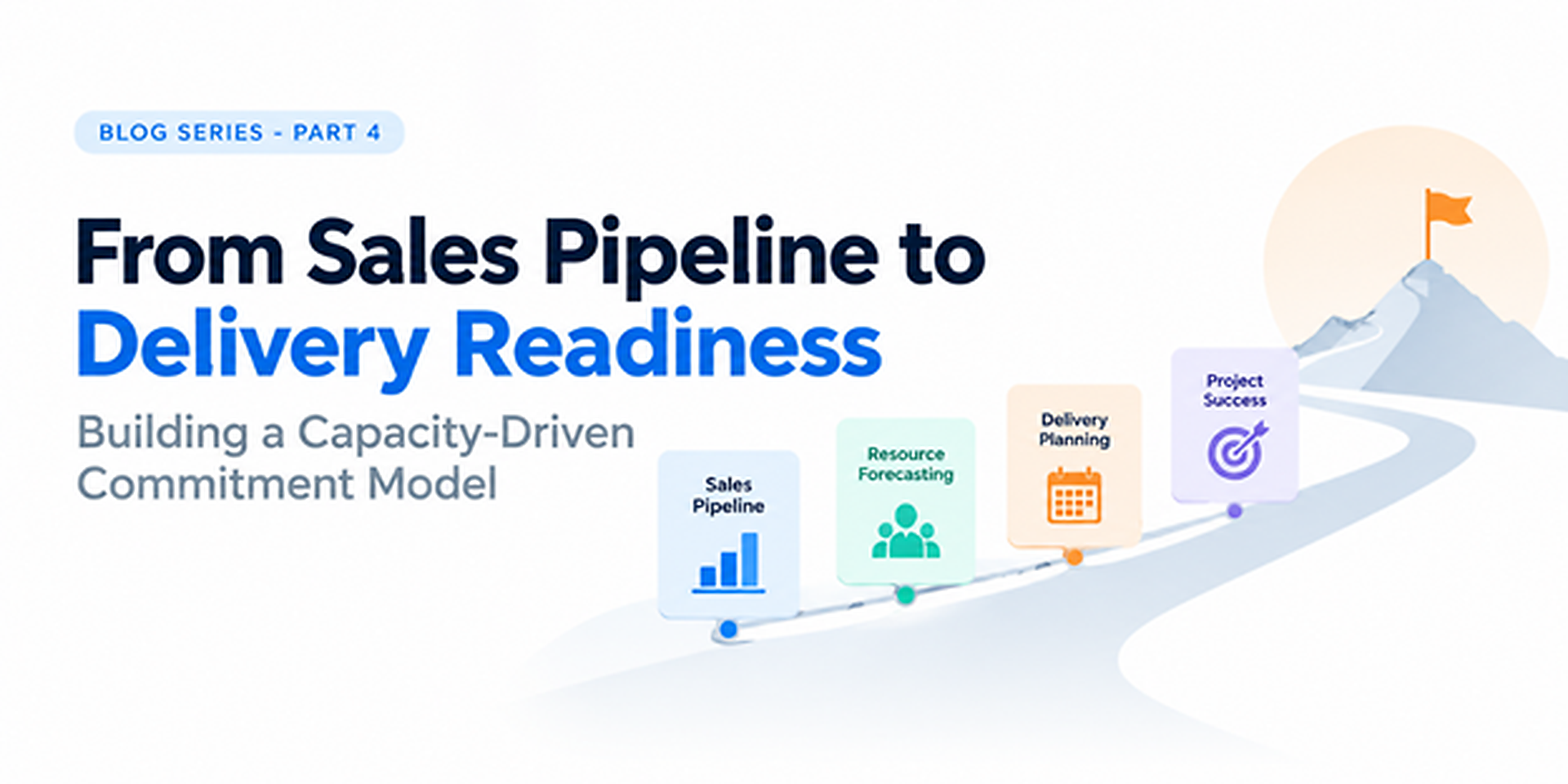
Most organizations invest significant effort in forecasting sales revenue. Opportunities are tracked, deal probabilities are reviewed, and future bookings are estimated.
Yet one critical question often receives less attention:
If these opportunities convert into projects, will the organization have the capacity to deliver them?
For project-driven enterprises, revenue forecasting without corresponding resource forecasting creates operational uncertainty.
A strong sales pipeline may indicate future business growth, but unless delivery teams understand the resource demand behind that pipeline, the same growth can create capacity shortages, delayed execution, and pressure on profitability.
The solution is to move from reactive staffing toward a capacity-driven commitment model.
The Problem: Sales Forecasts and Resource Plans Operate Separately
In many organizations, CRM systems track potential revenue while resource management teams plan staffing based primarily on confirmed projects.
This creates a timing gap.
By the time a project is officially handed over to delivery, resource managers may have limited time to secure suitable employees. Hiring decisions become urgent, specialists are reassigned, and project start dates become difficult to maintain.
The underlying problem is not necessarily a lack of forecasting. It is the absence of a connected view between commercial demand and operational capacity.
The Solution: Build Capacity Intelligence Into Commercial Planning
A capacity-driven commitment model allows organizations to consider potential project demand before contracts are finalized.
Sales opportunities can be translated into expected resource requirements based on probability, estimated start dates, required skills, and project duration.
Resource managers can then compare potential demand with existing allocations and forecasted availability.
This helps organizations identify whether upcoming opportunities can be supported through existing capacity, internal redeployment, hiring, or adjusted delivery timelines.
Four Steps Toward Capacity-Driven Delivery Planning
-
Translate pipeline into demand: Estimate roles, skills, effort, and start dates for major sales opportunities.
-
Validate future capacity: Compare projected demand with employee availability, existing allocations, and expected project roll-offs.
-
Evaluate delivery scenarios: Identify the impact of multiple deals closing simultaneously and determine staffing alternatives.
-
Connect execution with financial governance: Once opportunities become projects, monitor actual effort, resource costs, and profitability against the original plan.
These steps create a stronger connection between revenue expectations and the organization’s ability to fulfill them.
How Whizible Supports Connected Planning
Whizible provides resource management, project planning, and financial governance capabilities that can support this operating model.
Its integrated approach enables organizations to manage resource availability, project demand, utilization, and delivery performance with greater consistency.
Where CRM information is integrated with the appropriate planning workflows, organizations can extend this visibility toward pipeline-driven resource forecasting.
Whizible’s discussion of strategic bench management also highlights the importance of anticipating future resource demand and preparing available talent for upcoming assignments.
Conclusion: The Best Commitment Is One Backed by Capacity
Sustainable growth requires more than a strong sales pipeline.
It requires confidence that the organization can convert commercial opportunities into successful, profitable delivery.
By connecting demand forecasting, resource planning, project execution, and financial visibility, enterprises can reduce uncertainty and make more informed commitments.
Explore how Whizible supports connected project and resource management: www.whizible.com.
For leadership perspectives on execution, governance, and operational visibility, connect with Dr. Vishwas Mahajan.
Frequently Asked Questions
Q1. What is capacity-driven project planning?
It is an approach that aligns expected project demand with available skills, resources, and delivery timelines before commitments are finalized.
Q2. Why should sales pipeline data influence resource planning?
Pipeline information provides early signals of potential resource demand, allowing organizations to prepare for upcoming projects rather than reacting after contracts are signed.
Q3. How can organizations improve sales-to-delivery alignment?
By establishing shared forecasting processes, validating critical resource requirements, and connecting commercial, delivery, and financial information.
Q4. How does integrated project management support profitable growth?
It helps organizations make better allocation decisions, monitor project costs, identify delivery risks, and improve the predictability of project outcomes.