

Scaling an IT services organization is deceptively complex. Revenue growth creates optimism, expanded client portfolios signal success, and headcount growth feels like progress. Yet behind that expansion, something far more fragile begins to take shape operational complexity. Processes that once worked effortlessly start to strain. Leadership reviews become longer. Forecasts begin to fluctuate. Escalations increase despite strong sales momentum. What was once clarity slowly turns into controlled confusion.
The real challenge of scaling is not growth. It is governance.
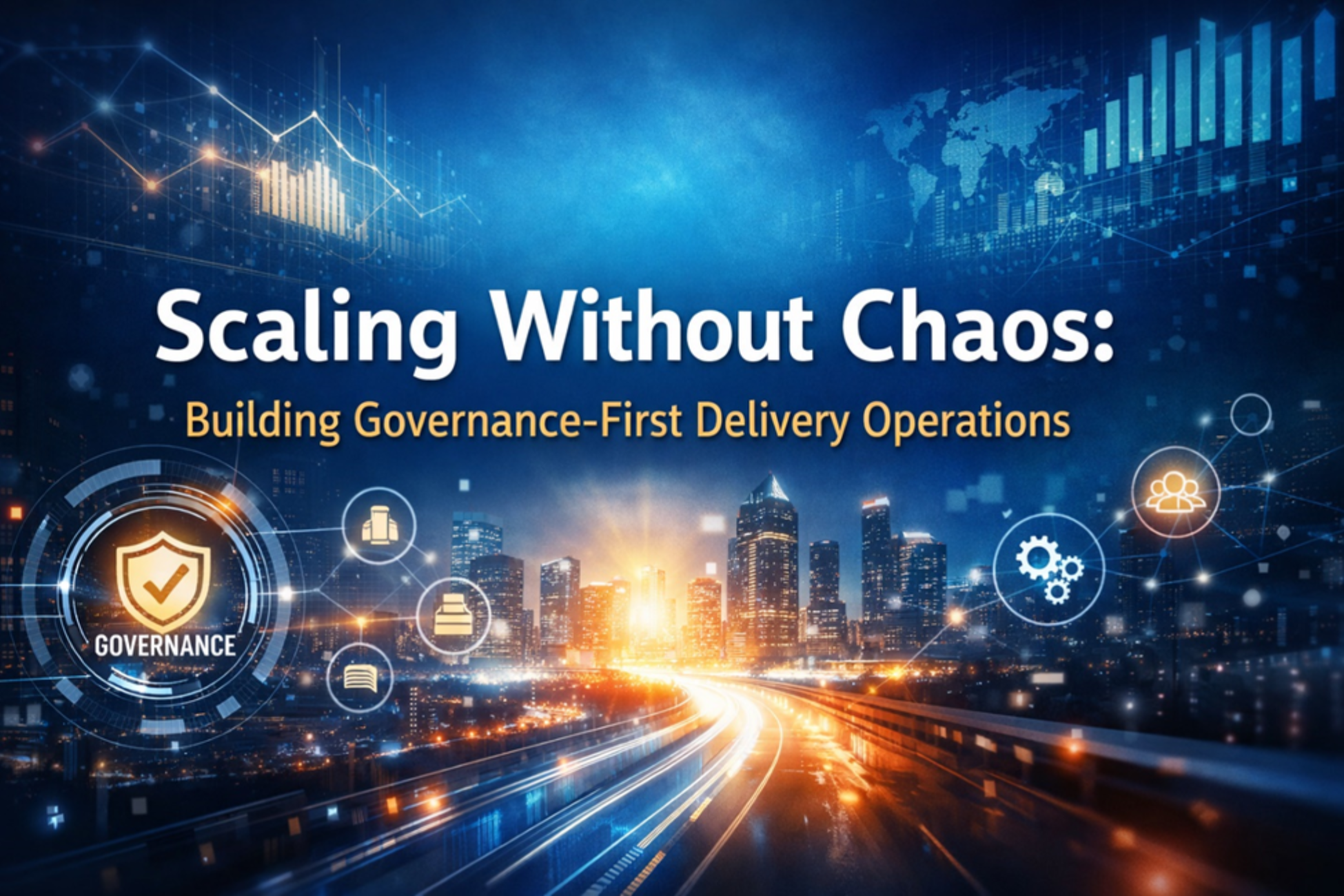
Organizations that scale successfully do not merely add people, projects, and revenue streams. They elevate their operating maturity. They transition from personality-driven execution to system-driven governance. Without this shift, growth becomes chaotic and chaos, at scale, becomes expensive.
This is why governance-first delivery operations are no longer optional. They are foundational.
The Early Warning Signs of Scaling Chaos
The Problem – Operational Complexity Outpacing Control
In the early stages of growth, delivery operations rely heavily on coordination and communication. Teams know each other. Project visibility is informal but manageable. Financial tracking is periodic but sufficient. Leadership is close enough to execution to intervene quickly.
However, as the organization grows across clients, geographies, vendors, and hybrid models, that informal coordination breaks down. Project data lives in one tool, resource plans in another, financial reports in a third, and performance analytics somewhere else entirely. Leadership begins to rely on aggregated reports that summarize outcomes but fail to expose emerging risks. Forecast accuracy begins to slip but the deviation is often noticed only after financial quarters close.
The issue is not incompetence. It is structural fragmentation.
Scaling amplifies every weakness in the operating model. A small margin miscalculation becomes a significant financial gap across dozens of projects. A minor resource mismatch multiplies across portfolios. An ungoverned change request in one account turns into recurring revenue leakage across many.
Chaos is rarely sudden. It accumulates.
The Solution – Governance Embedded in Execution
A governance-first delivery model addresses this at the architectural level. Instead of relying on periodic oversight, governance becomes embedded within daily workflows. Project health, financial exposure, utilization intelligence, and change impacts are not reviewed quarterly they are visible in real time.
This means that operational intelligence is not separate from execution. It is integrated into it. Delivery leaders see margin trends while projects are still active. Resource managers see skill shortages before staffing becomes urgent. Finance teams monitor realized rates as execution progresses, not after invoicing disputes arise.
When governance is embedded, complexity does not disappear but it becomes manageable.
To understand how governance intelligence replaces dashboard overload with decision clarity, explore:
To see how unified delivery control enables structured scale, visit:
https://www.whizible.com/
For strategic leadership insights on operational excellence:
https://www.linkedin.com/in/vishmahajan/
Resource Expansion Without Resource Intelligence
The Problem – Headcount Growth Without Strategic Alignment
One of the most dangerous assumptions in scaling organizations is that increasing headcount automatically increases capacity. In reality, unmanaged expansion often creates imbalance. Certain skills become oversupplied while critical capabilities remain scarce. Bench size grows in pockets while delivery teams struggle elsewhere. High performers are overloaded, while others remain underutilized.
This imbalance rarely shows up immediately in revenue. It manifests gradually declining realized rates, increased attrition, reactive hiring and margin compression in T&M engagements. When resource planning is disconnected from demand forecasting, staffing decisions become reactive rather than predictive.
As the organization grows, this disconnect widens.
Without structured resource governance, scaling becomes a cycle of overcorrection hiring surges followed by cost containment, skill shortages followed by rushed onboarding, utilization spikes followed by burnout.
The Solution – Predictive Resource Governance
Governance-first delivery introduces a strategic resource intelligence layer. Instead of viewing utilization purely as a cost metric, it becomes a revenue and risk indicator. Instead of allocating based on availability alone, decisions are driven by skill alignment, future demand forecasts, and financial impact.
This shift transforms resource management from administrative scheduling to strategic portfolio planning. Leaders gain visibility into projected billability across roles. Skill gaps are identified months ahead. Hiring becomes proactive rather than reactive. Bench becomes an asset not a burden.
The result is not just higher utilization. It is stable, predictable and margin-aligned deployment.
To explore why resource intelligence is missing in most PSA implementations:
https://www.whizible.com/why-resource-intelligence-missing-in-psa/
The Silent Financial Drift in Growing Portfolios
The Problem – Revenue Growth Masking Margin Erosion
As organizations scale, top-line performance often improves. However, profitability does not always follow the same trajectory. Margin erosion creeps in silently. Underreported time, excessive discounting, uncontrolled change requests and misaligned realized rates begin to distort project economics.
Finance teams typically view performance at a consolidated level. By the time underperformance is visible in aggregate reporting, the root causes are buried within execution details. Delivery teams focus on milestones and timelines, often unaware of the financial leakage occurring beneath the surface.
Scaling amplifies this disconnect. A small deviation across many projects becomes a significant financial gap.
The Solution – Projectized Financial Governance
A governance-first operating model integrates financial metrics directly into delivery workflows. Real-time project P&L tracking ensures that deviations are identified early. Realized versus planned rates are continuously monitored. Change requests are evaluated not only for scope impact but for margin effect.
This alignment creates financial awareness at the delivery layer. Project managers understand not just timelines, but profitability. Resource decisions are evaluated through cost lenses. Portfolio leaders can see which accounts strengthen EBITDA and which require corrective action.
Scaling then becomes financially disciplined growth rather than revenue expansion at any cost.
For insights on plugging revenue leakage:
https://www.whizible.com/revenue-leakage-is-silent-but-deadly-how-whizible-helps-you-plug-every-gap/
To understand how analytics protect profit margins:
https://www.whizible.com/future-trends-in-psa-and-whizible-next/
Change Request Chaos in Expanding Accounts
The Problem – Informal Change Governance
Growth inevitably increases scope variability. Clients evolve. Requirements shift. Competitive pressures alter priorities. Without structured governance, change requests are approved informally, executed operationally and invoiced inconsistently.
Over time, this creates revenue leakage, billing disputes and delivery strain. More critically, it erodes credibility. Clients perceive inconsistency. Internal teams feel pressure to absorb unaccounted work. Financial visibility deteriorates.
Scaling magnifies this issue because the volume of changes increases with portfolio size.
The Solution – Financially Structured Change Governance
Governance-first delivery ensures that every change request is evaluated against financial impact, resource allocation shifts, and margin implications before execution begins. Approval workflows are structured. Cost adjustments are visible immediately. Forecasts are updated dynamically.
This transforms change management from reactive accommodation to strategic revenue governance.
To explore how structured CR governance protects profitability:
https://www.whizible.com/change-request-chaos-project-profitability/
Leadership Fatigue and the Micromanagement Trap
The Problem – Oversight Replacing Strategy
As delivery operations expand, CXOs often find themselves pulled into operational reviews more frequently. Escalations increase. Review meetings grow longer. Decision cycles slow. Leaders compensate by increasing oversight.
However, oversight does not scale. Micromanagement creates dependency rather than resilience.
When governance maturity is low, leadership intervention becomes the control mechanism. But this approach collapses under scale.
The Solution – Governance as Structured Autonomy
Governance-first operations enable leaders to define thresholds, risk parameters and financial guardrails. Systems surface deviations automatically. Decision triggers replace manual scrutiny.
This creates structured autonomy. Teams operate independently within defined boundaries. Leaders focus on strategy rather than firefighting. Scaling becomes disciplined expansion rather than executive exhaustion.
For deeper insight into eliminating delivery surprises:
https://www.whizible.com/real-time-delivery-governance-eliminate-surprises/
Governance-First Delivery as Strategic Differentiator
Organizations that scale without governance accumulate complexity. Organizations that scale with governance build capability.
Governance-first delivery operations create predictability in forecasting, transparency in margins, stability in resource deployment and confidence in leadership reporting. They transform delivery from operational coordination into execution intelligence.
Growth without governance is volatility. Growth with governance is competitive advantage.
To explore how unified PSA platforms enable structured scaling:
https://www.whizible.com/unified-psa-platform-single-version-of-truth/
Conclusion: Scaling Is an Operating System Decision
Scaling without chaos is not about better meetings or stronger supervision. It is about elevating the operating model. Governance-first delivery operations ensure that growth strengthens the organization rather than destabilizes it.
They align execution with financial intelligence. They integrate resource planning with demand forecasting. They convert dashboards into decision engines. They transform complexity into structured visibility.
In high-growth IT services firms, governance maturity defines scaling success.
To understand how governance-first execution can be embedded across your delivery ecosystem:
https://www.whizible.com/
For leadership conversations around operational intelligence:
https://www.linkedin.com/in/vishmahajan/
👉 Book a Demo | 🌐 Visit Initiatives.app
📥 Learn more about features, benefits, and use cases at:
👉 www.initiatives.app
Contact Us : info@whizible.com | +91 855-498-3315
Address : Mrugank, Level 3, Kothrud, Pune, Maharashtra, 411038