
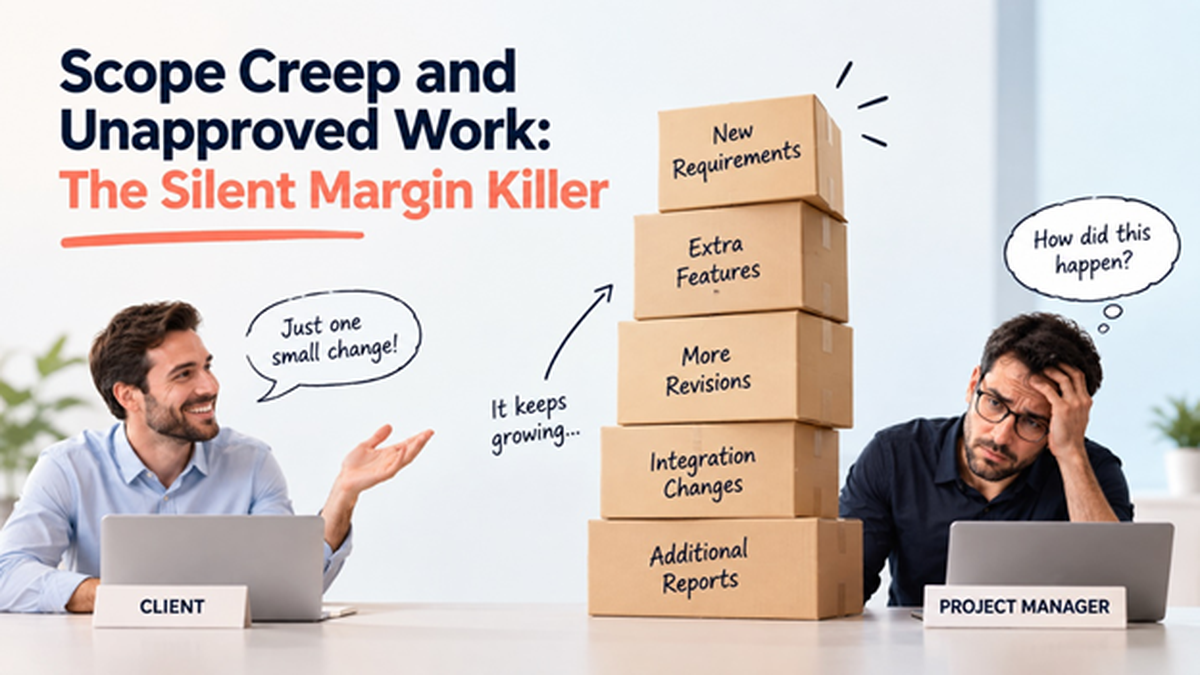
A client asks for “one small change.”
The delivery team agrees because the request appears minor. Then comes another adjustment, an additional report, an integration change and several rounds of revisions.
Each request seems manageable independently.
Collectively, however, they can turn a profitable project into a margin problem.
The Problem: Delivery Expands but Commercial Scope Does Not.
Scope creep becomes financially dangerous when additional work is performed without corresponding changes to project revenue.
The organization pays for every additional hour of delivery. But unless that effort is covered by the original agreement or an approved change request, the client may never be billed for it.
This is especially risky in fixed-price engagements because the provider absorbs additional delivery costs unless commercial terms are adjusted. Whizible’s analysis of fixed-price contract profitability identifies scope creep, cost overruns and resource misallocation among the key threats to margins in such projects.
Why Unapproved Work Remains Invisible
The problem often begins with good intentions.
Delivery teams prioritize client satisfaction. Small requests are accepted to keep momentum. Commercial approval is considered unnecessary for minor changes.
But when project scope, actual effort and financial data are reviewed separately, leadership cannot easily see how much free work is accumulating.
By the time the margin variance becomes visible, much of that work has already been delivered.
The Solution: Connect Change Control With Effort and Financial Impact.
Change management should not become bureaucracy. It should provide enough visibility to answer one question before additional work proceeds:
What will this change do to effort, cost, timeline and revenue?
A strong process should connect each meaningful scope change with its expected delivery effort and commercial treatment.
This creates a traceable chain:
Request → Impact assessment → Approval → Revised scope/budget → Delivery → Billing
With a connected project management environment such as Whizible, organizations can bring project execution and financial information closer together, giving project leaders greater visibility into effort variance and project performance.
Turn Effort Variance Into an Early Warning
Actual effort exceeding planned effort should not merely appear as a historical report.
It should trigger investigation.
Is the team taking longer than expected? Has project complexity increased? Is additional client work being performed? Is the work billable? Does a change request need to be raised?
This turns effort variance into an early-warning mechanism for revenue leakage.
For leadership, the objective is not to reject every additional client request. It is to ensure that delivery decisions and commercial decisions remain connected.
Perspectives on this broader connection between execution and business outcomes are also shared by Vishwas Mahajan on LinkedIn.
Conclusion
Scope creep becomes expensive when organizations cannot see it while it is happening.
Strong change control does not slow delivery. Done correctly, it protects both client relationships and project economics by making the financial consequences of additional work visible before margins disappear.
Next in the series: Closing the Revenue Leakage Gap: Building Real-Time Financial Visibility Across Projects.
FAQs
-
What is scope creep?
Scope creep occurs when project requirements or deliverables expand beyond the originally agreed scope without corresponding adjustments.
-
Why does scope creep reduce margins?
Additional work increases delivery cost. If the organization cannot charge additional revenue for that work, the extra cost directly reduces margin.
-
Should every small client request require a change request?
Not necessarily. Organizations should define thresholds and governance rules, but meaningful changes affecting effort, cost or timelines should be assessed.
-
How can project data identify scope creep early?
Comparing planned and actual effort, monitoring task additions and connecting change requests with financial information can reveal emerging scope expansion.
Explore Whizible to see how connected project visibility can help teams identify margin risks earlier.