
Every project begins with optimism milestones planned, teams mobilized, goals clearly articulated. Yet, despite the best intentions, more than 70% of IT projects either fail or don’t deliver on their original promise.
But here’s the uncomfortable truth: projects don’t fail overnight. They deteriorate slowly, giving off subtle yet visible signals long before the final collapse.
In this blog, we break down the anatomy of a failed project, dissecting early warning signs and exploring how real-time project intelligence can prevent small cracks from becoming delivery disasters.
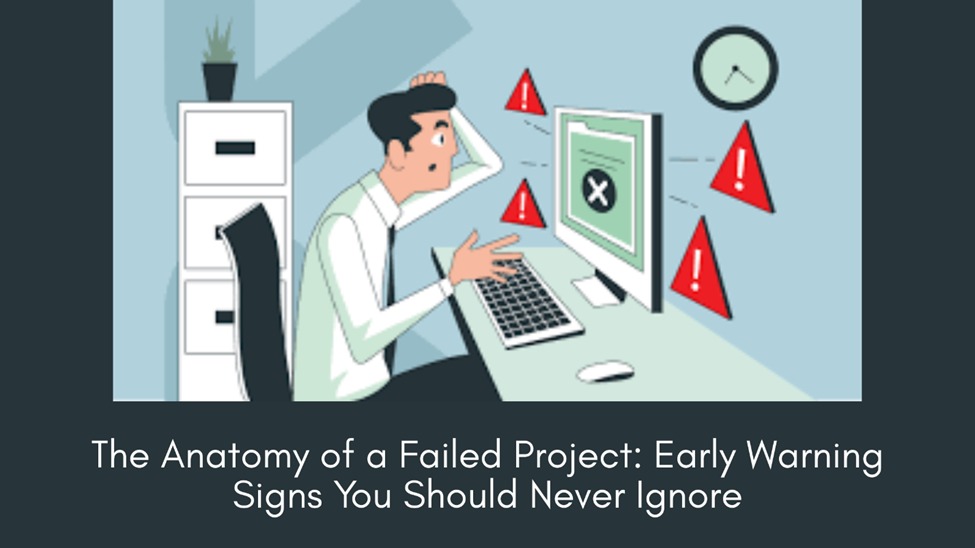
Why Projects Fail: The Real Root Cause
Failed projects are rarely the result of a single catastrophic error. Most derailments occur due to:
- Misaligned expectations
- Lack of visibility
- Resource bottlenecks
- Scope creep
- Leadership blind spots
According to PMI’s Pulse of the Profession, lack of clearly defined goals and poor communication are the top reasons for failure.
Yet all of these problems are detectable if you’re looking closely.
This brings us to the core question:
What are the earliest signals that your project is about to go off the rails?
Let’s explore them.
11 Early Warning Signs You Should Never Ignore
1. Inconsistent or Delayed Status Updates
If project teams are not updating status consistently or are always late in doing so—it’s a red flag. This usually means one of two things:
- They don’t have clarity on actual progress
- They’re firefighting and deprioritizing reporting
⛳ How to fix: Automate status reporting and integrate it into daily workflows using a delivery governance platform like Whizible.
2. Low Resource Engagement
If developers, analysts, or QA engineers are attending meetings but not contributing, it may indicate:
- Misalignment with goals
- Poor role clarity
- Overlapping or unclear responsibilities
? This is often a precursor to disengagement, which leads to reduced velocity and quality.
Whizible’s Smart Resource Allocation engine enables skill-based tagging, utilization heatmaps, and proactive resource balancing.
Explore Resource Management →
3. Tasks Keep Getting Pushed to the Next Sprint
A recurring backlog, where the same tasks keep rolling over to the next sprint, indicates either:
- Unrealistic planning
- Team capacity miscalculations
- Lack of clarity or prioritization
This habit of rollover work quickly spirals into missed milestones, especially in fixed-bid or time-bound projects.
? Use data-driven effort estimation and real-time sprint velocity tracking to catch this early.
4. Vague or Shifting Requirements
When stakeholders keep modifying scope mid-execution or can’t define it clearly upfront, you’re dealing with a moving target.
Scope creep is not just a delivery risk—it’s a commercial risk in services firms. It drains effort without corresponding billing.
Solution: Implement Change Request Management and versioned scope tracking using platforms like Whizible to ensure commercial traceability.
5. Incomplete or Inaccurate Timesheets
Timesheets are often treated as a compliance task. But in reality, they’re your most reliable cost control and effort tracking mechanism.
If timesheets are missing, filled inconsistently, or don’t match actual work done, you’re flying blind.
With Whizible’s timesheet module, you can connect time logs with tasks, cost, and billing ensuring effort visibility across delivery.
See Whizible Timesheet in Action →
6. Frequent Ad Hoc Communication
If most updates are happening in side chats or unstructured meetings, it’s a sign that formal processes aren’t being followed.
Slack messages, emails, and Zoom calls are great for collaboration but terrible for audit trails.
Bring structured updates inside Microsoft Teams with Whizible’s MS Teams Integration.
7. Low Morale or Frustrated Stakeholders
When project members or stakeholders begin showing signs of frustration missed meetings, lack of responsiveness, passive-aggressive comments, it often means:
- Expectations aren’t being met
- Project reality is far from what was promised
- Communication gaps are widening
These are soft signs, but highly predictive of hard failure later on.
Use regular sentiment analysis, check-in surveys, and real-time dashboards to stay ahead.
8. Budget Deviations Without Explanation
If your actuals are exceeding estimates but no one can pinpoint where the leak is, your financial governance is broken.
This often leads to revenue leakage, client dissatisfaction, and margin erosion.
Whizible’s integrated Project Financials module maps effort-to-cost-to-invoice, so every deviation is traceable.
Read : From Hours Lost to Hours Billed
9. No View of Risks Until They Escalate
By the time risks are escalated to leadership, it’s often too late. The key is not just risk identification but early detection.
Examples include:
- Dependency delays
- Overlapping resource schedules
- Overcommitted team leads
Set up risk watchlists and dependency maps within your delivery dashboard.
10. KPIs Aren’t Being Tracked Consistently
If key delivery metrics like burn rate, velocity, planned vs. actual effort, or earned value are not being monitored in real-time, you’re driving blind.
Project management becomes reactive instead of proactive.
Whizible’s Project Performance Cockpit offers:
- Real-time KPI tracking
- Drill-down dashboards
- Predictive analytics
Read – See Real-Time Governance in Action
11. Silence from the Customer
When customers stop asking questions, attending reviews, or giving feedback, don’t mistake it for satisfaction.
Often, this means:
- They’ve lost confidence
- They’re exploring alternatives
- You’re not on their priority list anymore
This is the most dangerous sign because by the time they complain, it’s usually terminal.
? Keep customers engaged with milestone reviews, transparent progress dashboards, and shared risk logs.
The Whizible Approach to Project Failure Prevention
Whizible’s integrated PSA platform is built to detect and address failure signals before they snowball. Here’s how:
|
Risk Signal |
Whizible Feature |
Preventive Action |
|
Incomplete updates |
Smart Alerts |
Automated nudges for missing reports |
|
Scope creep |
Change Log Tracker |
Formalized scope approvals |
|
Effort slippage |
Timesheet-AI Sync |
Compare planned vs. actual |
|
Resource issues |
Utilization Monitor |
Detect overload or underuse early |
|
Budget overruns |
Effort-Cost-Billing Link |
Cost leak visibility |
|
Executive blind spots |
CXO Dashboards |
Portfolio-wide risk visibility |
From Firefighting to Forecasting: Building Predictable Delivery
Organizations stuck in a firefighting mode are always reacting. The future belongs to firms that can forecast.
Whizible enables forecasting with:
- Historical data intelligence
- Early risk signals through AI
- Real-time project telemetry
- Actionable dashboards for PMs and CXOs
This is how IT services firms can go from gut-feel to governance.
Final Thoughts – Don’t Let Small Issues Become Big Failures
Project failures are rarely sudden. They are cumulative. Micro-signals—when ignored—compound into delays, budget overruns, and client exits.
But the good news?
? Every warning sign can be tracked, flagged, and addressed if you have the right system in place.
How Whizible Helps You Stay on Track
With Whizible, you don’t just manage delivery you build delivery intelligence.
✅ Centralized governance
✅ Real-time risk visibility
✅ Skill-based resource planning
✅ Automated status reporting
✅ Predictable billing and profitability
It’s time to move from reactive firefighting to proactive project success.
Book a Free Demo – Before the Next Project Fails
The best time to spot a failing project? Before it fails.
The second-best time? Now.
? Get your personalized walkthrough of Whizible’s Project Delivery Platform.
? Schedule a Demo Now : https://calendly.com/vishw/30min/invitees
? Learn more about Whizible : www.ehizible.com
? Email: info@whizible.com
Address: Mrugank, Level 3, Kothrud, Pune, Maharashtra, 411038