
Digital transformation rarely fails in the beginning. In fact, the first 6–12 months are often filled with momentum, executive sponsorship, budget approvals and visible progress. New tools are implemented, teams are trained, dashboards are built, and leadership celebrates early wins.
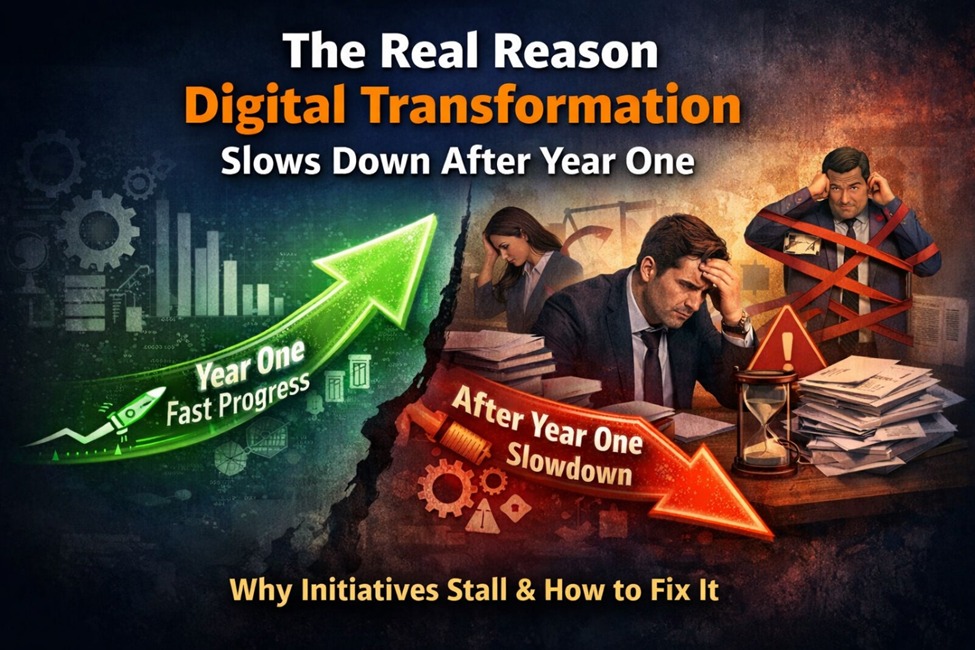
Yet, somewhere after the first year, a subtle but dangerous shift begins to occur. Progress slows. Initiatives start drifting. Reporting becomes heavier but less meaningful. Teams revert to old habits. And most importantly, leadership loses real-time visibility into whether transformation is actually delivering business value.
This is not a technology failure. It is not even a strategy failure.
The real reason digital transformation slows down after year one is execution breakdown due to lack of continuous visibility, governance and alignment between strategy and delivery.
The Illusion of Progress in Year One
Problem Early Wins Create False Confidence
In the first year, organizations operate in a highly structured environment. Transformation programs are closely monitored, leadership is deeply involved, and teams are aligned around clear milestones. This creates an illusion of control and progress.
However, most of this progress is activity-driven, not outcome-driven. Organizations track:
- Number of tools implemented
- Number of initiatives launched
- Adoption metrics
But they fail to track:
- Real-time project profitability
- Resource utilization linked to revenue
- Execution risks at a portfolio level
As a result, while the surface looks healthy, the underlying execution engine remains fragmented.
Solution Shift from Activity Tracking to Outcome Visibility
To sustain transformation beyond year one, organizations must move from tracking activities to measuring outcomes in real time. This requires a unified platform where delivery, finance and resource data are connected.
A system like Whizible enables organizations to monitor not just what is being done, but what value is being generated, ensuring transformation remains aligned with business outcomes.
? Learn how unified visibility drives execution outcomes: https://www.whizible.com/from-hours-to-outcomes-metrics-framework-value-delivery/
? External perspective on execution alignment: https://www.linkedin.com/in/vishmahajan/
Fragmentation Creeps Back Into the System
Problem Tool Sprawl Breaks Execution Continuity
During the initial phase, organizations often try to standardize tools. But as transformation scales, different teams begin adopting their own systems for project management, resource allocation, financial tracking and reporting.
The result is a familiar but dangerous state:
- PMO works in one tool
- Delivery teams work in another
- Finance operates in ERP
- Resource managers rely on spreadsheets
This fragmentation breaks the single version of truth, making it impossible to answer simple questions like:
- What is the real-time status of all initiatives?
- Are we profitable at a project level?
- Where is our capacity actually being utilized?
Solution Build a Unified Execution Layer
To prevent transformation slowdown, organizations must establish a single execution layer that integrates projects, resources, financials and governance.
Whizible acts as this unified layer, eliminating silos and ensuring that every stakeholder operates on the same real-time data model. This allows leadership to move from reactive reporting to proactive decision-making.
? Explore how unified platforms eliminate silos: https://www.whizible.com/psa-future-unified-platforms-it-services/
? External insights on enterprise execution: https://www.linkedin.com/in/vishmahajan/
Governance Becomes Bureaucracy
Problem Oversight Slows Down Execution
As transformation matures, organizations introduce more governance layers to maintain control. While this is well-intentioned, it often leads to:
- Increased approval cycles
- Delayed decision-making
- Manual reporting overhead
Instead of enabling execution, governance starts slowing it down. Teams spend more time preparing reports than actually delivering value.
Solution Enable Real-Time Governance Instead of Periodic Reviews
The answer is not less governance but smarter governance powered by real-time data.
With Whizible, governance is embedded into execution itself. Leaders can:
- Monitor project health in real time
- Identify risks early
- Make decisions without waiting for weekly reports
This transforms governance from a bottleneck into a strategic advantage.
? See how real-time governance transforms execution: https://www.whizible.com/real-time-delivery-governance-eliminate-surprises/
? Leadership insights on governance: https://www.linkedin.com/in/vishmahajan/
Resource Management Becomes Reactive
Problem No Link Between Demand and Capacity
One of the biggest reasons transformation slows down is poor resource planning. After year one, organizations struggle with:
- Hiring ahead of demand
- Rising bench without visibility
- Skill mismatches across projects
Without a clear link between pipeline demand and resource capacity, organizations either overutilize teams (leading to burnout) or underutilize talent (leading to revenue leakage).
Solution Introduce Resource Intelligence
Organizations need to move from static resource planning to dynamic resource intelligence.
Whizible provides real-time visibility into:
- Skill availability
- Allocation across projects
- Future demand vs capacity
This ensures that transformation initiatives are always backed by the right talent at the right time.
? Learn how resource intelligence drives utilization: https://www.whizible.com/why-it-services-companies-struggle-with-utilization-and-how-whizible-fixes-it/
? External perspective on workforce strategy: https://www.linkedin.com/in/vishmahajan/
Financial Visibility Disappears
Problem Transformation Lacks Profitability Tracking
In the early stages, budgets are allocated and monitored. But as initiatives scale, financial tracking becomes disconnected from execution.
Organizations struggle to answer:
- Which projects are profitable?
- Where are margins leaking?
- Are transformation investments delivering ROI?
This lack of financial visibility leads to delayed corrective actions and ultimately slows down transformation.
Solution Integrate Financial Governance with Delivery
To sustain transformation, financial governance must be embedded into project execution.
Whizible connects:
- Effort tracking
- Billing
- Revenue recognition
- Project profitability
This ensures that every decision is backed by financial impact, not just operational metrics.
? Understand how financial governance protects margins: https://www.whizible.com/using-data-analytics-to-protect-project-profit-margins/
? External insights on financial decision-making: https://www.linkedin.com/in/vishmahajan/
Strategy and Execution Drift Apart
Problem Initiatives Lose Strategic Alignment
Over time, transformation initiatives multiply. New priorities emerge but old projects continue running without reassessment.
This creates strategic drift, where:
- Teams work on low-impact initiatives
- High-priority goals lack execution bandwidth
- Leadership loses clarity on what truly matters
Solution Continuously Align Strategy with Execution
Organizations must create a system where strategy is continuously translated into execution and monitored in real time.
With Whizible, leaders can:
- Prioritize initiatives based on business impact
- Track execution against strategic goals
- Reallocate resources dynamically
This ensures that transformation remains aligned with organizational objectives.
? Learn how to maintain strategy alignment: https://www.whizible.com/aligning-strategy-and-execution-how-to-keep-teams-focused-without-platform-hopping/
? External leadership insights: https://www.linkedin.com/in/vishmahajan/
The Real Fix — Build an Execution-Native Operating Model
Digital transformation does not fail because of lack of intent or investment. It slows down because organizations rely on disconnected systems, delayed reporting and reactive decision-making.
The real solution is to build an execution-native operating model, where:
- Data flows in real time
- Governance is embedded, not imposed
- Resources are dynamically aligned
- Financial outcomes are continuously tracked
Platforms like Whizible enable this shift by creating a single, unified system of execution, ensuring that transformation does not lose momentum after year one but instead accelerates.
? Discover how to build an execution-native organization: https://www.whizible.com/moving-beyond-tools-why-it-services-need-an-execution-native-operating-system/
? External perspective on execution excellence: https://www.linkedin.com/in/vishmahajan/
Conclusion From Momentum to Maturity
The first year of digital transformation is about momentum.
But long-term success depends on maturity in execution.
Organizations that continue to rely on fragmented tools, manual reporting, and delayed insights will inevitably see transformation slow down.
On the other hand, those that invest in real-time visibility, unified execution and governance intelligence will not just sustain transformation—they will turn it into a long-term competitive advantage.
The question is no longer whether digital transformation should continue.
The question is: Do you have the execution foundation to sustain it beyond year one?