
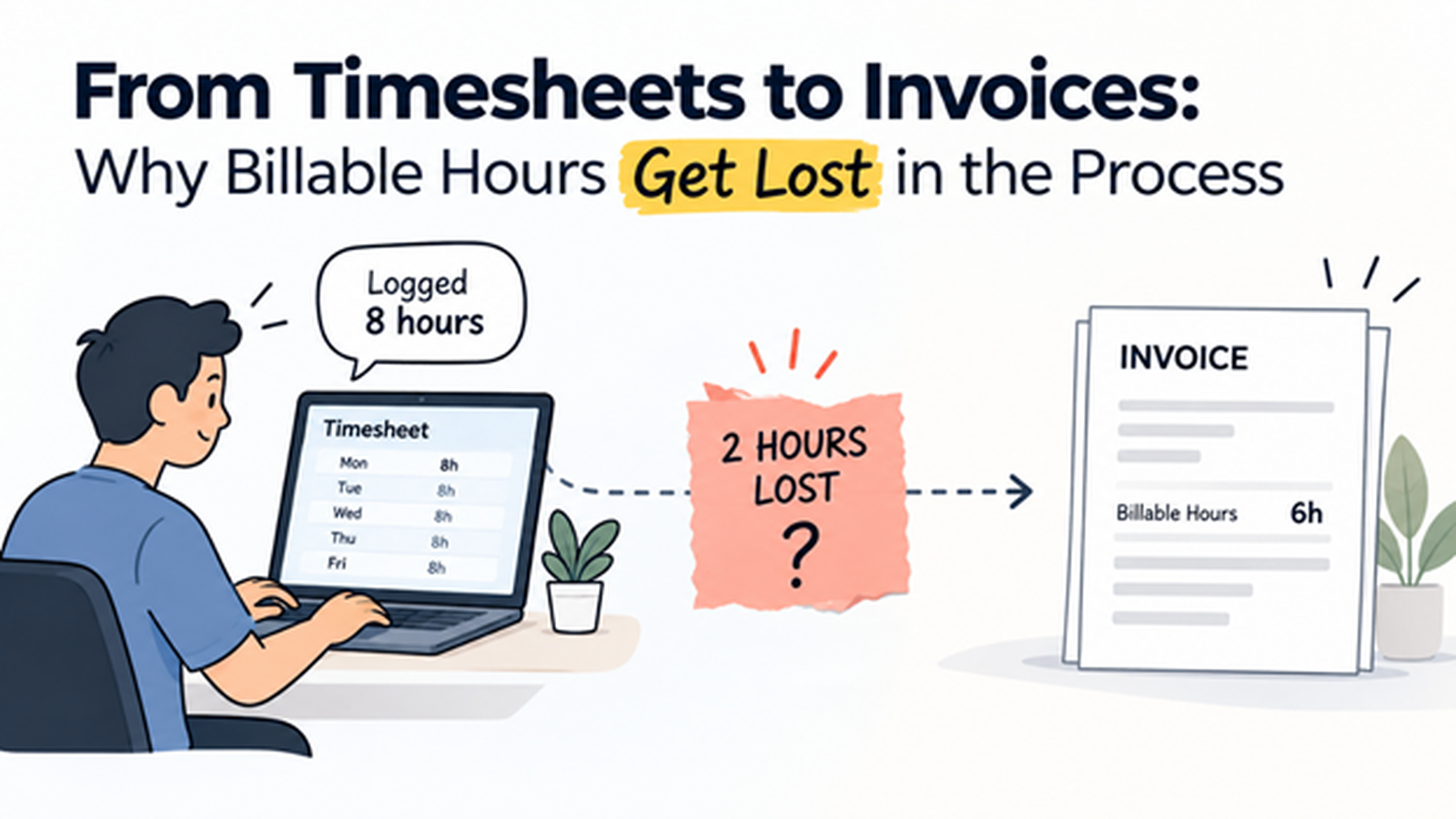
A consultant completes eight hours of client work. The project manager recognizes the effort. The employee records it. Yet weeks later, only six hours appear on the invoice.
Where did the other two hours go?
This is one of the most overlooked forms of revenue leakage in professional services. The problem is rarely that organizations do not track time at all. The real problem is that time capture, approvals, project rules and invoicing often operate as separate processes.
The Problem: The Timesheet-to-Invoice Gap.
Timesheets sit at the intersection of delivery and finance.
Delivery teams view them as records of effort. Resource managers use them for utilization. Project managers use them to understand progress. Finance needs them to determine billable effort.
When these stakeholders work from different systems or interpretations, small discrepancies emerge.
An employee may select the wrong project code. A manager may approve a timesheet after the billing cut-off. Billable work may be categorized as non-billable. Contract billing rules may not match the way effort is being captured.
The result is a gap between hours worked, hours approved, hours eligible for billing and hours actually invoiced.
Whizible’s discussion of seamless timesheet access and workforce optimization explains how fragmented timesheet processes can contribute to manual errors, poor compliance and billing inefficiencies.
Why More Timesheet Reminders Are Not Enough
Organizations often respond by sending more reminders.
“Submit your timesheet.”
“Approve pending entries.”
“Close timesheets before Friday.”
Compliance matters, but compliance alone does not solve the underlying financial problem.
A submitted timesheet can still contain the wrong project, incorrect billing category or effort against work that falls outside contractual scope.
The Solution: Build a Connected Effort-to-Billing Workflow.
Organizations need to connect four pieces of information:
- Who performed the work?
- Which project and task consumed the effort?
- Was that effort commercially billable?
- Did it ultimately reach the invoice?
Once these data points are connected, exception-based management becomes possible.
Instead of Finance manually checking hundreds of entries, teams can focus on anomalies unapproved billable hours, late submissions, unusual non-billable effort, effort exceeding estimates or completed milestones awaiting billing.
This is where an integrated PSA environment becomes valuable. Whizible brings project management, resource information and timesheet visibility into a connected operational framework, helping organizations create a clearer path from work performed to financial realization.
Make Billing Readiness Visible Before Month-End.
Finance should not have to wait until month-end to discover missing approvals.
Project managers should be able to see billing readiness throughout the delivery cycle. This means tracking pending timesheets, approval status, billable versus non-billable effort and project-level financial exceptions continuously.
The shift is important:
Traditional model: Work → Timesheet → Month-end reconciliation → Invoice
Connected model: Work → Validated effort → Approval → Billing readiness → Invoice
The second model allows problems to surface when they can still be corrected.
Timesheets Should Become Financial Signals
A timesheet should not be treated merely as proof that someone worked eight hours.
Combined with project budgets, billing rules, resource costs and planned effort, timesheet data becomes a powerful financial signal.
Unexpected effort can indicate scope creep. Increasing non-billable effort can indicate margin pressure. Delayed approvals can signal future invoicing delays.
This is also why resource allocation and financial performance are closely connected. Whizible’s guidance on smarter resource allocation notes the importance of billable/non-billable visibility and connecting resource decisions with financial outcomes.
For more perspectives on project economics and execution visibility, follow Vishwas Mahajan on LinkedIn.
Conclusion
Billable hours usually do not disappear in one dramatic failure. They disappear in the handoffs between systems, people and processes.
Improving timesheet compliance is important. But the larger opportunity is to connect effort capture directly with project and financial governance.
Because recording work is only the first step.
The real objective is ensuring that legitimate billable work becomes realized revenue.
Next in the series: Scope Creep and Unapproved Work: The Silent Margin Killer.
FAQs
-
Why do billable hours get missed during invoicing?
Common causes include late timesheets, incorrect project codes, approval delays, billing-rule mismatches and disconnected systems.
-
Does better timesheet compliance eliminate revenue leakage?
Not completely. Accurate classification, approvals and alignment with commercial terms are equally important.
-
What should Finance monitor before billing closes?
Pending billable timesheets, approval status, billable versus non-billable effort, completed milestones and unusual effort variances.
-
How does integrated PSA improve billing accuracy?
It connects operational effort with project and financial information, reducing manual handoffs and making billing exceptions easier to identify.
See how Whizible can turn timesheet data into stronger project and financial visibility.