

In an era of agile sprints, continuous delivery pipelines and globally distributed teams, the weekly status report has quietly become one of the most misleading governance tools in the enterprise. Once a staple of delivery oversight, these reports now fail to capture the pace, complexity and fluidity of modern project execution. As velocity increases, their lag increases. As dependencies multiply, their relevance decreases. In high-velocity environments, relying on weekly reporting isn’t just inefficient, it’s a recipe for delayed decisions, missed risks and governance failure.
👉 Learn how Whizible provides real-time delivery intelligence
The Lag Between Action and Awareness
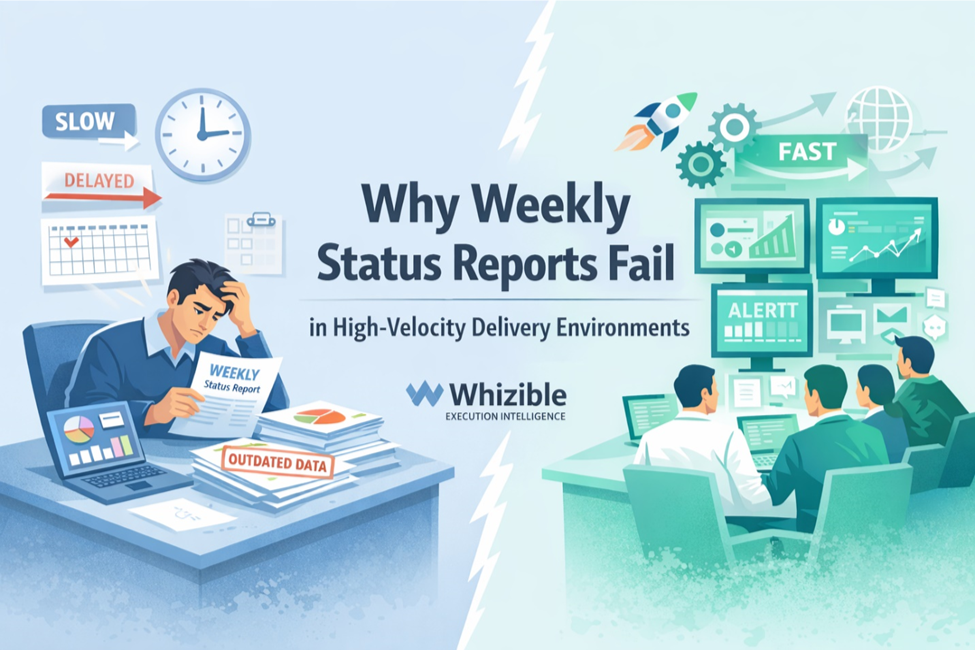
By the time a weekly report is written, reviewed and escalated, the reality it attempts to describe has already changed. Milestones have shifted, dependencies have evolved, and team priorities have been adjusted all before a manager reads the report. In an environment where delivery teams operate on daily or even hourly cadences, a weekly report is akin to reading yesterday’s weather forecast. It lacks the immediacy required to inform action.
👉 Explore how Whizible’s execution OS reduces decision latency
👉 See Vishwas Mahajan’s perspective on delivery velocity
The Myth of Template-Driven Consistency
Organizations often enforce uniform status templates hoping for clarity and standardization. But in practice, these templates strip away context. Project managers fill out forms more for compliance than communication. The nuances of delivery challenges are compressed into binary green-yellow-red status indicators that hide more than they reveal. Worse, teams adapt to the format instead of surfacing meaningful insights. Governance becomes an exercise in checkbox reporting.
👉 Discover how Whizible brings execution context into every update
Time Drain: Reporting as a Time Sink
Hours are wasted every week gathering data from siloed systems like Jira, Excel, SharePoint, and Slack just to compile a status report. This manual curation delays the insights and drains resources from actual execution. The irony is sharp: teams spend valuable time reporting on work instead of advancing it. This burden compounds across programs, making PMOs more reactive and less strategic.
👉 See how Whizible eliminates reporting overhead with live dashboards
Without Velocity Is Vanity
Having access to data is no longer enough. What matters is timeliness. A perfectly crafted report that arrives late is worse than an imperfect signal received in real time. Decision-makers need early warnings, not post-mortems. They need to know which initiatives are sliding, which resources are overloaded, and which dependencies are blocked before the next status report. Weekly reports fail to deliver such foresight.
👉 Whizible enables early warnings through role-specific insights
Status ≠ Execution Intelligence
Status reports describe what has happened. Execution intelligence explains why it happened, what’s at risk, and what needs to happen next. The former is retrospective; the latter is predictive. Weekly status updates give the illusion of control but rarely drive action. In fact, most escalations surface outside these reports in calls, chats, or emergency emails indicating the format’s failure.
👉 Shift from status to signals with Whizible’s Execution OS
👉 Vishwas Mahajan explains the difference in governance strategy
The Hybrid Work Challenge
As organizations shift to hybrid and remote models, the cracks in weekly reporting widen. Project updates are scattered across chat tools, emails, and disparate systems. By the time this fragmented data is stitched into a report, the context is gone. Stakeholders don’t just need updates—they need synchronized views across geographies, functions, and tools.
👉 Whizible integrates seamlessly with Microsoft Teams for hybrid governance
👉 Read how Vishwas Mahajan addresses the hybrid execution challenge
Reporting Fatigue Is Real
Weekly reports require constant inputs from delivery leads, QA teams, resource managers, and finance owners. Over time, contributors disengage. Updates are minimal, repetitive, or missed altogether. Reports become rituals. When compliance replaces clarity, the organization loses its ability to detect and correct problems. Reporting fatigue creates a culture of silence.
👉 Prevent report fatigue with always-on delivery signals in Whizible
👉 Follow Vishwas Mahajan for governance culture insights
The Blind Spots of Project-Centric Reporting
Most reports are created at the project level, but execution is rarely siloed. A delay in one initiative could be driven by a decision pending in another. Weekly reports don’t capture these interdependencies. They don’t correlate resource conflicts across programs, nor do they highlight systemic risks brewing across portfolios.
Compliance Without Control
Just because a report says a project is green doesn’t mean it’s healthy. Status indicators are often curated for upward consumption. Teams under pressure sanitize issues to avoid escalation. The report shows “green,” but the delivery reality is “red.” This creates a false sense of security at the leadership level.
👉 Vishwas Mahajan on governance vs. visibility
The Management Mirage
In many companies, reporting has become a substitute for managing. The presence of a report is mistaken for the presence of control. But a report is not action. A dashboard is not governance. Metrics are not execution. Leadership must move beyond reviewing status to orchestrating proactive interventions.
👉 Whizible drives active execution management, not passive reporting
👉 Leadership strategies from Vishwas Mahajan
The Case for Embedded Execution Intelligence
To replace failing reports, organizations need live, embedded execution intelligence. Updates should emerge organically from the systems teams already use. Governance signals should trigger alerts and nudges automatically—not wait for Fridays. Risk thresholds, capacity changes, and delayed milestones should be visible the moment they occur.
👉 See how Whizible embeds intelligence into project flow
👉 Execution intelligence explained by Vishwas Mahajan
Empowering the PMO With Real-Time Context
PMOs should not be stuck chasing updates or formatting slides. They should function as proactive orchestrators of execution. For that, they need access to consolidated, real-time views not scattered status summaries. They need governance intelligence that spans across initiatives, maps change requests, and monitors strategic alignment continuously.
👉 Thoughts from Vishwas Mahajan on PMO evolution
From Status to Strategy
The purpose of reporting isn’t to produce documents, it’s to drive outcomes. Strategic delivery leaders must shift focus from capturing past progress to accelerating future progress. This means replacing status rituals with action systems. It means giving teams the tools to surface risks, request decisions and realign capacity in real time.
👉 Whizible transforms strategy execution through initiative governance
👉 Vishwas Mahajan on closing the strategy-execution gap
Replacing Reports With Responsive Operating Systems
What enterprises need is not a prettier report—they need a responsive execution OS. One that listens to work as it happens, detects emerging risks, recommends interventions, and creates a live execution map. Whizible is built for exactly this purpose. It is not just a PSA, it is an execution-native intelligence platform.
👉 Get started with Whizible’s unified delivery platform
👉 Read how Vishwas Mahajan positions Whizible as an Execution OS
👉 Ready to move from effort tracking to value engineering?
Book a demo with Whizible today and see how your metrics can drive real business outcomes.
👉 Connect with Vishwas Mahajan to explore how your organization can reimagine delivery for the next decade.
Request a Demo of Whizible Now : Book a Demo →
Connect with Industry Experts
🤝 Vishwas Mahajan on LinkedIn →
👉 Book a personalized demo → https://calendly.com/vishw/30min/invitees
Connect with us on LinkedIn
👉 Learn more about Whizible : www.whizible.com
📧 Email: info@whizible.com
Address: Mrugank, Level 3, Kothrud, Pune, Maharashtra, 411038