


In the professional services world, utilization is often treated as the ultimate indicator of operational success. Delivery leaders celebrate when utilization numbers rise above 80%. Finance teams track utilization ratios as a measure of revenue productivity. Resource managers use it to justify hiring or redistribution decisions. And executives frequently assume that higher utilization means better performance.
But in reality, utilization is one of the most misunderstood metrics in IT services organizations.
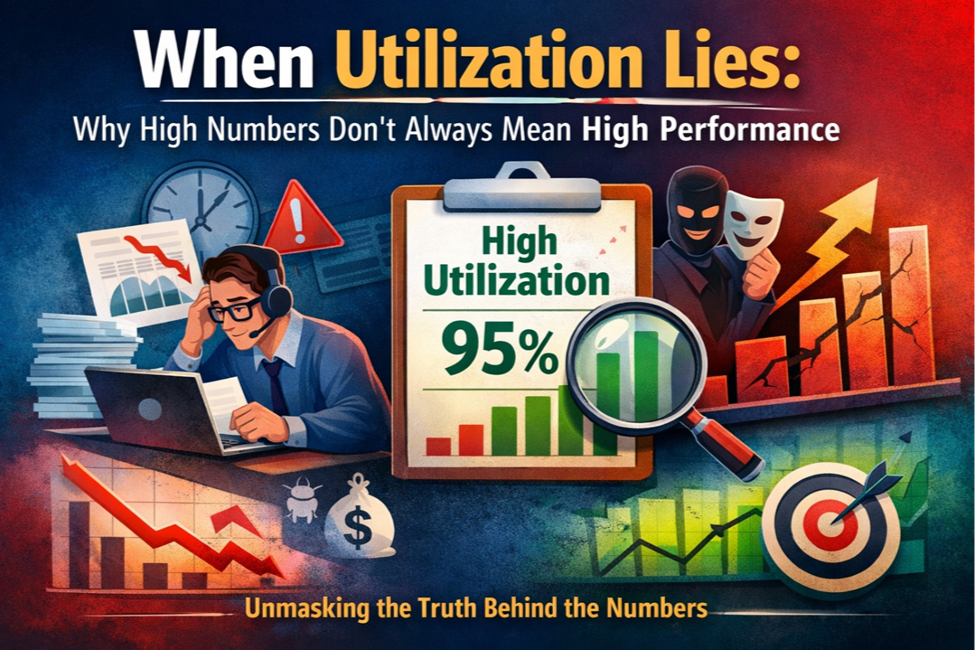
A team running at 92% utilization might still be missing deadlines, overrunning budgets, and frustrating clients. Meanwhile, another team with slightly lower utilization may be delivering projects predictably, protecting margins, and maintaining customer trust.
The uncomfortable truth is that utilization numbers can lie.
High utilization does not automatically translate into high performance. In many organizations, the metric hides operational inefficiencies, poor planning, skill mismatches and invisible delivery risks. Without deeper execution intelligence, leaders may end up optimizing the wrong thing.
This is why modern services organizations are moving beyond raw utilization metrics and adopting **execution intelligence platforms like Whizible that combine resource visibility, financial governance, and real-time delivery analytics.
To understand why utilization can be misleading, we must explore the structural problems that hide beneath impressive numbers and how organizations can solve them.
The Utilization Illusion: Why High Numbers Can Be Dangerous
Problem Utilization Measures Activity, Not Value
Utilization metrics traditionally measure how much of a resource’s available time is billed or allocated to projects. While this sounds logical, it focuses on activity rather than value creation.
An engineer can be fully utilized while working on low-impact tasks, redundant rework, or poorly scoped projects. Similarly, teams may appear highly utilized because they are constantly firefighting delivery issues caused by earlier planning mistakes.
When organizations focus exclusively on utilization percentages, they inadvertently encourage behavior that prioritizes being busy instead of being effective.
The result is an operational environment where:
Projects run late despite full utilization
Teams experience burnout while productivity stagnates
Revenue grows slower than expected
Delivery predictability deteriorates
In such scenarios, utilization becomes a lagging indicator of systemic problems rather than a reliable performance metric.
Solution Shift From Utilization to Execution Intelligence
Instead of measuring activity alone, organizations must evaluate execution outcomes delivery predictability, project profitability, resource effectiveness and client impact.
Modern PSA platforms like Whizible help organizations track utilization alongside deeper execution signals such as project health, cost variance, and delivery risks.
This enables leaders to understand not just how busy teams are but how effectively they are delivering value.
👉 Learn how execution intelligence transforms delivery visibility:
https://www.whizible.com/it-services-execution-native-operating-system/
👉 Explore how predictive delivery insights improve operational control:
https://www.whizible.com/why-most-it-services-firms-fail-at-forecasting-and-how-whizible-makes-it-a-strength/
Industry thought leaders like Vishwas Mahajan often emphasize that the future of services organizations will be defined not by utilization alone but by operational intelligence that connects strategy, execution and outcomes.
https://www.linkedin.com/in/vishmahajan/
When High Utilization Masks Resource Misalignment
Problem Skill Mismatch Hidden Behind Allocation
One of the most common issues in resource management is skill misalignment.
A developer may be fully utilized on a project that only partially uses their capabilities. Another team member may spend time compensating for missing expertise within the team.
From a utilization perspective, everything looks perfect.
But operationally, the organization suffers from:
Lower productivity
Increased delivery timelines
Quality issues
Hidden opportunity costs
Skill mismatches often arise because organizations lack real-time visibility into skills, demand forecasts, and project requirements.
As a result, resources are allocated based on availability rather than capability.
Solution Build Skill-Aware Resource Intelligence
To eliminate hidden inefficiencies, organizations must adopt skill-aware resource planning.
Execution platforms like Whizible provide unified visibility across resource capacity, skill inventory, project demand and utilization trends.
This enables resource managers to match the right skill to the right demand at the right time, dramatically improving delivery outcomes.
👉 Learn how smarter resource allocation improves utilization accuracy:
https://www.whizible.com/maximize-talent-utilization-in-it-services-expert-playbook/
👉 Explore how resource intelligence improves project outcomes:
https://www.whizible.com/why-resource-intelligence-missing-in-psa/
These capabilities allow organizations to move beyond simple utilization metrics and build strategic resource optimization frameworks.
The Hidden Cost of Artificially High Utilization
Problem Organizations Inflate Utilization to Look Efficient
In many services organizations, utilization becomes a performance target rather than an analytical metric.
Delivery managers feel pressure to keep utilization high, which often leads to artificial adjustments such as:
Allocating resources to placeholder tasks
Overloading teams with parallel assignments
Ignoring necessary downtime between projects
Pushing employees into reactive firefighting roles
While these actions temporarily boost utilization metrics, they create long-term damage:
Employee burnout
Reduced innovation
Higher attrition rates
Declining delivery quality
Eventually, the organization finds itself trapped in a cycle of high utilization but declining performance.
Solution Introduce Balanced Performance Metrics
To break this cycle, leaders must adopt a balanced set of metrics that combine utilization with delivery performance indicators such as:
Project margin
Delivery predictability
Customer satisfaction
Change request impact
Modern PSA platforms help organizations measure utilization within the broader context of operational performance.
👉 Discover how project financial governance improves delivery outcomes:
https://www.whizible.com/using-data-analytics-to-protect-project-profit-margins/
👉 Learn how integrated PSA platforms improve operational transparency:
https://www.whizible.com/single-version-of-truth-unified-psa-platforms/
This integrated visibility ensures that utilization supports performance rather than masking operational weaknesses.
When Utilization Hides Delivery Risk
Problem Teams Become Overloaded Without Warning Signals
Another common problem is overutilization disguised as productivity.
When teams operate close to maximum utilization for extended periods, they lose the ability to absorb delivery shocks such as:
Change requests
Client escalations
Technical issues
Unexpected dependencies
Without buffer capacity, even small disruptions can cause cascading delays across multiple projects.
Unfortunately, traditional utilization dashboards rarely highlight these risks.
They simply show that resources are fully booked.
Solution Enable Real-Time Delivery Visibility
Organizations must combine utilization tracking with real-time delivery intelligence.
Platforms like Whizible provide integrated visibility across projects, resources, risks, and financial metrics.
This enables leaders to identify delivery risks early and rebalance resources before problems escalate.
👉 Explore how real-time delivery intelligence improves governance:
https://www.whizible.com/real-time-governance-monitor-execution/
👉 Learn why unified visibility is critical for scaling delivery operations:
https://www.whizible.com/managing-delivery-at-scale-it-services-organizations-grow/
With real-time operational visibility, utilization becomes a strategic input for decision-making rather than a misleading KPI.
The Future of Utilization in Modern IT Services Organizations
The next generation of IT services organizations will treat utilization differently.
Instead of asking, “How busy are our teams?” leaders will ask more meaningful questions:
Are our resources working on the highest value initiatives?
Are our delivery teams operating sustainably?
Are our projects profitable and predictable?
Are we detecting delivery risks early?
Answering these questions requires a new operational layer execution intelligence.
Execution intelligence connects resource data, project performance, financial governance, and delivery signals into a unified view.
This is the foundation of modern Professional Services Automation platforms.
Organizations adopting execution intelligence platforms like Whizible are able to:
Improve utilization accuracy
Protect project margins
Increase delivery predictability
Enhance customer satisfaction
Reduce operational surprises
👉 Learn how execution intelligence is redefining modern service delivery:
https://www.whizible.com/how-to-build-high-performance-project-delivery-engine/
👉 Explore how operational excellence drives competitive advantage:
https://www.whizible.com/why-operational-excellence-competitive-advantage/
Conclusion: Stop Optimizing Utilization Start Optimizing Outcomes
Utilization will always remain an important metric in professional services organizations.
But it should never be viewed in isolation.
High utilization numbers can hide deeper operational problems such as skill mismatches, delivery risk, poor planning, and employee burnout.
The most successful IT services organizations understand that true performance lies beyond utilization metrics.
They invest in execution intelligence platforms that combine resource visibility, project governance, and financial insights to create a single version of truth across the organization.
In this new operational model, utilization becomes what it was always meant to be: a supporting metric within a broader system of execution intelligence.
And that is where modern delivery leaders are focusing their attention today.
👉 Book a Demo | 🌐 Visit Initiatives.app
📥 Learn more about features, benefits, and use cases at:
👉 www.initiatives.app
Contact Us : info@whizible.com | +91 855-498-3315
Address : Mrugank, Level 3, Kothrud, Pune, Maharashtra, 411038