
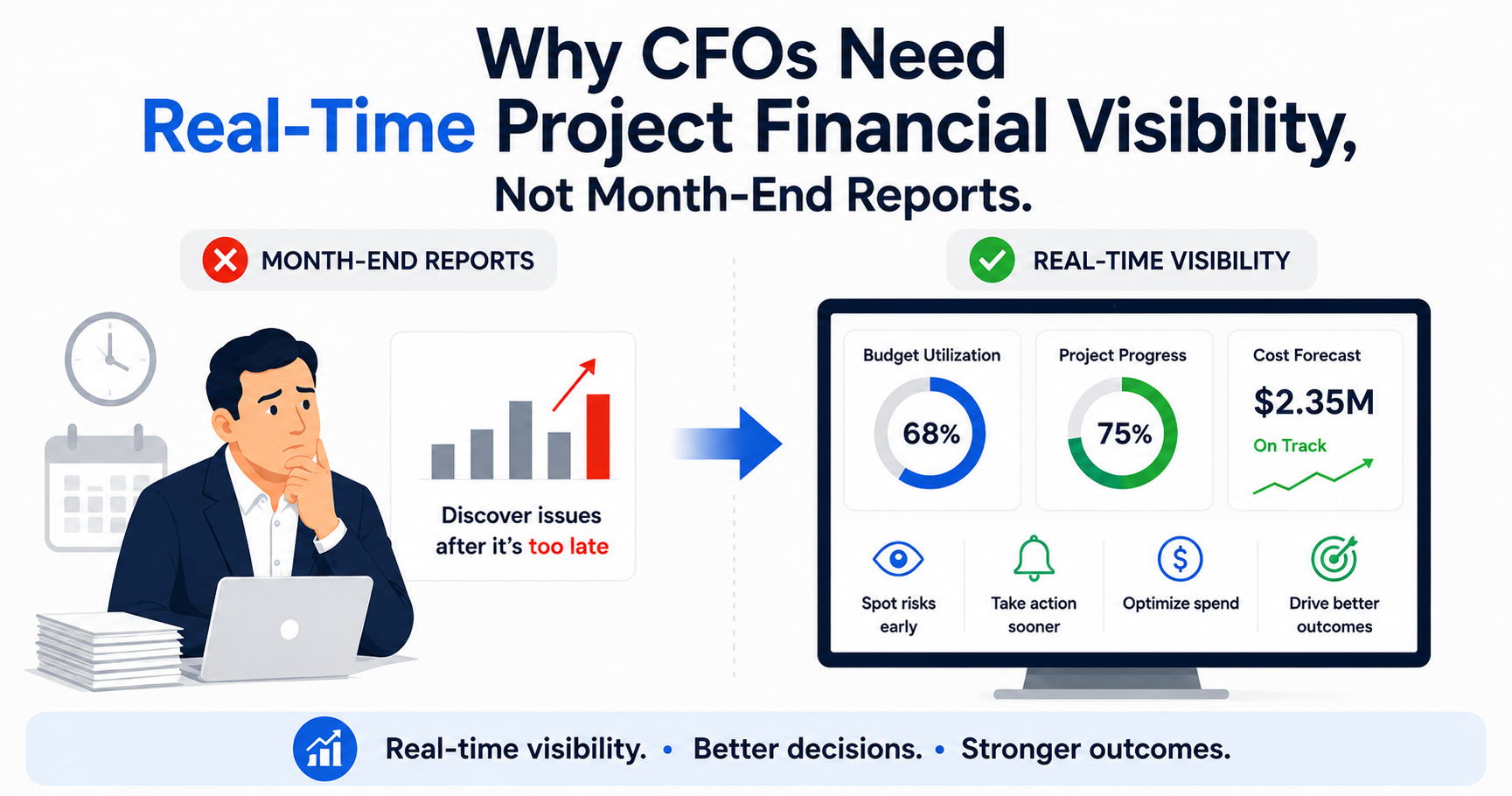
For decades, month-end reporting has been one of the foundations of financial management. Revenue is consolidated, costs are reconciled, variances are analyzed, and leadership receives a structured view of business performance.
The problem is not that month-end reporting is inaccurate. The problem is that in a project-driven organization, the information often arrives after the opportunity to influence the outcome has passed.
A project can consume additional effort, exceed its resource budget, accumulate unbilled hours, experience scope changes, or suffer declining margins long before those issues become visible in the financial statements.
For today’s CFO, financial visibility therefore needs to move from reporting what happened to identifying what is changing.
The Problem: Financial Reporting Is Often Disconnected from Project Execution.
Finance teams typically depend on information flowing from multiple operational sources.
Project managers track delivery. Employees submit timesheets. Resource managers manage allocation. Finance monitors revenue, billing, costs, and collections.
When these activities operate independently, CFOs may receive an accurate financial picture but only after several layers of consolidation.
Consider a fixed-price project that was originally expected to deliver a healthy margin. During the month, additional senior resources are assigned, effort exceeds estimates, and a milestone is delayed.
Operationally, the economics of the project have already changed.
Financially, however, leadership may not recognize the full impact until the reporting cycle closes.
Whizible’s guidance on fixed-price profitability similarly emphasizes continuously monitoring project progress, resource utilization and financial health so that potential overruns can be identified before they escalate.
The Solution: Move from Periodic Reporting to Continuous Financial Visibility.
Real-time project financial visibility gives CFOs an operating view of financial performance while projects are still being executed.
Instead of waiting for the end of the month, finance can continuously monitor indicators such as:
- Budget versus actual effort
- Project cost consumption
- Resource utilization and billability
- Revenue and billing readiness
- Unbilled effort
- Forecast versus actual performance
- Project-level profitability
This does not eliminate traditional financial reporting. It adds an early-warning layer before formal reporting takes place.
A CFO who sees project economics changing early has more options: challenge additional effort, review scope, change resource composition, accelerate approvals, correct billing gaps, or revise the forecast.
That is fundamentally different from explaining the variance after the month has closed.
Internal Reading: Managing Fixed-Price Contracts Profitably
From Financial Reporting to Financial Intelligence
The real transformation is not simply giving CFOs another dashboard.
It is connecting operational activity with financial impact.
Whizible brings project management, resource information, time capture, billing and financial controls into a connected environment, helping leadership move toward a unified view of project performance. Whizible also provides financial controls including milestone-based invoicing, cost tracking and profitability analysis.
When CFOs can see where margin is changing, why it is changing and which project requires intervention, financial data becomes actionable intelligence.
FAQs
-
Are month-end reports becoming unnecessary?
No. Month-end reporting remains essential for accounting, compliance and formal financial management. Real-time project visibility complements it by allowing CFOs to intervene before the reporting period closes.
-
What should CFOs monitor at project level?
Important indicators include project revenue, actual and forecast costs, budget consumption, resource cost, billability, unbilled effort, billing status and projected margin.
-
How does real-time visibility improve profitability?
It exposes emerging financial variances earlier, giving management time to correct resource, scope, effort or billing issues before they materially affect project margins.
-
Can PSA platforms support CFO-level financial visibility?
Yes. Integrated PSA platforms can connect project execution, resources, timesheets, billing and financial information to provide a more current view of project economics.
The Next Question
Real-time visibility tells the CFO that something is changing.
But the next challenge is understanding how profitable projects quietly become unprofitable between reporting cycles.
That is the subject of Part 2 of this series.
Explore: Whizible
Leadership Perspective: Dr. Vishwas Mahajan on LinkedIn