
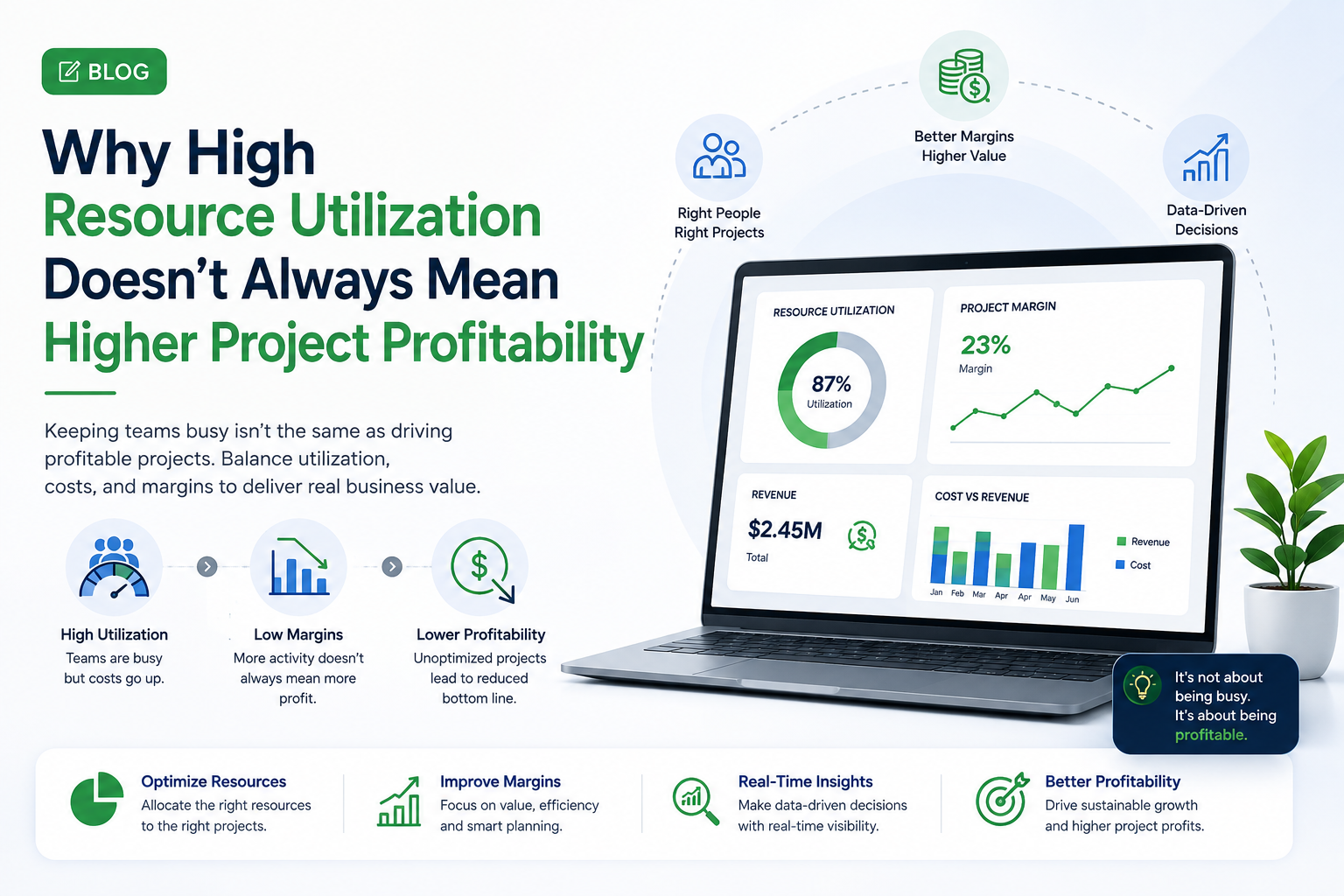
Many project-driven organizations proudly report 80–90% resource utilization as a sign of operational excellence. Leadership teams often celebrate these numbers because they suggest employees are fully engaged and projects are progressing efficiently.
However, one question often remains unanswered:
If everyone is busy, why are project margins still shrinking?
This contradiction is becoming increasingly common across IT services companies, Global Capability Centers (GCCs), engineering firms, consulting organizations, and professional services businesses. Teams are working harder than ever, yet projects continue to experience budget overruns, missed deadlines, scope creep, and declining profitability.
The reality is that high utilization measures activity not business outcomes.
Modern organizations need to move beyond simply tracking how busy their people are and start understanding how effectively their work contributes to project profitability.
The Problem: Busy Doesn’t Always Mean Profitable.
Imagine two projects with the same utilization rate.
One delivers on time, stays within budget, and achieves healthy margins.
The other requires repeated rework, uses expensive resources for routine tasks, and exceeds its planned effort.
On paper, both projects may show similar utilization. In reality, their financial outcomes are completely different.
Focusing only on utilization often hides issues such as:
- Poor resource allocation
- Cost overruns
- Scope creep
- Excessive non-billable work
- Delayed financial reporting
By the time these issues become visible, profitability has already been affected.
The Solution: Measure Business Outcomes, Not Just Activity.
Instead of asking “How busy are our people?”, leaders should ask:
- Which projects generate the highest margins?
- Where is effort exceeding estimates?
- Which customers consume more resources than planned?
- Are project costs aligned with revenue?
Answering these questions requires connected visibility across projects, resources, timesheets, and financial data.
Platforms like Whizible bring these insights together, helping organizations identify risks early, optimize resource allocation, and improve project profitability before small issues become major financial problems.
For more insights, explore the Whizible Blog:
https://www.whizible.com/blog/
You can also follow industry perspectives from Dr. Vishwas Mahajan:
https://www.linkedin.com/in/vishmahajan/
Conclusion
High utilization is an important operational metric but it should never be the only measure of success.
Organizations that combine utilization with project financials, forecasting, and resource intelligence make better decisions, protect margins, and deliver more profitable projects.
The real goal isn’t to keep people busy, it’s to ensure every hour contributes to business value.
Frequently Asked Questions
-
Does higher utilization always increase profitability?
No. Profitability depends on factors such as pricing, resource allocation, project costs, and delivery efficiency not utilization alone.
-
Why do highly utilized teams still experience low margins?
Because rework, scope changes, poor planning, and inefficient resource allocation can increase costs despite high utilization.
-
How can organizations improve project profitability?
By combining project management, resource planning, financial tracking, and real-time reporting to make informed decisions.
Ready to move beyond utilization reports? Discover how Whizible helps organizations connect project execution, resource management, and financial visibility to improve profitability. Explore more at www.whizible.com.