

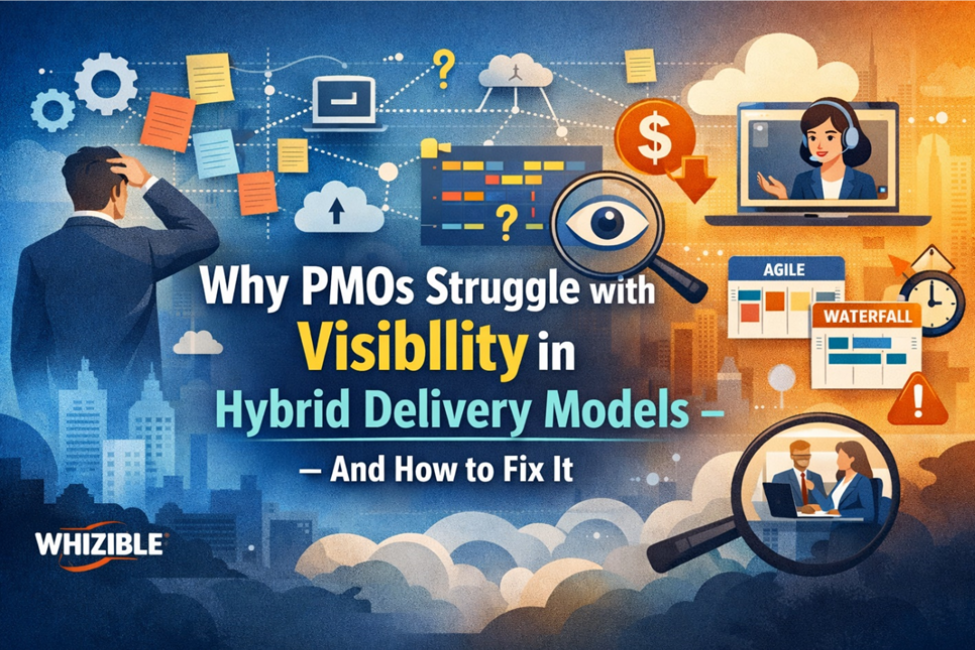
Hybrid delivery is no longer an experiment. It is the default operating environment for IT services organizations, global capability centers, engineering teams, and digital transformation programs. Distributed teams, blended methodologies, remote collaboration, and multi-vendor ecosystems have become permanent structural realities. Yet while delivery models evolved rapidly, governance models did not. And nowhere is this mismatch more visible than inside the PMO.
Project Management Offices were originally designed for centralized environments. Physical co-location, waterfall-heavy programs, periodic status reviews, and clear reporting hierarchies made visibility manageable. In hybrid models, however, work flows across time zones, tools, methodologies and organizational silos. The result is a structural visibility crisis.
PMOs today are not struggling because they lack dashboards. They are struggling because they lack integrated, real-time, contextual intelligence. They see fragments, not patterns. They see lagging indicators, not predictive signals. They see status updates, not execution truth.
This blog explores the structural problems that create visibility breakdowns in hybrid delivery models and provides solution frameworks grounded in operational intelligence and unified governance.
The Structural Visibility Breakdown in Hybrid Delivery
The Problem: Distributed Work, Centralized Governance
Hybrid delivery distributes execution across remote teams, offshore centers, contractors, agile pods, and traditional project structures. However, governance frameworks often remain centralized and periodic. This structural mismatch creates reporting friction.
Teams update Jira, Excel sheets, Teams chats, standalone PSA tools, and financial systems independently. By the time information reaches the PMO, it has already lost context. Visibility becomes retrospective rather than real-time.
PMOs often believe the problem is “lack of reporting discipline.” In reality, the problem is architectural. When execution systems are fragmented, reporting will always be delayed and incomplete.
The deeper issue is that hybrid delivery multiplies data sources. A project’s health might depend on resource utilization from one system, sprint velocity from another, billing realization from finance software, and risk logs maintained manually. No dashboard can compensate for disconnected architecture.
The Solution: Real-Time Unified Execution Layer
The solution is not more reporting. It is architectural integration. PMOs require a unified execution layer that connects resource management, project tracking, financial governance and collaboration into a single version of truth.
A platform like Whizible® enables this by integrating project management, resource allocation, timesheets and financial analytics into one ecosystem. Instead of aggregating static reports, PMOs gain real-time delivery intelligence across hybrid environments.
This approach eliminates reconciliation cycles and provides proactive signals on schedule variance, cost overruns, and resource conflicts.
For deeper insights into execution intelligence, refer to:
https://www.whizible.com/single-version-of-truth-unified-psa-platforms-essential-it-services-growth/
And for leadership perspective on building operational intelligence-driven organizations, explore:
https://www.linkedin.com/in/vishmahajan/
Resource Visibility: The Hidden Blind Spot
The Problem: Bench Visibility Without Skill Intelligence
Hybrid delivery amplifies resource complexity. Employees may work remotely, part-time, across multiple projects, or under matrix reporting structures. PMOs often track utilization percentages without understanding skill alignment, capacity constraints or demand forecasting accuracy.
The illusion of visibility arises when utilization dashboards show green numbers but project delivery suffers because the wrong skills are assigned at the wrong time.
Hybrid models also obscure bench intelligence. A resource may appear “available” in one system but be allocated informally elsewhere. Shadow allocation is common in distributed environments.
Without dynamic capacity forecasting, PMOs cannot predict bottlenecks. They react to escalations instead of preventing them.
The Solution: Resource Intelligence with Predictive Forecasting
True visibility requires skill-tagged capacity planning combined with forward-looking demand mapping. PMOs must move from static utilization reports to predictive resource intelligence.
Whizible’s integrated resource management engine allows PMOs to map skills, forecast demand, simulate allocations, and detect overload scenarios before they affect delivery timelines.
This shifts governance from reactive allocation to proactive workforce orchestration.
To understand how resource intelligence transforms utilization control, read:
https://www.whizible.com/why-it-services-companies-struggle-with-utilization-whizible-solution/
And explore the strategic importance of bench visibility here:
https://www.whizible.com/bench-visibility-vs-bench-size/
Financial Visibility in Hybrid Programs
The Problem: Cost Signals Arrive Too Late
In hybrid environments, cost data is fragmented across billing systems, vendor invoices, subcontractor arrangements and time tracking tools. PMOs often receive financial updates at month-end, long after deviations begin.
This delay is dangerous. Revenue leakage accumulates silently. Change requests inflate scope without margin tracking. Hybrid models with distributed teams and multi-currency billing, increase financial opacity.
When financial governance operates in isolation from project execution, margin erosion becomes invisible until it is irreversible.
The Solution: Integrated Project Financial Governance
Visibility must extend beyond timelines into profitability analytics. PMOs need embedded financial dashboards that align cost, revenue, burn rate and effort variance in real time.
Whizible integrates project profitability tracking directly within delivery workflows, allowing PMOs to monitor margin drift as execution unfolds not after financial closure.
This transforms governance from financial reporting to financial steering.
For deeper insight into revenue leakage risks, explore:
https://www.whizible.com/revenue-leakage-whizible/
And for advanced profit control models:
https://www.whizible.com/revenue-leakage-whizible/
Change Management Chaos in Hybrid Delivery
The Problem: Change Requests Multiply Without Visibility
Hybrid delivery accelerates iteration cycles but also multiplies change requests. Agile sprints, client escalations, remote approvals and evolving requirements create CR avalanches.
When CRs are tracked across email threads, spreadsheets and standalone trackers, PMOs lose control over scope governance. Hybrid delivery makes informal changes easier and traceability harder.
The absence of structured approval workflows leads to invisible scope creep.
The Solution: Structured CR Governance with Workflow Automation
PMOs must embed structured approval workflows directly into execution systems. Change management cannot be external to delivery; it must be integrated.
Whizible enables structured CR workflows, impact analysis and financial implications tracking before approvals are finalized. This creates audit-ready governance without slowing agility.
For a detailed exploration of CR control frameworks, read:
https://www.whizible.com/change-request-chaos-project-profitability/
Governance Intelligence vs Dashboard Fatigue
The Problem: Too Many Dashboards, Not Enough Intelligence
Hybrid delivery environments generate more dashboards than ever before. Yet PMOs often feel less informed.
Why? Because dashboards show metrics, not patterns. They display status, not risk trajectory. They reveal current states but not future scenarios.
PMOs drown in KPI overload without predictive insight.
The Solution: Governance Intelligence Layer
Governance must evolve from static dashboards to intelligent alert systems. PMOs require automated anomaly detection, dependency mapping and early warning signals.
Whizible’s governance intelligence layer provides cross-project insights, risk scoring and interdependency visibility across hybrid portfolios.
This enables leadership to manage at scale without micromanaging teams.
To explore governance intelligence trends, refer to:
https://www.linkedin.com/posts/initiatives-with-whizible_beyond-dashboards-the-rise-of-governance-activity-7416430944196190208-4Ld7
Collaboration Fragmentation in Hybrid Teams
The Problem: Communication Without Context
Microsoft Teams, Slack, emails, and collaboration platforms enable hybrid work but they fragment decision trails. Conversations occur outside project systems. Approvals are buried in chats. Documentation lives in silos.
PMOs struggle to reconstruct decision histories during audits or escalations.
The Solution: Embedded Collaboration within Execution Systems
Collaboration must be embedded within project governance tools. Contextual discussions, document repositories, and approval trails should live alongside execution data.
Whizible integrates directly with collaboration ecosystems, ensuring decisions remain attached to delivery artifacts.
To understand hybrid execution alignment, explore:
https://www.whizible.com/whizible-integration-with-microsoft-teams/
Conclusion: Visibility Is Architectural, Not Behavioral
PMOs do not struggle with visibility because teams fail to report. They struggle because hybrid delivery magnifies structural fragmentation.
Visibility cannot be solved by stricter reporting mandates. It must be solved by architectural unification.
Hybrid delivery is here to stay. Governance models must evolve accordingly. The future PMO is not a reporting body, it is an intelligence engine.
Platforms like Whizible enable PMOs to transition from reactive oversight to proactive orchestration by unifying resource intelligence, financial governance, CR control and portfolio analytics within a single ecosystem.
Hybrid delivery demands hybrid governance powered by real-time intelligence.
If your PMO is navigating hybrid complexity and seeking structured visibility, explore how Whizible’s integrated platform can restore clarity and control:
And connect with strategic leadership insights here:
https://www.linkedin.com/in/vishmahajan/
👉 Book a Demo | 🌐 Visit Initiatives.app
📥 Learn more about features, benefits, and use cases at:
👉 www.initiatives.app
Contact Us : info@whizible.com | +91 855-498-3315
Address : Mrugank, Level 3, Kothrud, Pune, Maharashtra, 411038