
The Illusion of Structured Prioritization
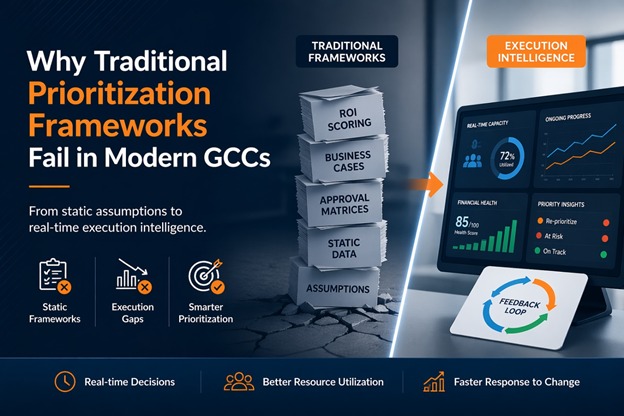
Most GCCs depend on frameworks like ROI scoring, business cases and approval hierarchies to prioritize initiatives. While structured, these frameworks often operate in isolation from execution reality.
They assume stability but execution environments are dynamic.
As discussed in
? https://www.whizible.com/from-spreadsheets-to-enterprise-ppm-when-why-to-make-the-switch/
relying on static tools creates blind spots that frameworks alone cannot fix.
The Execution Gap
Static Inputs vs Dynamic Execution
A business case might look strong on paper but it rarely accounts for:
- Real-time resource constraints
- Competing initiatives
- Execution risks
This mismatch leads to overcommitment and delivery slippage patterns commonly seen in fragmented execution environments:
Solution: Embed Execution Intelligence
The future of prioritization lies in execution intelligence where decisions are backed by live data, not assumptions.
This includes:
- Real-time capacity insights
- Progress tracking
- Financial visibility
This approach ensures prioritization is not theoretical but executable, aligning with modern PSA-driven governance models:
For deeper leadership thinking on aligning strategy with execution, refer to Vishwas Mahajan:
? https://www.linkedin.com/in/vishmahajan/
From Frameworks to Feedback Loops
Modern GCCs must evolve from rigid prioritization frameworks to continuous feedback loops, where decisions adapt as execution evolves.