
Every project begins with optimistic forecasts.
Delivery timelines look achievable. Resource plans appear balanced. Revenue projections satisfy leadership. Budgets receive approval.
Yet only a few months later, reality starts to diverge from the original plan.
Projects require additional effort. Resource availability changes unexpectedly. Customer priorities shift. Margins begin to shrink. Leadership meetings become focused on explaining variances rather than preventing them.
The problem is rarely the forecasting model itself.
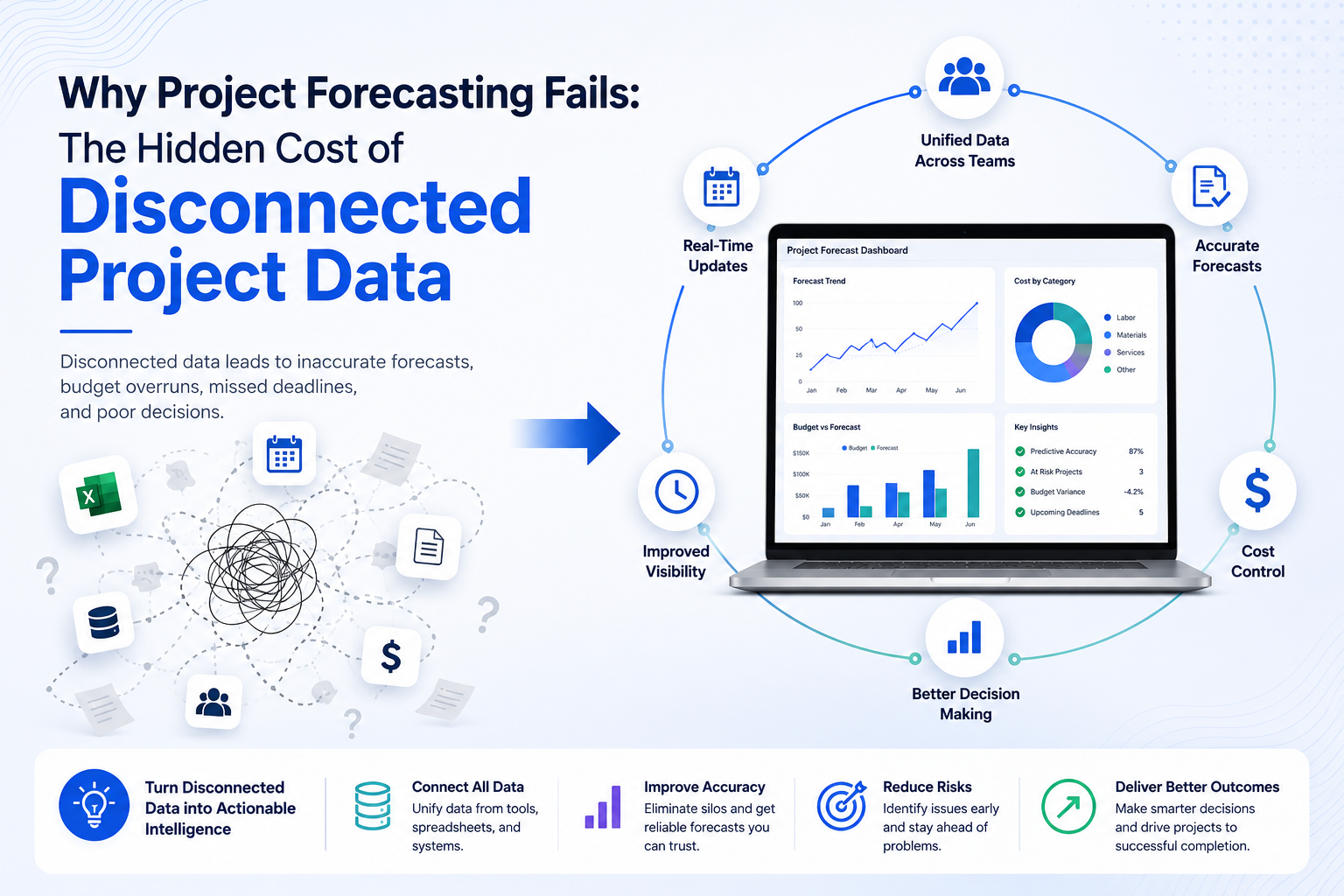
The real problem is that forecasts are built on fragmented operational data.
The Problem: Forecasts Built on Partial Information.
Many organizations still rely on disconnected systems for project execution.
Project schedules may reside in one application, resource allocation in another, financial data inside ERP systems, while timesheets and utilization reports are maintained separately.
Because these systems operate independently, project managers often prepare forecasts using incomplete information.
As a result:
- Resource capacity assumptions become outdated.
- Budget estimates no longer reflect actual delivery effort.
- Revenue projections ignore execution delays.
- Leadership receives reports after problems have already developed.
Forecasting becomes an exercise in assumptions instead of evidence.
The Solution: Build Forecasts on Connected Operational Data.
Forecast accuracy improves dramatically when every operational signal is connected.
Instead of relying on isolated spreadsheets, organizations should connect:
- Resource allocation
- Project progress
- Timesheets
- Financial performance
- Delivery milestones
- Executive dashboards
When these data sources continuously update one another, forecasting becomes dynamic instead of static.
Project managers identify risks earlier.
Executives gain visibility before financial impact occurs.
Organizations using integrated Professional Services Automation platforms such as Whizible can establish a unified operational foundation where project delivery, resource management, financial performance, and executive reporting remain synchronized across the entire lifecycle.
Related insight:
https://www.whizible.com/blog/
For additional leadership perspectives on execution intelligence and enterprise delivery, follow Dr. Vishwas Mahajan:
https://www.linkedin.com/in/vishmahajan/
Conclusion
Project forecasting does not fail because organizations lack experienced project managers.
It fails because disconnected operational data creates disconnected decisions.
The more connected your delivery information becomes, the more reliable every forecast becomes.
Frequently Asked Questions
Why are project forecasts often inaccurate?
Because forecasts are typically created using disconnected information across projects, resources, finance, and delivery.
Can forecasting improve without changing project methodology?
Yes. Better visibility and connected operational data often produce significant forecasting improvements without changing delivery frameworks.
How does connected data improve forecasting?
It continuously updates project assumptions using real execution data instead of static planning documents.
How does Whizible help?
Whizible connects projects, resources, timesheets, financials, governance, and executive dashboards into one platform, enabling more accurate and proactive forecasting.