
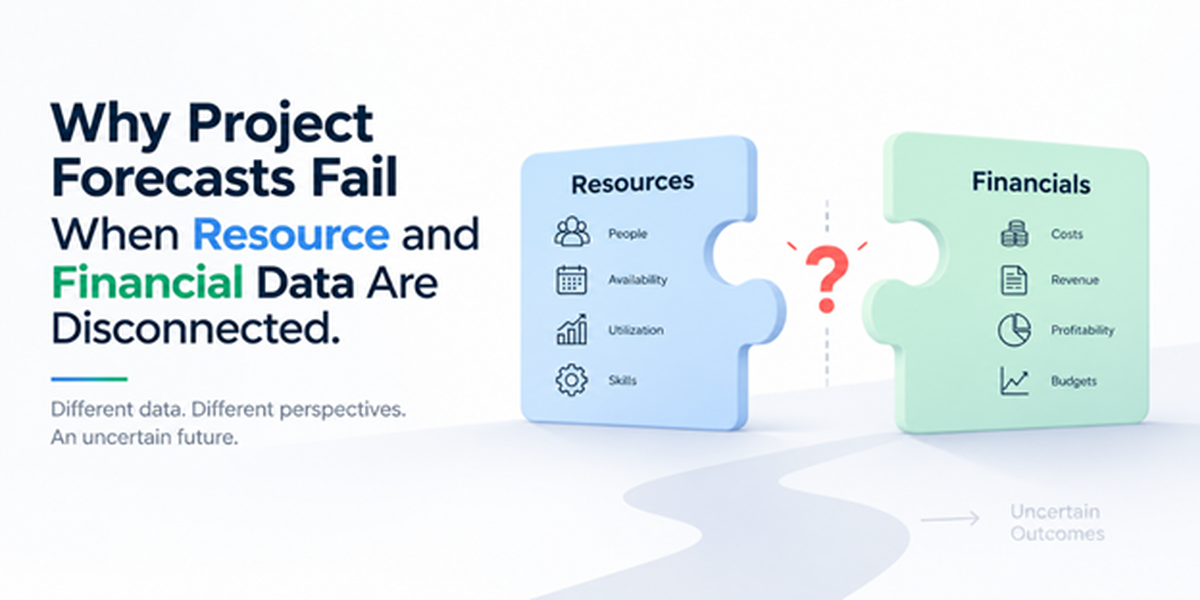
Project forecasts are expected to tell leadership what is likely to happen next.
Will the project finish within budget? Are enough resources available? Is the expected margin still achievable? Is additional capacity required?
The problem is that many organizations try to answer these questions using data that was never connected in the first place.
Resource managers forecast people and capacity. Project managers forecast effort and timelines. Finance forecasts cost, revenue and margins. When these forecasts live in different systems or spreadsheets, each function can be individually correct while the overall project forecast is wrong.
The Problem: Multiple Forecasts, Different Versions of the Future.
Consider a project that appears healthy from a delivery perspective. The required people are allocated, milestones are on schedule and utilization looks strong.
Finance may see something completely different.
Senior resources may be spending more hours than originally budgeted. Planned work may have shifted to more expensive skill sets. Additional effort may not yet be reflected in billing. A delayed milestone could also move expected revenue into another period.
The resource forecast says capacity is available.
The project forecast says delivery is on track.
But the financial reality says margin is deteriorating.
This disconnect is particularly important for fixed-price work, where cost overruns and resource misallocation directly affect profitability because additional effort cannot automatically be passed to the customer.
Why Resource Data Must Be Connected to Financial Data
Every resource decision has a financial consequence.
Changing a resource changes cost. Extending an allocation changes projected effort. Delaying a resource release affects capacity elsewhere. Increasing non-billable effort can reduce expected margin.
That is why forecasting cannot stop at “Who is available?”
It must progress to:
Who is required → for how long → at what cost → against what revenue → with what expected margin?
Whizible’s approach to integrated resource management brings availability, workload, utilization and project demand into a unified environment rather than leaving resource planning isolated in spreadsheets.
Explore: Whizible
The Solution: Build One Connected Forecast.
Reliable forecasting requires a common operational data layer connecting project plans, resource allocations, actual effort, timesheets, costs, revenue and billing.
When these elements move together, a change in execution can be reflected in the financial outlook much earlier.
Instead of asking at month-end, “Why did the margin fall?”, leadership can ask during execution, “What is changing our expected margin, and what action can we take?”
That is the fundamental shift from reporting the past to managing the future.
For more perspectives on project execution and business visibility, follow Vishwas Mahajan on LinkedIn.
FAQs
Why are project forecasts often inaccurate?
Forecasts become unreliable when resource allocation, actual effort, project progress, cost and revenue data are updated independently.
How does resource allocation affect profitability forecasting?
Resource mix, allocation duration, utilization and cost directly influence the expected cost of delivering a project.
Can spreadsheets handle project forecasting?
They can support smaller forecasting exercises, but complexity increases when multiple projects, resources, cost rates and changing allocations need continuous synchronization.
What improves forecasting accuracy?
A connected system where operational and financial changes continuously update the project’s forward-looking view.